
TL;DR:
- Social listening analyzes online conversations to generate strategic insights that improve marketing and customer experience. It goes beyond monitoring by proactively identifying trends and sentiment shifts over time. Implementing social listening effectively requires clear objectives, proper tools, and consistent integration into decision-making processes.
Social listening is defined as the practice of tracking and analyzing online conversations about your brand, competitors, and industry to generate insights that improve marketing strategy and customer experience. Unlike passive monitoring, it interprets sentiment, themes, and patterns over time. Tools like Sprout Social, Hootsuite, and Onclusive power this process for thousands of marketing teams globally. For business owners and marketers in Dubai and across the UAE, understanding what social listening delivers, and how to act on it, separates brands that react from brands that lead.

What is social listening and how does it differ from monitoring?
Social listening goes beyond monitoring by analyzing conversations to generate insights for marketing, PR, and customer experience. Monitoring is reactive. It tracks direct mentions of your brand name, a specific hashtag, or a product in real time. Listening is proactive. It analyzes the broader conversation landscape to identify trends, sentiment shifts, and emerging narratives that inform strategy.
Think of monitoring as reading today’s newspaper and listening as studying a year of headlines to understand what the public actually cares about. Monitoring tracks direct mentions; listening analyzes the conversation landscape to improve strategy and campaigns. Both serve different but complementary functions.
The table below shows where each practice fits in your workflow:
| Dimension | Social monitoring | Social listening |
|---|---|---|
| Focus | Specific mentions, tags, keywords | Themes, sentiment, trends over time |
| Approach | Reactive | Proactive |
| Output | Alerts and reports | Strategic insights |
| Time horizon | Real time | Ongoing and longitudinal |
| Primary use | Customer service, response | Campaign planning, brand strategy |
Pro Tip: Run monitoring and listening in parallel. Use monitoring to catch urgent customer complaints within the hour, and use listening data weekly to adjust your content strategy and messaging.
Combining both practices creates a continuous feedback loop that improves real-time responsiveness and long-term planning at the same time.
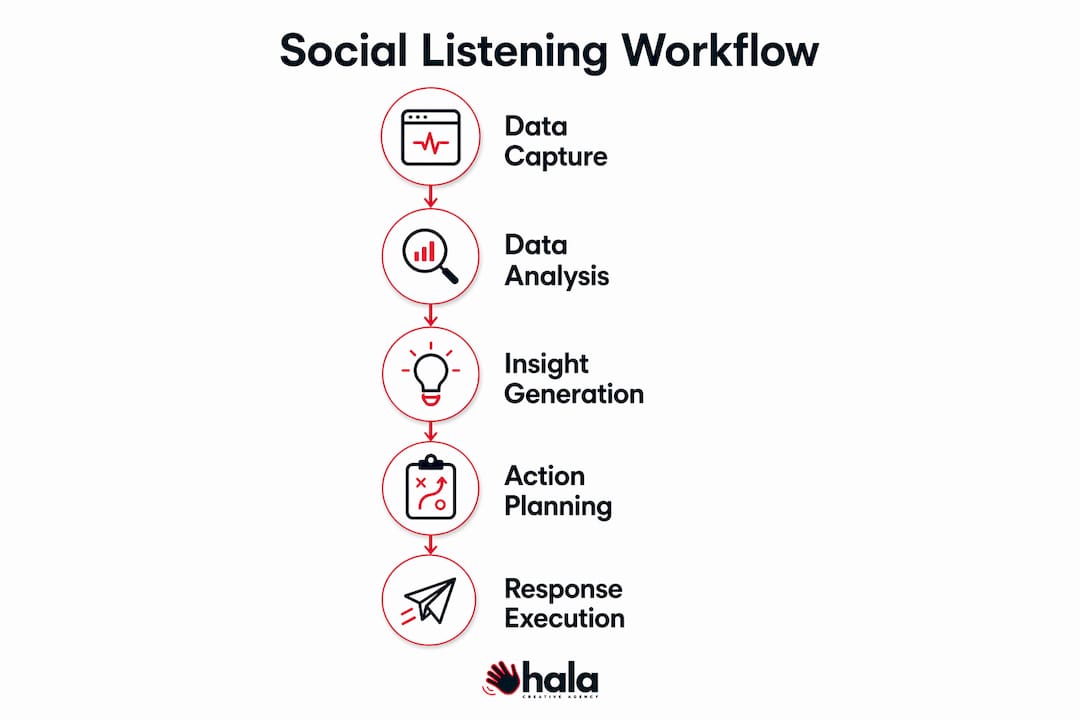
How does social listening work? The core workflow
Social listening follows a repeatable four-stage cycle: Monitor, Analyze, Insight, Act. Each stage builds on the previous one, and skipping any step breaks the chain.
-
Monitor: Set up queries across social platforms, forums, review sites, and news sources. This covers your brand name, product names, common misspellings, competitor names, and customer pain-point phrases. Well-crafted search terms that cover brand, competitors, and customer language capture conversations that never tag you directly.
-
Analyze: Apply sentiment analysis to categorize conversations as positive, negative, or neutral. Layer in theme detection to group mentions by topic, such as pricing complaints, feature requests, or delivery praise. Trending topic tracking shows which subjects are gaining velocity.
-
Insight: Translate the analysis into specific, decision-ready findings. “Negative sentiment around our checkout experience increased 34% this month” is an insight. “People are talking about us” is not.
-
Act: Route insights to the right team. A spike in product complaints goes to customer support and product. A competitor narrative gaining traction goes to marketing and communications. This workflow enables brands to adjust messaging, improve customer experience, and influence product decisions.
Pro Tip: Set velocity-based alerts rather than volume-based ones. A sudden 40% shift in negative sentiment over six hours is more meaningful than a raw count of 200 mentions. Narrative-driven alerting catches crises earlier than mention spikes alone.
Real-time escalation protocols matter here. Define who receives which alert, within what timeframe, and what action they must take. Without that structure, insights pile up in a dashboard and nothing changes.
What are the benefits of social listening for marketing and business?
The strategic advantages of social listening are concrete and measurable across four areas.
-
Audience intelligence: Social listening uncovers the exact language, concerns, and interests your audience uses. Later’s 2026 guide and Sprinklr highlight how understanding audience discussion patterns directly improves content relevance and campaign performance. When you write copy using the words your customers actually use, conversion rates improve.
-
Competitive intelligence: Analyzing competitor-related conversations reveals how their audience perceives them, what gaps exist in their offering, and where your positioning can win. This is not guesswork. It is structured analysis of publicly available signals.
-
Crisis prevention: 68% of reputational crises escalate within 24 hours of the first social signal. That statistic means a brand that detects a negative narrative at hour one has a fundamentally different outcome than one that discovers it at hour 25. Early detection through social listening is the difference between managing a story and being managed by it.
-
Campaign optimization: Listening data tells you which messages resonate before you spend budget amplifying them. If organic conversation around a campaign theme is already positive, you scale it. If sentiment is flat or negative, you adjust before the paid push.
“Social listening only creates value when insights are tied to business goals and acted upon.” — Hootsuite
For Dubai-based SMEs competing in fast-moving sectors like hospitality and real estate, social media’s impact on brand awareness multiplies when listening data informs what you post and when.
Which social listening tools should you consider?
The right tool depends on your data needs, team size, and budget. The four platforms most widely used by marketing teams are Sprout Social, Hootsuite, Meltwater, and Sprinklr. Each has distinct strengths.
| Tool | Best for | Key strength |
|---|---|---|
| Sprout Social | Mid-size teams | Unified inbox plus listening |
| Hootsuite | Broad social management | Wide platform coverage |
| Meltwater | PR and media monitoring | News and web coverage depth |
| Sprinklr | Enterprise brands | AI-powered sentiment at scale |
Evaluating tools based on data coverage, sentiment accuracy, ease of use, and integrations is the right starting point before committing to any platform.
Beyond the feature list, ask three practical questions before selecting a tool:
- Does it cover the platforms where your audience actually talks? For UAE markets, this includes X (formerly Twitter), Instagram, LinkedIn, and Arabic-language forums.
- How accurate is its sentiment analysis for your language and industry context? Generic sentiment models often misread sarcasm or regional slang.
- Does it integrate with your CRM, reporting stack, or project management tools so insights flow into action automatically?
Smaller businesses can start with Hootsuite’s listening features or Sprout Social’s standard plan before moving to enterprise platforms like Meltwater or Sprinklr as needs grow.
How to implement social listening in your marketing workflow
Effective implementation follows six steps. Skipping the early ones makes the later ones meaningless.
-
Define your objectives. Decide what business question social listening must answer. Options include: understanding customer sentiment, tracking a campaign, monitoring a competitor, or detecting reputation risks. One clear objective produces better results than five vague ones.
-
Build your query sets. Create separate keyword lists for your brand (including misspellings and abbreviations), your competitors, and your customers’ pain-point language. Separate, comprehensive query sets covering all three categories prevent blind spots in your data.
-
Select your channels. Not every conversation happens on Instagram. B2B brands need LinkedIn and Reddit. Consumer brands need TikTok and review platforms. Map your audience’s actual online behavior before setting up monitoring streams.
-
Establish escalation protocols. Assign ownership. Define which insight type triggers which response, and who is responsible. Clear roles and escalation paths are what separate teams that act on data from teams that collect it.
-
Integrate insights cross-functionally. Social listening data belongs in campaign briefs, product roadmaps, and customer support playbooks, not just the social media manager’s weekly report. Schedule a monthly insight-sharing session with marketing, product, and leadership.
-
Measure and refine. Track whether acting on listening insights produces measurable outcomes: improved sentiment scores, higher campaign engagement, faster crisis resolution. Adjust your query sets and alert thresholds quarterly based on what you learn.
For smarter data-driven decisions across your business, social listening data should feed into your broader analytics framework, not sit in isolation.
Key takeaways
Social listening transforms raw online conversation into business decisions, and its value depends entirely on whether insights are defined, routed, and acted upon.
| Point | Details |
|---|---|
| Listening vs. monitoring | Monitoring is reactive and real-time; listening is proactive and strategic over time. |
| Four-stage workflow | Monitor, analyze, generate insights, and act. Skipping any stage breaks the value chain. |
| Crisis detection speed | 68% of reputational crises escalate within 24 hours, making early signal detection critical. |
| Tool selection criteria | Evaluate platforms on data coverage, sentiment accuracy, integrations, and language support. |
| Implementation discipline | Clear objectives, defined query sets, and escalation protocols determine whether listening produces results. |
Why most brands are still doing this wrong
Most marketing teams I work with treat social listening as a reporting function. Someone pulls a weekly dashboard, notes that sentiment is “mostly positive,” and moves on. That is monitoring dressed up as listening, and it produces almost no strategic value.
The shift that actually changes outcomes is treating listening as a decision-making input, not a retrospective summary. When a Dubai hospitality brand I advised started routing listening insights directly into their weekly campaign brief, their content engagement improved within two months. Not because they discovered some secret, but because they stopped guessing what their audience wanted and started reading the signals that were already there.
The other mistake I see constantly is obsessing over mention volume. Volume tells you how loud the conversation is. Velocity and sentiment shift tell you where it is going. A brand with 500 mentions and a 20% negative sentiment spike in 48 hours has a bigger problem than a brand with 5,000 mentions and stable sentiment. Focus on the direction of change, not the size of the number.
The brands that get the most from social listening are the ones that build it into their organizational rhythm. Weekly insight reviews. Monthly cross-functional briefings. Quarterly query audits. It is not a tool you switch on. It is a practice you build into how decisions get made.
For businesses managing online reputation risks, social listening is the earliest warning system available. Use it like one.
— Hisham
How Hala Creative Agency puts social listening to work for your brand
Hala Creative Agency integrates social listening directly into the marketing strategies we build for clients across Dubai and the wider UAE. We do not just track mentions. We analyze sentiment patterns, map competitor narratives, and translate those findings into content, campaign, and positioning decisions that move your brand forward.
If you are a business owner or marketing professional ready to stop reacting and start leading, our marketing services are built to turn listening data into growth. Explore our social media strategies for small businesses or contact us directly to discuss a custom approach for your brand.
FAQ
What is the simplest definition of social listening?
Social listening is the process of tracking and analyzing online conversations about your brand, competitors, and industry to generate insights that guide marketing and business decisions. It goes beyond counting mentions by interpreting sentiment and themes over time.
How is social listening different from social media monitoring?
Monitoring tracks specific brand mentions in real time and is reactive. Social listening analyzes broader conversation trends and sentiment over time to inform strategy. The two practices are complementary and work best when used together.
What can social listening achieve for a small business?
Social listening helps small businesses understand what their customers actually want, detect reputation risks before they escalate, and refine their messaging based on real audience language rather than assumptions. Even basic tools like Hootsuite or Sprout Social provide this capability at accessible price points.
Which social listening tools are best for Dubai-based businesses?
Sprout Social, Hootsuite, Meltwater, and Sprinklr are the most widely used platforms. For UAE markets, prioritize tools with strong Arabic-language sentiment support and coverage of Instagram, X, and regional forums alongside standard Western platforms.
How often should you review social listening data?
Marketing teams benefit most from daily alert monitoring for crisis signals, weekly insight reviews for campaign adjustments, and monthly cross-functional briefings to apply findings across product, support, and strategy functions.