
TL;DR:
- Marketing automation uses software to trigger personalized actions based on customer data. It boosts ROI, saves time, and improves lead quality for small and medium-sized businesses. Success depends on clean data, thoughtful workflows, and balanced human oversight.
Marketing automation is defined as software that executes repetitive marketing tasks automatically, replacing manual effort with rule-based workflows triggered by customer behavior, time, or data attributes. Platforms like HubSpot, Salesforce, and Mailchimp use this technology to send personalized emails, score leads, and manage campaigns across multiple channels without a human initiating each action. For small and medium-sized businesses competing in fast-moving markets like Dubai and the wider Middle East, understanding what is marketing automation means understanding how to do more with a leaner team. The return is measurable: organizations earn $5.44 for every $1 spent on automation, with 76% seeing positive ROI within 12 months.
What is marketing automation and how does it actually work?
Marketing automation works by connecting customer data to predefined rules that trigger specific actions. When a contact fills out a form, opens an email, or abandons a shopping cart, the platform detects that behavior and responds automatically with a relevant message or action. The result is a system that runs campaigns around the clock without manual input.

The core engine is the workflow. A workflow is a sequence of conditions and actions: if a lead visits your pricing page twice, then send a follow-up email; if they do not open it within 48 hours, then assign the lead to a sales rep. These logic chains can be simple or multi-branched, depending on how segmented your audience is.
Automation manages tasks including email campaigns, social media scheduling, lead scoring, audience segmentation, and CRM updates. Integration with CRM data is what makes these tasks accurate. Without a clean, unified customer record, the platform cannot distinguish a first-time visitor from a loyal buyer, so messages miss the mark.
Common automated sequences include:
- Welcome series: A new subscriber receives a three-email introduction to your brand over seven days.
- Cart abandonment: A shopper who leaves without purchasing gets a reminder email within one hour, followed by a discount offer 24 hours later.
- Lead nurturing drips: A prospect who downloaded a whitepaper receives educational content weekly until they request a demo.
- Re-engagement campaigns: Contacts who have not opened an email in 90 days receive a targeted “we miss you” message.
- Post-purchase follow-ups: A customer who just bought receives an onboarding guide and a review request on day three.
Pro Tip: Before building any workflow, map the customer journey on paper first. Automation amplifies whatever process you already have. If the process is unclear, the automation will be too.
What are the key benefits of marketing automation?
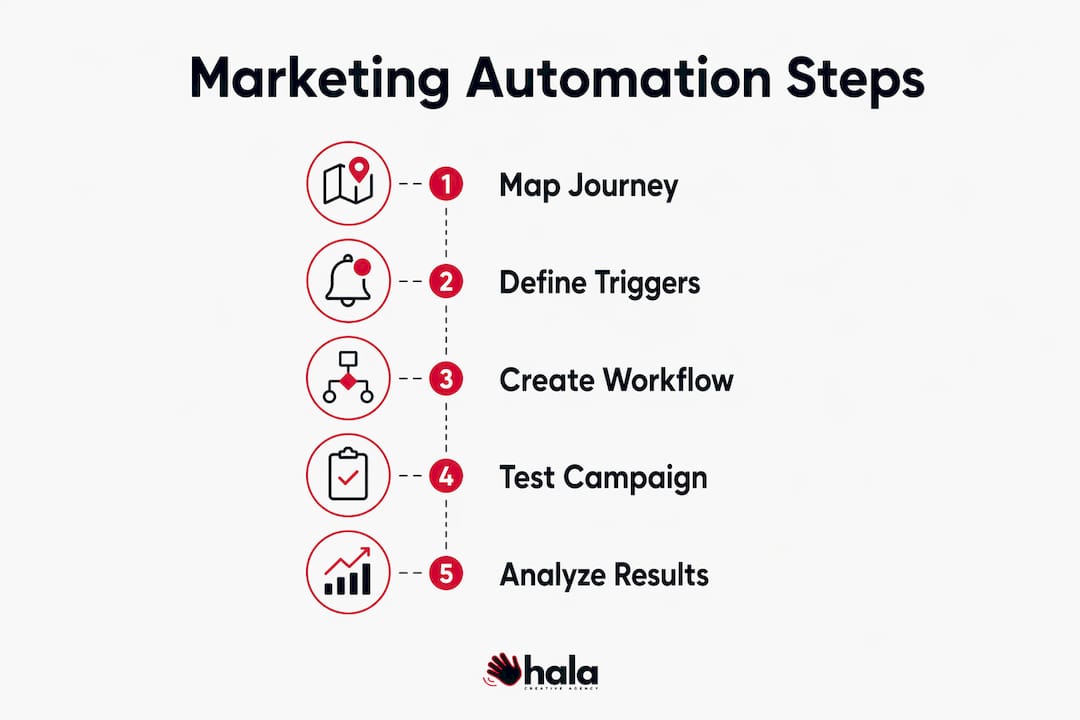
The financial case for automation is direct. Marketing automation saves teams 6+ hours per week and boosts sales productivity by 14.5%, while cutting marketing overhead costs by 12.2%. Those numbers compound quickly for an SMB where every team member wears multiple hats.
The productivity gain matters beyond the hours saved. When your team stops manually scheduling emails and pulling contact lists, they shift attention to campaign strategy, creative development, and customer relationships. Automation shifts marketers from manual execution to strategic roles, enabling data-driven optimization of campaigns. That shift is where the real competitive advantage lives.
The benefits extend across the full marketing funnel:
- Lead quality: Automated scoring ranks leads by engagement level, so sales teams call the right contacts first.
- Personalization at scale: Platforms deliver personalized communications triggered by customer actions or lifecycle stages automatically, without requiring a dedicated team member for each segment.
- Campaign measurement: Automation platforms track open rates, click rates, conversions, and revenue attribution in one dashboard, making ROI reporting straightforward.
- Consistency: Every lead receives the same quality of follow-up regardless of how busy your team is that week.
For Dubai-based SMBs running digital marketing workflows across Arabic and English audiences, automation also handles language-based segmentation automatically, routing contacts to the correct content version without manual sorting.
How to choose and implement marketing automation tools
The right platform depends on three factors: the channels you use, the CRM you already have, and the complexity of your customer journeys. HubSpot suits businesses that want an all-in-one CRM and marketing platform. Mailchimp works well for email-first SMBs with simpler workflows. Salesforce Marketing Cloud fits organizations with complex, multi-channel needs and larger budgets.
| Platform | Best for | CRM integration | Starting complexity |
|---|---|---|---|
| HubSpot | SMBs wanting CRM + marketing in one | Built-in | Low to medium |
| Mailchimp | Email-focused small businesses | Native + third-party | Low |
| Salesforce Marketing Cloud | Mid-market and enterprise | Native Salesforce CRM | High |
| ActiveCampaign | SMBs needing advanced segmentation | Built-in | Medium |
Data hygiene is the most overlooked factor in implementation. Poor data quality leads to ineffective automated campaigns, sending incorrect or mistargeted messages that damage brand reputation. Before you activate any workflow, audit your contact database. Remove duplicates, standardize field formats, and confirm that every contact has a valid email address and an accurate lifecycle stage.
The second pitfall is over-automation. Excessive automated touchpoints can make a brand feel impersonal, so balancing automation with human interaction is critical, especially during key sales phases. A prospect who has requested a custom proposal should hear from a real person, not receive another drip email. Build human handoff points into your workflows at high-stakes moments.
Pro Tip: Start with one workflow and run it for 30 days before building more. Measure open rates, click rates, and conversion at each step. Fix what is broken before you scale.
What are real-world marketing automation use cases for SMBs?
Small and medium-sized businesses use automation to compete with larger enterprises by running sophisticated campaigns without large teams. The key is choosing use cases that match your current customer volume and data quality.
-
Automated lead nurturing: A real estate agency in Dubai captures leads from a property listing page. Each lead automatically enters a 10-email sequence over 30 days, receiving neighborhood guides, mortgage calculators, and agent introductions based on the property type they viewed.
-
E-commerce cart abandonment: A regional fashion retailer sends a recovery email one hour after abandonment, then a 10% discount offer 24 hours later. This sequence runs without any manual action and consistently recovers a portion of lost revenue.
-
Customer onboarding: A SaaS company sends a structured onboarding series triggered the moment a trial account is created. Each email unlocks a new feature tutorial, reducing churn by keeping new users engaged during the critical first two weeks.
-
Cross-channel campaigns: A hospitality brand in the UAE runs coordinated campaigns across email, SMS, and Instagram using a single automation platform. When a guest books a stay, they receive a confirmation email, a WhatsApp message with check-in instructions, and a retargeted Instagram ad for their next visit.
-
Re-engagement and win-back: A B2B services firm identifies contacts who have not engaged in 60 days and automatically sends a case study relevant to their industry. Contacts who click are flagged for a sales follow-up call.
Marketing automation supports lead generation, nurturing, scoring, and ROI measurement, making it practical for managing complex marketing processes even with a small team. For SMBs exploring how AI marketing benefits can extend these capabilities further, the combination of automation and AI-driven personalization is where the next level of growth sits.
Key Takeaways
Marketing automation delivers measurable ROI, saves significant team time, and produces better lead quality only when it is built on clean data, thoughtful workflows, and deliberate human touchpoints.
| Point | Details |
|---|---|
| Definition is clear | Marketing automation uses software to trigger personalized actions based on customer behavior or data. |
| ROI is proven | Organizations earn $5.44 per $1 spent, with 76% seeing positive returns within 12 months. |
| Data quality drives results | Poor contact data produces mistargeted messages that harm brand reputation and waste budget. |
| Over-automation is a real risk | Build human handoff points at high-stakes moments to keep customer relationships authentic. |
| Start small and measure | Launch one workflow, measure every step for 30 days, and fix gaps before scaling further. |
Why I think most SMBs get marketing automation backwards
Most businesses I work with approach automation by asking “what can we automate?” That is the wrong starting question. The right question is “where are we losing customers because we are too slow or too inconsistent?” Automation should fix a specific gap, not just digitize a process that was already broken.
The second mistake I see constantly is treating automation as a one-time setup. Marketing automation is not “set and forget.” It requires ongoing monitoring, clean CRM data, and thoughtful integration to avoid common pitfalls. A workflow you built in January may be sending outdated offers by April if nobody reviewed it. Campaigns decay. Audiences change. The platform does not know that unless you tell it.
The insight that changed how I think about this: automation is an execution engine, not a substitute for creativity. The businesses that win with automation are the ones that invest equally in the creative strategy behind the workflows. A perfectly timed email with a weak message still gets ignored. A well-written message sent at the wrong time still gets ignored. Both elements have to work together.
For SMBs in Dubai and the Middle East, the practical advice is this: start with your highest-volume, most repetitive customer touchpoint. Automate that one thing well. Measure it for a full month. Then build from there. The compounding effect of getting one workflow right is far more valuable than having ten mediocre ones running simultaneously.
— Hisham
How Hala Creative Agency helps SMBs build automation that works
Hala Creative Agency works with SMBs across Dubai and the Middle East to design and implement marketing automation systems that are built on clean data and real customer journeys, not generic templates.
The agency handles CRM data audits, workflow design, platform setup, and ongoing campaign management so your team can focus on growth instead of manual follow-ups. Every automation system Hala Creative Agency builds is paired with a creative strategy, because the technology only performs as well as the messaging behind it. If you are ready to put your marketing on a system that runs consistently and measures results clearly, explore the marketing services Hala Creative Agency offers or review the digital marketing guide for Dubai SMEs to see where automation fits into your broader strategy.
FAQ
What is the definition of marketing automation?
Marketing automation is software that uses rule-based workflows to execute marketing tasks automatically, triggered by customer behavior, data attributes, or time. It replaces manual processes like email sending, lead scoring, and social media posting with automated sequences.
What are the best marketing automation tools for small businesses?
HubSpot, Mailchimp, and ActiveCampaign are the most widely used platforms for small businesses. HubSpot offers a built-in CRM, Mailchimp suits email-focused teams, and ActiveCampaign provides advanced segmentation at a mid-range price point.
How does marketing automation work with CRM data?
Marketing automation platforms pull contact records from a CRM to trigger personalized actions based on lifecycle stage, behavior, or attributes. Clean, unified CRM data is required for accurate targeting. Poor data quality produces mistargeted messages that hurt campaign performance.
What are the main benefits of marketing automation?
The primary benefits are time savings of 6+ hours per week, a 14.5% boost in sales productivity, a 12.2% reduction in marketing overhead, and an average ROI of $5.44 per $1 spent. It also improves lead quality and campaign consistency.
Can marketing automation replace a marketing team?
Marketing automation handles execution, not strategy or creativity. It frees marketers from repetitive tasks so they can focus on campaign planning, creative development, and customer relationships. The technology performs best when paired with strong human judgment and clear messaging.