
TL;DR:
- A marketing funnel visualizes a customer’s journey from brand awareness to loyalty and advocacy. Small UAE businesses often focus on top-of-funnel marketing but neglect middle and bottom stages that drive conversions and repeat sales. Building a simple three-stage funnel aligned with customer needs improves ROI and sustains long-term revenue.
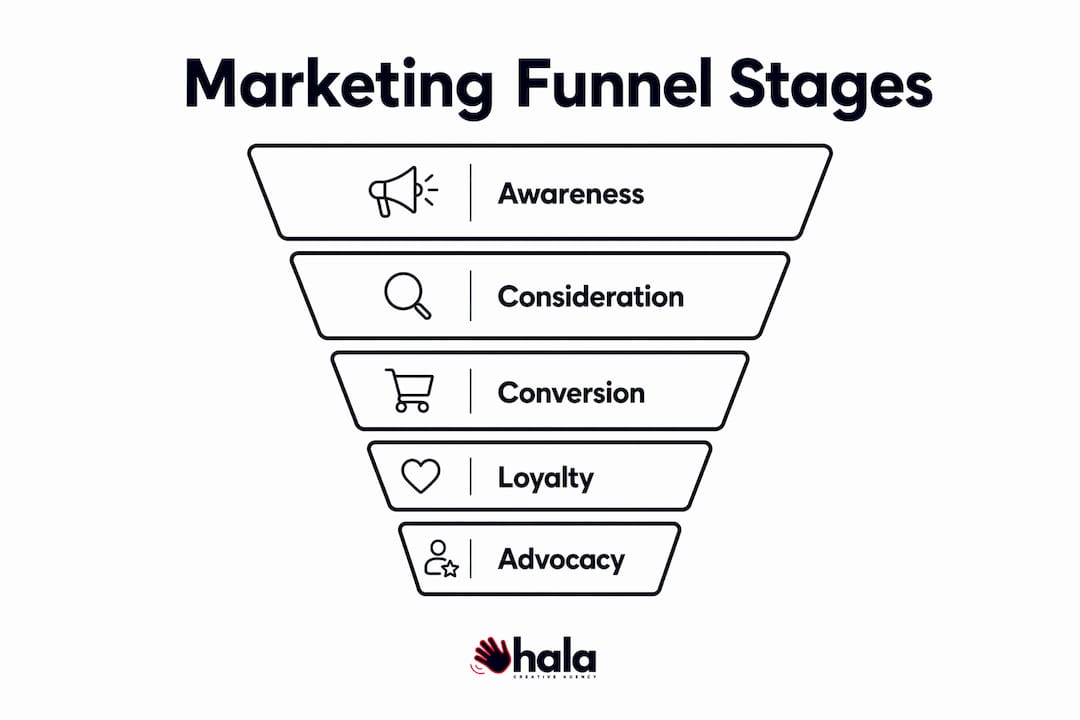
A marketing funnel is a visual framework that maps the steps a customer takes from first discovering your brand to making a purchase and becoming a loyal advocate. The standard model moves through five stages: Awareness, Consideration, Conversion, Loyalty, and Advocacy. For small business owners in the UAE, understanding what is a marketing funnel is the difference between spending money on ads that go nowhere and building a system that turns strangers into repeat buyers. Tools like HubSpot CRM and platforms like Spotify Ads have built entire campaign frameworks around this model because it works.
What are the main stages of a marketing funnel?
A marketing funnel divides into three core zones: Top of Funnel (TOFU), Middle of Funnel (MOFU), and Bottom of Funnel (BOFU), plus two post-purchase stages that most businesses ignore at their own cost.

Top of funnel: awareness
TOFU is where prospects first encounter your brand. Your goal here is reach, not sales. The right content at this stage includes blog posts, social media videos, Instagram Reels, and Google Display ads. A Dubai-based restaurant, for example, runs awareness ads showing its ambiance and menu highlights to people who have never heard of it. The prospect is not ready to book a table. They just need to know you exist.
Middle of funnel: consideration
MOFU is where prospects compare options and decide whether to trust you. Content tailored to funnel stage at this point includes case studies, testimonials, email sequences, and comparison guides. A real estate agency in Abu Dhabi might send a lead a PDF guide on “What to look for in off-plan properties” after they download a brochure. That guide builds credibility before any sales call happens.
Bottom of funnel: conversion
BOFU is where the decision gets made. Pricing pages, free demos, limited-time offers, and direct calls to action belong here. The prospect already trusts you. Now they need a clear reason to act. A well-placed WhatsApp CTA or a personalized email offer can close a deal that weeks of awareness content set up.
Loyalty and advocacy stages
Post-purchase stages like loyalty and advocacy are the most neglected parts of the funnel. Repeat customers cost far less to retain than new ones cost to acquire. Advocacy, where happy customers refer friends and leave reviews, is essentially free marketing. A UAE fitness studio that sends personalized check-ins and renewal offers to existing members keeps its funnel producing revenue long after the first sale.
Pro Tip: Map your current content against each funnel stage. If everything you publish is awareness-level, you are feeding the top but starving the middle and bottom.
| Stage | Goal | Audience action | Key tactics |
|---|---|---|---|
| Awareness (TOFU) | Build brand recognition | Discovers your brand | Blog posts, social ads, SEO content |
| Consideration (MOFU) | Build trust and interest | Compares options | Email nurture, case studies, webinars |
| Conversion (BOFU) | Drive purchase decision | Makes a purchase | Demos, pricing pages, WhatsApp CTAs |
| Loyalty | Retain existing customers | Repeats purchase | Loyalty programs, personalized offers |
| Advocacy | Generate referrals | Recommends your brand | Reviews, referral programs, community |
Why do marketing funnels matter for small businesses?
A funnel gives you a diagnostic system, not just a marketing plan. Without one, you are guessing which messages to send and when. With one, you know exactly what a prospect needs to hear based on where they are in their buying journey.
The clearest benefit is budget efficiency. A full-funnel approach lets you target content by buyer mindset, which improves ROI and creates more predictable sales pipelines. A small business in Dubai spending AED 5,000 a month on ads gets far more from that budget when the ads match the audience’s stage. Awareness ads go to cold audiences. Retargeting ads go to people who visited the pricing page. Each dirham works harder.
Funnels also reduce customer acquisition costs over time. When your digital marketing strategies align with funnel stages, you stop wasting spend on conversion-focused ads aimed at people who have never heard of you. That misalignment is one of the most common and expensive mistakes UAE small businesses make.
“Funnels should represent how customers naturally want to buy, not how businesses want to sell.” — Contentsquare
The funnel also protects your brand from message fatigue. Sending a hard-sell offer to someone who just discovered you feels pushy and damages trust. Sending educational content to someone ready to buy wastes their time. Matching message to stage solves both problems.
How to build a marketing funnel for your UAE small business
Building a funnel does not require a large team or a complex tech stack. A three-stage funnel with clear content for each stage beats no funnel every time.
-
Define your customer personas. Write down who your ideal buyer is, what problems they face, and how they typically research solutions. A Dubai-based e-commerce brand selling skincare products has a different buyer persona than a B2B logistics company in Sharjah. Your funnel structure follows from this.
-
Map content to each stage. TOFU content educates and attracts. MOFU content builds trust and answers objections. BOFU content removes friction and drives action. Content aligned with user intent at each stage lowers acquisition costs and increases lifetime value. Use your blog, email, and social channels to cover all three zones.
-
Set up lead scoring and handoff criteria. A lead who downloads a pricing guide is further along than one who read a blog post. Tools like HubSpot CRM let you assign scores to actions so your sales team only contacts prospects who are genuinely ready. This prevents wasted calls and frustrated leads.
-
Choose your channels by stage. Instagram and TikTok work well for TOFU in the UAE market. Email nurture sequences and WhatsApp Business handle MOFU well. Google Search ads and retargeting campaigns close at BOFU. You do not need every channel. You need the right ones for each stage.
-
Build in loyalty and advocacy from day one. A simple post-purchase email sequence, a referral discount, or a Google review request costs almost nothing. Integrating loyalty programs into your funnel turns one-time buyers into a recurring revenue source.
Pro Tip: Start with a three-stage funnel covering Awareness, Consideration, and Conversion. Add Loyalty and Advocacy once the first three stages are producing consistent results.
For content ideas at each stage, the content marketing practices used by Dubai brands offer a practical starting point.
Common misconceptions about marketing funnels
The biggest misconception is that customers move through a funnel in a straight line. They do not. A prospect might discover your brand on Instagram, ignore you for three weeks, then search Google for your product name after a friend mentions you. Customer journeys are rarely linear. A good funnel accounts for this by staying visible across multiple touchpoints rather than assuming a neat sequence.
A second misconception is that the marketing funnel and the sales funnel are the same thing. They are not. The marketing funnel covers the journey from awareness to a qualified lead. The sales funnel takes over from there, managing the prospect through negotiation and close. Effective lead handoff between marketing and sales requires clear scoring criteria, such as specific content downloads or page visits, so qualified leads reach the right person at the right time.
“Funnels are diagnostic tools to spot friction, not rigid paths forcing prospects through constructed steps.” — Contentsquare
A third mistake is treating the funnel as a one-time build. Markets shift, buyer behavior changes, and new channels emerge. UAE businesses that review their funnel quarterly and adjust content based on drop-off data consistently outperform those that set it and forget it.
- Funnels are not just for large companies. A three-stage funnel works for a single-person consulting business in Dubai.
- Vanity metrics like follower counts do not measure funnel health. Track stage-specific metrics like email open rates, demo requests, and repeat purchase rates.
- Mid and bottom-funnel optimization often delivers more revenue growth than expanding top-of-funnel reach alone.
Key Takeaways
A marketing funnel is the most practical framework a small UAE business can use to align content, budget, and messaging with where each customer actually is in their buying journey.
| Point | Details |
|---|---|
| Funnel stages drive content decisions | Match every piece of content to TOFU, MOFU, or BOFU intent to avoid message misalignment. |
| Budget efficiency improves with funnel alignment | Targeting by buyer mindset reduces wasted ad spend and improves ROI across all channels. |
| Linear journeys are a myth | Build funnels that stay visible across multiple touchpoints, not rigid step-by-step paths. |
| Post-purchase stages generate the best ROI | Loyalty and advocacy programs cost less than acquisition and produce repeat and referral revenue. |
| Start simple, then scale | A three-stage funnel with clear content per stage outperforms a complex funnel with no consistency. |
Why I think most UAE small businesses are skipping the most valuable part
I have worked with dozens of small businesses across Dubai and the wider UAE, and the pattern is almost always the same. They pour budget into awareness. Instagram ads, influencer posts, Google Display campaigns. The top of the funnel looks busy. Then the prospect shows up, looks around, finds nothing that speaks to where they are in their decision, and leaves.
The middle and bottom of the funnel are where most UAE businesses are losing money without realizing it. A prospect who visited your pricing page three times is not a cold lead. They are one well-timed WhatsApp message or retargeting ad away from converting. But if you have no MOFU content and no BOFU follow-up, that prospect goes to a competitor who does.
The fear I hear most often is that building a funnel is complicated. It is not. Starting small with three stages avoids message misalignment and brand fatigue. You do not need a CRM with 50 automation rules on day one. You need one clear awareness piece, one trust-building piece, and one conversion offer. That is a funnel. It is also more than most of your competitors have.
The UAE market has specific nuances worth noting. Buyers here respond strongly to social proof, especially from local references. Arabic-language content at the awareness stage opens doors that English-only campaigns miss. WhatsApp is a legitimate BOFU channel in this market in a way it simply is not in most Western markets. Build your funnel with those realities in mind, and you will see results faster than any generic playbook promises.
— Hisham
How Hala Creative Agency builds funnels that convert
Small UAE businesses that want a funnel built around their actual customers, not a generic template, get real results faster with expert support.
Hala Creative Agency designs full-funnel marketing strategies for UAE small and medium businesses, covering everything from awareness content and SEO to email nurture sequences and conversion-focused ad campaigns. The agency’s hybrid AI-human approach means your funnel gets built faster without losing the local market insight that generic tools miss. Whether you are starting from zero or fixing a funnel that leaks at the middle, Hala Creative Agency brings the structure and the content to make it work. Reach out for a personalized funnel consultation built around your business and your customers in the UAE.
FAQ
What is a marketing funnel in simple terms?
A marketing funnel is a model that maps the steps a customer takes from first hearing about your brand to making a purchase and referring others. It helps businesses deliver the right message at each stage of the buying journey.
What are the five stages of a marketing funnel?
The five stages are Awareness, Consideration, Conversion, Loyalty, and Advocacy. Each stage requires different content and tactics to move prospects forward.
What is the difference between a marketing funnel and a sales funnel?
A marketing funnel covers the journey from brand discovery to a qualified lead. A sales funnel takes over from that point, managing the prospect through negotiation and closing the deal.
How do I build a marketing funnel for a small business in the UAE?
Start by defining your customer persona, then create one piece of content for each of the three core stages: awareness, consideration, and conversion. Add loyalty and advocacy steps once the core funnel produces consistent results.
Why do small businesses ignore the bottom of the funnel?
Most small businesses focus on growing their audience and neglect conversion and retention. Optimizing mid and bottom-funnel stages typically delivers more revenue growth than expanding top-of-funnel reach alone.