
Creative branding is one of the most misunderstood growth tools available to small and medium-sized businesses in the Middle East. Most owners assume it means picking a nice logo and a color palette, then calling it done. But brand identity is a full strategic system that shapes how customers feel, think, and act every time they encounter your business. In Dubai, Doha, and Riyadh, where competition across every sector is intensifying fast, the SMBs that grow consistently are the ones that treat branding as a business engine, not a design task. This guide breaks down what creative branding really means, why it matters for your market, and exactly how to build it.
Table of Contents
- What is creative branding? Breaking the misconception
- The core elements of creative branding
- Cultural fusion: Standing out with modern and heritage branding
- Creative branding in action: Channels, consistency, and engagement
- Why Middle East SMBs need a creative branding mindset shift
- Accelerate your creative branding with regional experts
- Frequently asked questions
Key Takeaways
| Point | Details |
|---|---|
| More than a logo | Creative branding is about purpose, culture, and consistent digital presence, not just visuals. |
| Cultural fusion wins | Blending modern strategies with heritage builds trust and higher engagement in the Middle East. |
| Bilingual is better | Campaigns using both Arabic and English drive significantly higher engagement online. |
| Consistency counts | Unified branding across channels boosts your SMB’s credibility and customer connection. |
What is creative branding? Breaking the misconception
Let’s be direct: creative branding is not a logo project. It is the strategic process of fusing your business’s core values, personality, and purpose into every single touchpoint a customer experiences. That includes your website, your Instagram captions, the way your team answers the phone, and even the packaging on your product. Core creative branding goes beyond logo and visuals; it includes purpose, values, USP, and consistent customer experiences.
The misconception runs deep. Many Middle East SMBs invest in a sleek logo, build a website, and expect customers to come. When engagement stays flat, they blame the platform or the budget. The real issue is almost always a branding gap. There is no clear story, no emotional connection, and no consistent voice that makes someone choose you over the competitor two clicks away.
Creative branding is built on five foundational pillars: purpose, values, audience understanding, market positioning, and customer experience. Each one informs the others. Your purpose tells customers why you exist beyond profit. Your values shape how you communicate. Your audience definition determines what language and visuals resonate. Your positioning makes clear why you are different. And your customer experience ensures every interaction reinforces the promise you made.
Here are the signs your SMB may need a serious branding reset:
- Your social media presence looks different every week with no visual consistency
- Your team struggles to explain what makes your business unique in one sentence
- Customers frequently ask what exactly you do or who you serve
- Your online engagement is low despite regular posting
- You attract the wrong type of clients or price-sensitive buyers only
“A brand is not what you say it is. It is what your customers say it is when you are not in the room.”
Recognizing these gaps early is the first step. Building creative brand assets with intention, rather than convenience, is what separates growing businesses from stagnant ones.
The core elements of creative branding
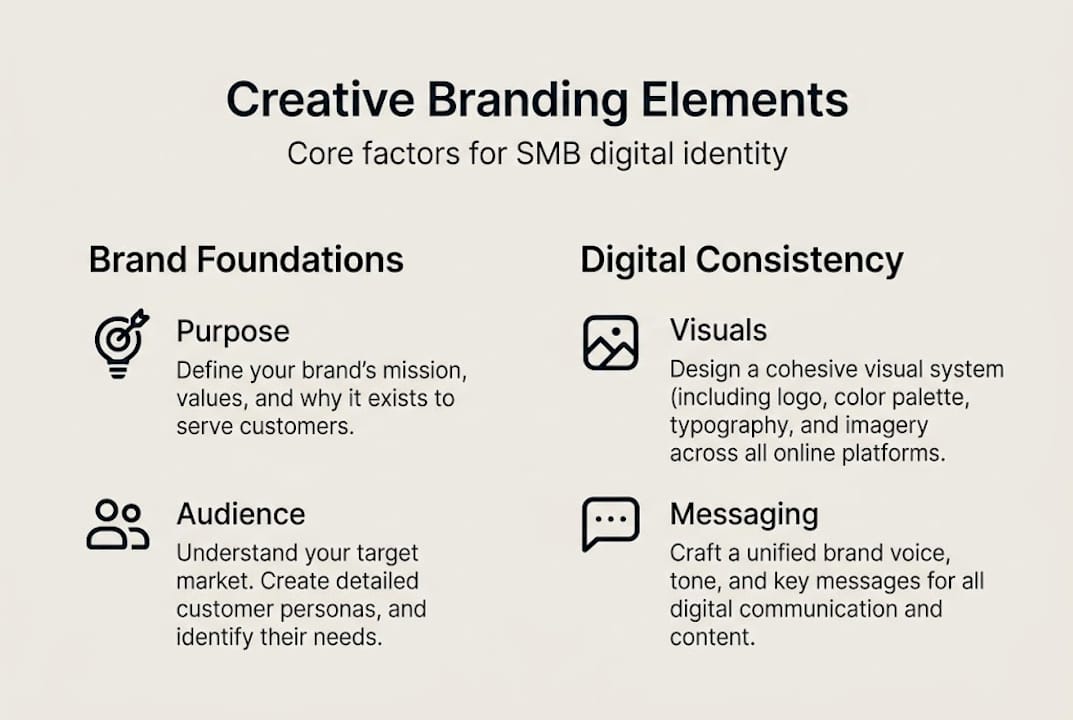
Once you accept that branding is a strategy and not a style exercise, the next step is understanding what that strategy actually contains. For Middle East SMBs, there are five elements that matter most, and each one carries cultural weight that Western branding frameworks often ignore.
Purpose and audience are your foundation. You need to know exactly why your business exists and who it serves. Not in vague terms like “we help businesses grow” but in specific, emotionally resonant language. Who is your ideal customer in Dubai or Riyadh? What keeps them up at night? What do they celebrate?
Cultural alignment is where Middle East branding gets interesting. Color symbolism carries real meaning here. Gold signals prestige and quality. Blue builds trust. Green connects to heritage and values. Ignoring these signals is a missed opportunity. Crafting bilingual positioning and choosing culturally relevant colors boosts engagement and trust, and this is especially true in the Gulf where Arabic and English audiences often overlap.
Consistent digital identity means your brand looks, sounds, and feels the same whether a customer finds you on TikTok, your website, or a Google search. This is harder than it sounds. Most SMBs have three or four different visual styles running simultaneously across platforms without realizing it.

| Element | What it means | Middle East SMB example |
|---|---|---|
| Purpose | Your business’s core reason for existing | A Riyadh restaurant built around family heritage |
| Visuals | Colors, fonts, photography style | Gold and white palette for a luxury Dubai retailer |
| Messaging | Tone, language, key phrases | Bilingual captions that feel natural in both Arabic and English |
| Cultural fit | Local values, symbols, seasonal relevance | Ramadan campaigns with genuine community focus |
| Consistency | Same identity across all platforms | Matching Instagram, website, and packaging visuals |
The data supports this approach. Bilingual campaigns achieve 35% higher engagement in the UAE, which means the investment in Arabic content is not optional for brands targeting local audiences.
Pro Tip: Use a simple positioning formula to sharpen your digital communication: “We help [specific audience] achieve [specific outcome] by [your unique method].” Write this out and test it with five real customers. If they nod, you have your brand voice.
Exploring branding strategies for growth and culturally sensitive branding will help you move from generic messaging to something that actually connects.
Cultural fusion: Standing out with modern and heritage branding
Here is a truth that many imported branding agencies miss entirely: in the Middle East, the brands that win long-term are almost never the ones that look the most “global.” They are the ones that feel both modern and rooted at the same time.
Blending tradition with innovation is not a compromise. It is a competitive advantage. A brand that uses Arabic calligraphy in a clean, minimalist layout communicates sophistication and cultural pride simultaneously. That combination is hard to copy and even harder to forget.
| Branding approach | Key elements | Example use |
|---|---|---|
| Modern / digital-first | Minimalist design, bold typography, animation | Tech startups, fintech, SaaS platforms |
| Heritage / culture-rooted | Arabic script, geometric patterns, earthy tones | Food brands, retail, hospitality, family businesses |
| Cultural fusion | Blend of both, bilingual, layered storytelling | Regional lifestyle brands, fashion, real estate |
Campaigns embracing heritage elements saw 23% more emotional engagement than those focused solely on innovation. That number should change how you think about your next campaign brief.
Here is how to align your brand with both Vision 2030 aspirations and authentic local culture:
- Audit your current brand assets and identify where heritage is absent or tokenized
- Research symbols, stories, and values that resonate specifically with your target city, whether that is Dubai, Doha, or Riyadh
- Work with local creatives who understand the cultural nuance, not just the aesthetic
- Integrate heritage elements into digital formats that feel native, not forced
- Test your creative with real audience segments before full launch
Brands that are reflecting regional aspirations in their messaging build loyalty that discounts and promotions simply cannot buy.
Creative branding in action: Channels, consistency, and engagement
Strategy without execution is just a document. Let’s talk about where and how creative branding actually shows up in your day-to-day digital presence.
For Middle East SMBs, the top-performing channels right now are Instagram, TikTok, Snapchat, and Google Search. Each serves a different role. Instagram builds visual brand equity. TikTok drives discovery and emotional connection through short video. Snapchat reaches younger Gulf audiences with high purchase intent. SEO ensures you are found when customers are actively searching. Bilingual and hyper-local content on social platforms like Instagram, TikTok, and Snapchat delivers better engagement than generic, translated content.
Here are the best practices for cross-platform brand consistency:
- Use a brand style guide that defines your exact colors, fonts, and tone for every platform
- Create platform-specific templates so your content looks intentional, not rushed
- Audit your profiles every quarter to catch visual drift before it becomes a habit
- Keep your bio, contact details, and brand description identical across all channels
- Respond to comments and messages in a consistent brand voice, not just whatever feels right in the moment
For social marketing for SMBs, the execution gap is usually not creativity. It is consistency. And for using influencers effectively, the same rule applies: the influencer’s audience must align with your brand values, not just your product category.
Pro Tip: Think in terms of “brandformance,” which means balancing long-term brand building with short-term performance campaigns. In the Gulf market, businesses that only run conversion ads without brand investment burn out their audiences fast. Brands that invest in both see compounding returns. When choosing a digital strategy, always ask: does this build the brand and drive results?
Why Middle East SMBs need a creative branding mindset shift
Here is the uncomfortable truth most branding guides skip: the majority of SMBs in Dubai, Doha, and Riyadh are spending money on branding without actually doing branding. They are buying deliverables, a logo here, a social media package there, a website refresh every few years. But deliverables without strategy are just decoration.
The real shift is moving from “what does our brand look like” to “what does our brand mean to the people we serve.” That is a fundamentally different question, and it leads to fundamentally different decisions.
Many agencies still push cookie-cutter minimalism because it is fast and easy to sell. But minimalism without cultural soul is invisible in a market as emotionally rich as the Gulf. Cultural fusion is key: modern plus heritage delivers more meaningful engagement in Gulf markets, and that is not a trend. It is a structural truth about how trust is built here.
The businesses we see grow fastest are not the ones with the biggest budgets. They are the ones with the clearest sense of who they are and the courage to express it consistently. Everything else, the tools, the platforms, the ad spend, is just amplification. Creative approaches that work always start from a place of genuine identity, not imitation.
Accelerate your creative branding with regional experts
You now have a clear picture of what creative branding really involves and why it matters for your business in the Middle East. The next step is putting it into practice with partners who understand both the digital landscape and the cultural context of your market.
At Hala Creative Agency, we work with SMBs across Dubai, Doha, and Riyadh to build digital branding solutions that combine cultural intelligence with data-driven strategy. Whether you need a full brand identity, a targeted content plan, or SMB marketing strategies that actually convert, our hybrid AI-human approach keeps your budget efficient and your brand voice authentic. Visit Hala Creative Agency to start a conversation about what your brand could look like when strategy, culture, and creativity all work together.
Frequently asked questions
What is the difference between creative branding and regular branding?
Creative branding fuses a business’s purpose and culture with its visual identity and messaging, going beyond basic logos to drive engagement and relevance. Holistic branding strategies include values, audience definition, and consistent touchpoints that regular branding often skips.
Why is creative branding important for Middle East SMBs?
It helps SMBs stand out in crowded markets, aligns with local culture, and boosts online engagement. Culturally sensitive branding increases digital engagement by 35% in the region, making it a measurable growth driver.
How can an SMB get started with creative branding?
Start by defining your purpose, audience, and unique positioning, then unify messaging and visuals across all digital platforms with cultural relevance. Core branding steps include defining purpose, crafting positioning, developing identity, and ensuring consistency.
Which digital channels work best for creative branding in the Middle East?
Instagram, TikTok, and Snapchat are the most effective platforms, especially when content is bilingual and locally relevant. Hyper-local content on these platforms consistently sees higher engagement and conversion rates across Gulf markets.