
Most SMEs across Dubai, Doha, and Riyadh are spending real money on digital marketing without a clear process to show for it. Campaigns launch without briefs, content goes out without a schedule, and ad budgets disappear with no measurable return. The problem is rarely the budget. It’s the absence of a repeatable workflow that ties strategy, execution, and measurement into one clean system. This guide walks you through every stage of building a digital marketing workflow that fits small teams, regional market realities, and the kind of budgets most Middle East SMEs are actually working with.
Table of Contents
- Understanding the digital marketing workflow
- Setting up your workflow: Tools and team alignment
- Step-by-step execution: Bringing your workflow to life
- Troubleshooting and optimizing your workflow
- What most SMEs get wrong about digital marketing workflows
- Supercharge your digital marketing workflow with Hala Creative Agency
- Frequently asked questions
Key Takeaways
| Point | Details |
|---|---|
| Workflow clarity | A simple, structured digital marketing workflow saves resources and boosts SME results. |
| Right tools matter | Choosing just the tools your team needs prevents burnout and confusion. |
| Consistency wins | Sustained results come from consistent execution, not chasing every new tactic or channel. |
| Optimize and improve | Regular workflow reviews and data tracking help you correct mistakes and increase ROI over time. |
Understanding the digital marketing workflow
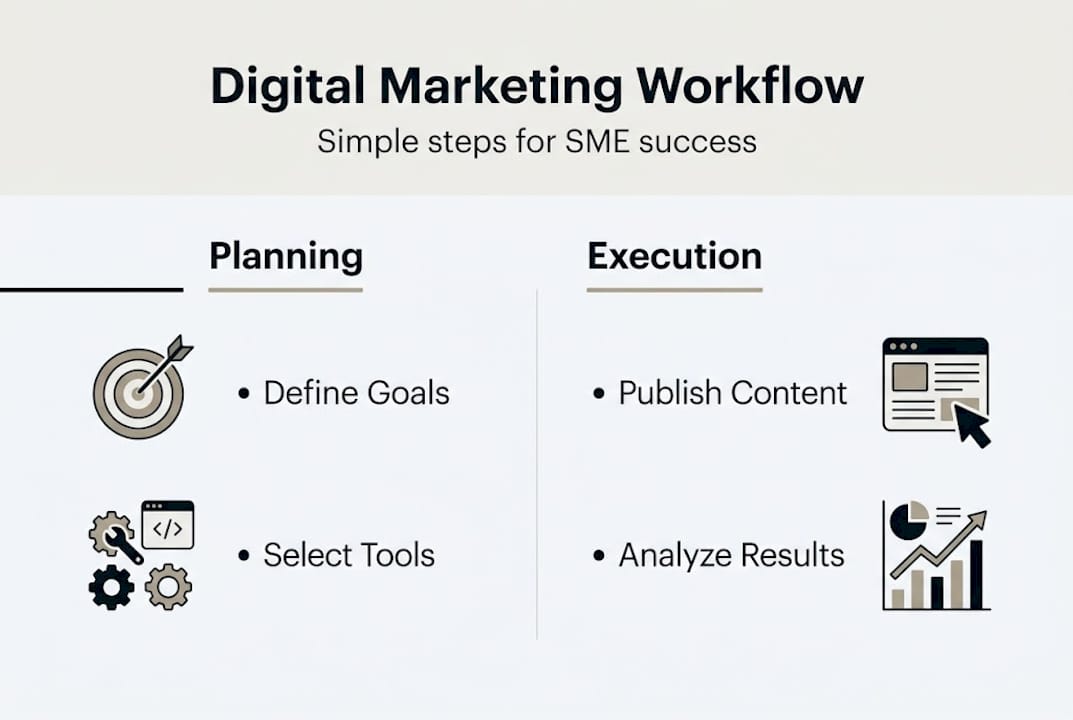
A digital marketing workflow is a structured, repeatable process that guides every marketing activity from the initial idea to the final performance report. Think of it as the operating system behind your brand’s online presence. Without it, tasks pile up, ownership gets blurry, and results become impossible to predict or replicate.
For SMEs, this matters more than it does for large enterprises. You don’t have the luxury of a 20-person team to absorb chaos. Every hour lost to unclear processes is a direct hit to your bottom line.
A standard workflow moves through five core stages:
- Planning: Define goals, audience, budget, and channels
- Content creation: Develop copy, visuals, and assets aligned to the plan
- Execution: Publish, schedule, and launch campaigns across platforms
- Measurement: Track KPIs against benchmarks in real time
- Optimization: Use data to refine what’s working and cut what isn’t
The Middle East context adds a layer of complexity most generic guides ignore. Audience preferences shift between platforms in Saudi Arabia versus the UAE. Arabic-language content performs differently than English in Riyadh compared to Dubai. Ramadan campaigns require a completely different tone and schedule. These nuances affect every stage of your workflow.
| Workflow stage | Key tools | Regional challenge |
|---|---|---|
| Planning | Google Analytics, Meta Ads Manager | Audience segmentation by language and country |
| Content creation | Canva, Adobe Express, ChatGPT | Bilingual content and cultural tone |
| Execution | Hootsuite, Buffer, Meta Business Suite | Platform preference varies by market |
| Measurement | Google Looker Studio, HubSpot | Attribution across paid and organic channels |
| Optimization | SEMrush, Hotjar | Rising CPMs and competitive ad landscape |
The ROI of a structured workflow shows up in three ways: time saved, content consistency, and campaign performance. Teams that follow a documented process publish more frequently, waste less on misaligned ads, and build stronger brand recognition over time.
Paid ads deliver quick wins but face rising competition and CPMs across MENA, while organic SEO builds compounding value over 3 to 6 months. The smartest SMEs use both, but only within a workflow that makes each channel intentional.
Exploring the digital marketing essentials behind each channel will help you decide which stages to prioritize first based on your market.
Setting up your workflow: Tools and team alignment
Most workflow breakdowns don’t happen because of bad strategy. They happen because the team is juggling six different tools with no clear owner for any of them. Tool overload is one of the most common and most avoidable problems SMEs face when building a marketing process.
Start with three categories of tools and nothing more:
- Automation and scheduling: Handles content publishing and email sequences without manual effort every day
- Content pipeline management: Keeps briefs, drafts, approvals, and final assets organized in one place
- Analytics dashboard: Consolidates performance data so decisions are based on numbers, not gut feel
Here’s a practical comparison to help you choose:
| Tool | Category | Best for | Monthly cost (approx.) |
|---|---|---|---|
| Buffer | Scheduling | Social media automation | Free to $15 |
| Notion | Content pipeline | Brief and asset management | Free to $10 |
| Google Looker Studio | Analytics | Custom performance dashboards | Free |
| Mailchimp | Email automation | Lead nurturing sequences | Free to $20 |
| SEMrush | SEO and research | Keyword tracking and audits | From $130 |
Once tools are selected, assign clear ownership. Every stage of the workflow needs a named person responsible for it. Not a department. A person.
Here’s how to structure your workflow from kickoff to execution:
- Hold a monthly planning session to set goals and assign content themes
- Create a content calendar with deadlines for drafts, reviews, and publishing
- Assign each task to one team member with a clear due date
- Set up automated publishing for approved content
- Review analytics weekly and flag underperforming content immediately
AI and automation scale small teams effectively, but only after a simple, manual workflow is already running smoothly. Adding AI to a broken process just creates faster chaos.

Pro Tip: Run your workflow manually for 30 days before introducing any automation. This forces clarity on roles and reveals exactly where the bottlenecks are before you try to automate around them.
For regional SMEs aligning with Vision 2030 in Saudi Arabia, your marketing workflow should also connect to supply chain and logistics timelines. A product launch campaign that goes live before inventory is ready wastes every dirham spent on ads. Explore marketing automation tools and review influencer marketing workflow tips to see how other regional brands are structuring their pipelines.
Step-by-step execution: Bringing your workflow to life
Knowing the stages is one thing. Running them consistently is another. Here’s how to execute a repeatable digital marketing workflow from campaign brief to final report.
- Write a campaign brief: Define the goal, target audience, key message, budget, and timeline before any content is created
- Build your content calendar: Map out every post, email, and ad for the next 30 days with assigned owners
- Create and approve assets: Use a review process with at least one round of feedback before anything goes live
- Schedule and launch: Use your scheduling tool to publish at peak engagement times for each platform
- Monitor in real time: Check performance daily for the first week of any new campaign
- Pull a weekly report: Document what’s working and what needs adjustment before the next cycle begins
Content scheduling varies by channel. Instagram and TikTok in the UAE see peak engagement in the evenings, particularly between 7 and 10 PM. LinkedIn performs better mid-morning for B2B audiences in Riyadh. Email open rates in the Gulf tend to spike on Sunday mornings when the work week begins.
Measurement must be built into the workflow from day one, not added as an afterthought. Track these KPIs from the start:
- Cost per lead (CPL) across paid channels
- Organic traffic growth month over month
- Email open and click-through rates
- Social media reach and engagement rate
- Conversion rate from landing pages
Pro Tip: Pick one core channel and optimize it fully before expanding. Most SMEs spread thin across five platforms and master none. One channel done well builds the foundation for everything else.
Organic SEO compounds long-term but takes 3 to 6 months to show meaningful results. This means your SEO strategy needs to start on day one, not after paid ads plateau. Pair it with consistent social media workflow tips to build audience while search rankings grow.
Troubleshooting and optimizing your workflow
No workflow runs perfectly out of the gate. The warning signs of a broken process are easy to spot if you know what to look for: inconsistent posting schedules, leads falling through the cracks between marketing and sales, and team members unsure who owns the next step.
These five mistakes show up in almost every SME workflow we’ve seen:
- Too many tools with no integration: Data lives in five places and no one has the full picture
- No regular data review: Campaigns run for weeks without anyone checking if they’re working
- Unclear next steps after publishing: Content goes live and then nothing happens with the results
- Overcomplicated automations: Triggers and sequences that no one fully understands and no one can fix
- Ignoring localization: Running the same creative in Dubai and Riyadh without adapting tone, language, or cultural references
Fixing these issues starts with a simple audit. Pull your last 90 days of performance data and ask three questions: What delivered results? What cost money without return? What was never measured at all?
Paid ads face rising CPMs across MENA markets, which means SMEs relying only on paid channels will see diminishing returns without a smarter, more diversified workflow. This is where data-driven decision making becomes your competitive edge.
Pro Tip: Schedule a quarterly workflow review with your full team. Bring performance data, ask what’s slowing people down, and update your process document before the next quarter begins. Small adjustments every 90 days compound into major efficiency gains over a year.
What most SMEs get wrong about digital marketing workflows
Here’s an uncomfortable truth we’ve observed working with SMEs across the region: most teams overcomplicate their workflow before they’ve mastered the basics. They invest in five tools, set up complex automations, and chase every new platform, then wonder why results are inconsistent.
Quick wins from paid ads are real, but they create a dangerous habit. When a boosted post performs well, the instinct is to spend more rather than build the organic foundation that makes every future campaign cheaper and more effective. Sustainable growth in the Middle East market comes from mastering a simple, repeatable process first, then layering on automation and AI once the routine is solid.
We’ve seen small teams of two or three people outperform agencies with ten staff simply because their workflow was clear, their roles were defined, and they reviewed data consistently. The goal isn’t a sophisticated system. It’s one your team can actually run without burning out. Streamlining with AI works best when it supports a human process, not replaces one that was never properly built.
Supercharge your digital marketing workflow with Hala Creative Agency
Building a workflow that actually sticks takes more than a checklist. It takes strategy, the right tools, and someone who understands the regional market nuances that generic platforms don’t account for.
Hala Creative Agency works directly with SMEs in Dubai, Doha, and Riyadh to design and implement digital marketing workflows built for your team size, budget, and growth goals. From social media workflow solutions to organic SEO and full-funnel automation, our approach blends AI efficiency with human creativity so your brand voice stays intact. Explore our full range of digital marketing services or get started with Hala Creative Agency today and let’s build a process that delivers real, measurable results for your business.
Frequently asked questions
What is a digital marketing workflow and why does it matter for SMEs?
A digital marketing workflow is a repeatable process covering every step from planning to optimization, making marketing more effective, cost-efficient, and consistent for SMEs.
How long before I see results from digital marketing for my SME?
Paid ads can show quick results within weeks, but organic SEO takes 3 to 6 months to yield noticeable gains, so starting both channels early is essential.
What is the biggest mistake SMEs make in digital marketing workflow?
Overcomplicating workflows with too many tools is the most common pitfall. Simple workflows first allow AI and automation to add genuine value without creating confusion.
Can I automate my digital marketing workflow fully with AI?
Not right away. AI scales small teams effectively, but only after a clear, manual workflow is already running without errors or ownership gaps.
Recommended
- Hala Creative Agency – crafting digital awareness 10x faster with AI
- SEO: Which Digital Advertis Ing Strategy Is Right For You? – Hala Creative Agency
- Social Media Marketing Strategies For Small Business – Hala Creative Agency
- How Businesses Can Leverage Data for Smarter Decisions – Hala Creative Agency