
TL;DR:
- Up to 22% of digital ad traffic is fraudulent, costing businesses over $100 billion annually worldwide.
- Digital advertising offers targeted, measurable campaigns across search, social, display, and video channels.
- Proper setup, verification, focus, and expert support are essential to avoid waste and achieve real growth.
Up to 22% of digital ad traffic is fraudulent, costing businesses over $100 billion globally each year. For small and medium-sized business owners in Dubai, that number should stop you cold. You might be paying for clicks that no real customer ever made. Digital advertising is genuinely powerful, but only when you understand how it works, where the risks hide, and how to build campaigns that actually deliver. This guide covers the core types of digital advertising, the best channels for Dubai businesses, the real risks you face, and the steps that separate wasted spend from real growth.
Table of Contents
- What is digital advertising?
- The most effective digital advertising channels for Dubai businesses
- Common challenges and risks: Ad fraud, data gaps, and supply chain opacity
- Best practices: Building trustworthy and effective digital campaigns
- The uncomfortable truth: Most digital ad spend is wasted—here’s what actually works
- Boost your digital impact with expert support
- Frequently asked questions
Key Takeaways
| Point | Details |
|---|---|
| Quality over quantity | Focus your ad spend on selected channels where your customers are most active. |
| Be vigilant about ad fraud | Demand transparency and watch out for fake traffic to protect your budget. |
| First-party data matters | Rely on your own customer data for better targeting and trustworthy results. |
| Work with trusted partners | Direct deals and reputable agencies can help you avoid hidden risks and maximize returns. |
What is digital advertising?
Digital advertising is any paid promotion that runs through online channels. That includes search engines, social media platforms, websites, video platforms, and mobile apps. Unlike a billboard or a newspaper ad, digital advertising lets you target specific people, measure every click, and adjust your campaign in real time.
For Dubai SMBs, the main types worth knowing are:
- Search ads: Text-based ads that appear when someone searches a keyword on Google or Bing. You pay when someone clicks.
- Social media ads: Paid posts or stories on Facebook, Instagram, LinkedIn, or TikTok, targeted by demographics, interests, or behavior.
- Display banners: Visual ads placed on websites across the internet, usually bought through ad networks.
- Video ads: Short clips shown before or during content on YouTube or social platforms.
- Influencer partnerships: Paid collaborations with content creators who promote your brand to their audience.
Each format serves a different purpose. Search ads capture people who are already looking for what you sell. Social ads build awareness among people who might not know you yet. Video ads tell a story. Understanding choosing the right digital advertising strategy before spending a single dirham is the most valuable thing you can do.
The role of AI in digital advertising is growing fast. Platforms use AI to decide who sees your ad, when, and at what price. Done well, AI improves ad efficiency by 20 to 40%, lowering your cost per customer. But AI is only as good as the data it learns from. Feed it bad data, and it optimizes toward the wrong outcomes. That is a critical point we will return to.
The benefits of digital advertising over traditional methods are real. You can reach tens of thousands of people in Dubai with a modest budget, target by location, language, job title, or buying intent, and see exactly which ads drove results. For digital services that require measurable ROI, this transparency is a major advantage. But transparency only exists if you know where to look and what questions to ask.
Key stat: Digital ad spend in the MENA region continues to grow year over year, with the UAE consistently ranking among the top markets for digital engagement per capita.
The most effective digital advertising channels for Dubai businesses
Not every platform is right for every business. The channel that works brilliantly for a B2B software company in Dubai will likely underperform for a retail brand targeting everyday consumers. Here is a practical breakdown of the top platforms and how they compare.
| Channel | Best for | Cost model | Targeting strengths | Typical use case |
|---|---|---|---|---|
| Google Ads | Search intent | CPC | Keywords, location, device | Lead gen, e-commerce |
| Facebook/Instagram | B2C awareness | CPM/CPC | Demographics, interests, lookalikes | Brand awareness, offers |
| B2B lead gen | CPC/CPM | Job title, industry, company size | Professional services | |
| TikTok | Young audiences | CPM | Interests, behavior, trending content | Product launches, brand recall |
| Local UAE publishers | Regional reach | CPM | Geography, language | Arabic-speaking audiences |
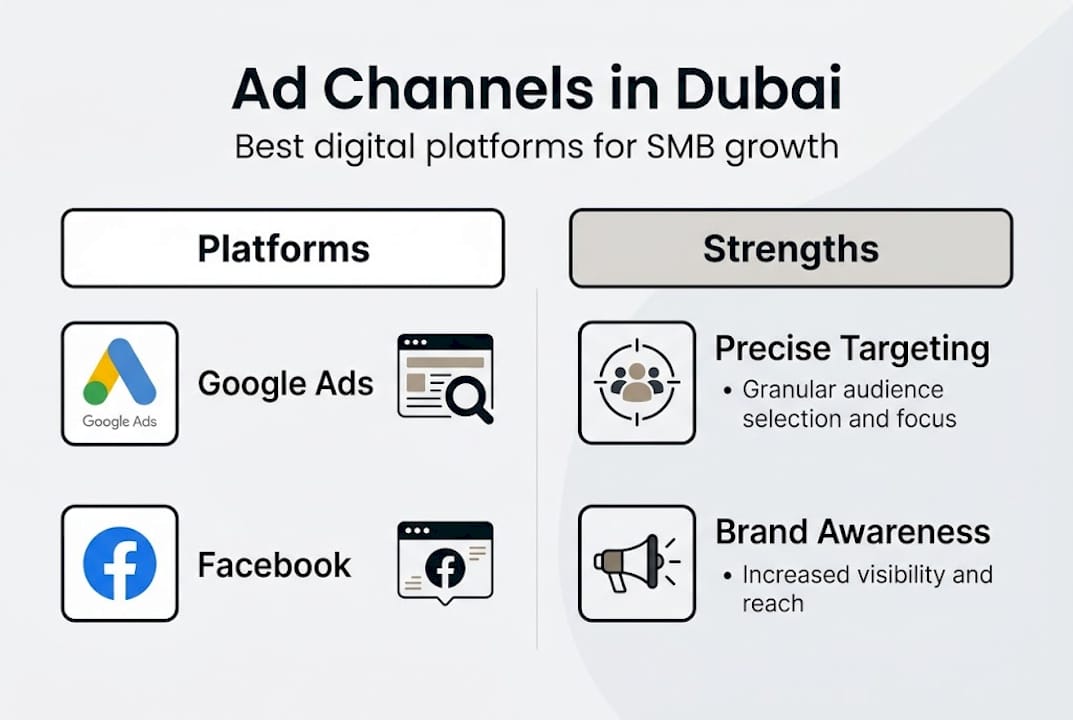
Google Ads remains the dominant platform for businesses that want to capture demand. If someone in Dubai searches “accounting software for small business,” a well-placed Google ad puts you right in front of them at the moment they are ready to buy.

Facebook and Instagram together give you access to a massive, highly segmented audience. The visual format works especially well for retail, hospitality, and lifestyle brands. Social media marketing strategies that combine organic content with paid promotion consistently outperform paid-only approaches.
LinkedIn is expensive on a cost-per-click basis, but for B2B businesses targeting decision-makers in Dubai, the targeting precision is unmatched. TikTok is newer to the advertising space but growing fast, particularly for brands targeting under-35 consumers.
For Dubai SMBs, focused channel selection consistently outperforms broad multi-platform campaigns. Spreading a limited budget across five platforms usually means none of them gets enough investment to work properly.
Bullet points to guide your channel selection:
- Know where your customers actually spend time online
- Match the ad format to your message (video for storytelling, search for intent)
- Start with one or two channels, prove results, then expand
- Check platform demographics against your target audience in Dubai
Pro Tip: Before launching on a new platform, run a small test campaign with a capped budget for two weeks. Use the data to decide whether to scale, not your gut feeling.
Exploring the right marketing solutions for your specific business type will save you months of trial and error.
Common challenges and risks: Ad fraud, data gaps, and supply chain opacity
Digital advertising has a dark side that most platform sales teams will not mention. Understanding these risks is not optional for Dubai SMBs. It is essential.
Ad fraud is the practice of generating fake clicks, impressions, or conversions to drain your ad budget without delivering real customers. The main types are:
- Bot traffic: Automated programs that click your ads repeatedly, inflating your click numbers
- Ad stacking: Multiple ads layered on top of each other, where only the top ad is visible but all ads register an impression
- MFA sites (Made for Advertising): Low-quality websites created purely to host ads and collect advertiser money, with no real human audience
Programmatic ad fraud can reach 22% of traffic, with global losses exceeding $100 billion. For a Dubai SMB spending AED 10,000 per month on programmatic display ads, that could mean AED 2,200 going straight to fraud.
Beyond fraud, data gaps and misattribution cause serious problems. If your tracking is set up incorrectly, you might credit a sale to the wrong ad, causing you to scale the wrong campaign. Hidden fees within ad networks can also eat into your effective budget without appearing in your dashboard.
The deeper problem is structural. Opaque programmatic supply chains create incentives for fraud at every layer, and only log-level transparency can expose it. Most small businesses never see log-level data because they do not know to ask for it.
| Risk type | Estimated budget impact | Detection difficulty |
|---|---|---|
| Bot traffic | 8 to 22% of spend | Medium |
| Misattribution | 10 to 30% of reported conversions | High |
| Hidden network fees | 5 to 15% of spend | High |
| MFA site placements | Up to 15% of display spend | Medium |
Here are the top three actions to reduce fraud and waste:
- Use verified ad platforms with transparent reporting. Google and Meta offer more accountability than many third-party networks.
- Install independent tracking such as Google Tag Manager alongside platform pixels to cross-check data.
- Review placement reports regularly. If your display ads are appearing on unknown or irrelevant websites, exclude them immediately.
For deeper guidance on reading your data correctly, leveraging data for smarter decisions is a strong starting point.
Best practices: Building trustworthy and effective digital campaigns
The risks above are real, but they are manageable. Here is how to build campaigns that you can actually trust.
Step-by-step campaign setup:
- Define your goal first. Are you driving website visits, form submissions, phone calls, or purchases? Every campaign decision flows from this.
- Build your first-party data foundation. First-party data is information you collect directly from your customers, like email lists and CRM records. Using first-party data reduces your reliance on platform data, which is increasingly restricted due to privacy regulations.
- Choose direct deals where possible. Buying ad space directly from a publisher or using a curated whitelist of approved sites reduces exposure to fraud-heavy open exchanges.
- Set up conversion tracking independently. Do not rely solely on the platform’s reported conversions. Cross-reference with your own analytics.
- Request log-level reporting. This means getting raw data on every impression and click, not just summary dashboards. Most reputable partners will provide this if you ask.
- Review and optimize weekly. Pause underperforming ads, reallocate budget to what is working, and test one new variable at a time.
Pro Tip: Insist on log-level transparency in any reporting agreement with an agency or ad network. If a partner refuses or cannot provide it, that is a red flag worth taking seriously.
Warning signs of bad inventory and fake results:
- Click-through rates that are unusually high (above 5% on display ads)
- Bounce rates near 100% from paid traffic
- Conversions that spike suddenly without a clear cause
- Ad placements on websites with no clear audience or topic relevance
- Reporting that only shows summary metrics with no drill-down capability
The uncomfortable truth: Most digital ad spend is wasted—here’s what actually works
Here is something most agencies will not say out loud: the majority of digital advertising budgets, especially from SMBs, are partially wasted. Not because digital advertising does not work, but because businesses chase scale before they have earned it.
We have seen it repeatedly. A business launches on four platforms at once, spreads a thin budget across all of them, gets mediocre results everywhere, and concludes that digital advertising does not work for their industry. The real problem was the strategy, not the channel.
Focused SMB campaigns consistently outperform broad ones because concentration of budget and attention produces better data, faster learning, and stronger creative. Doing fewer things better is not a limitation. It is the actual strategy.
The other uncomfortable truth is that intuition is a poor guide in digital advertising. The ad you think looks best rarely performs best. The audience you assume is your customer is often not the one converting. Data must drive decisions, not confidence. And that data must be clean, verified, and transparent.
Choosing the right digital advertising strategy means accepting that discipline and focus will always outperform volume and speed.
Boost your digital impact with expert support
Understanding the risks and best practices of digital advertising is a strong first step. But applying them consistently while running a business is a different challenge entirely.
At Hala Creative Agency, we work with Dubai SMBs to build digital advertising campaigns that are transparent, data-driven, and built for real results. From setting up clean tracking and first-party data systems to managing your digital solutions and marketing expertise, we handle the complexity so you can focus on your business. Whether you need search, social, or social media marketing services, we bring the structure and accountability that turns ad spend into growth.
Frequently asked questions
What makes digital advertising different from traditional methods?
Digital advertising gives you real-time data on who saw your ad, who clicked, and who converted, something print or TV simply cannot match. It also allows precise audience targeting and instant budget adjustments based on performance.
How can I avoid wasting money on fake clicks or bots?
Work only with reputable platforms, monitor your analytics for unusual spikes in clicks or bounce rates, and use independent tracking to verify what your ad dashboard reports. Bot and MFA fraud can account for 8 to 22% of programmatic traffic, so verification is not optional.
Which digital ad channels are most effective in Dubai?
Google Ads and LinkedIn perform best for B2B businesses targeting professionals, while Facebook and Instagram lead for B2C. Focused channel strategies consistently outperform broad multi-platform approaches for SMBs with limited budgets.
What is the role of AI in digital advertising?
AI automates bidding, audience targeting, and ad delivery to improve efficiency. It can reduce cost per acquisition by 20 to 40%, but only when the underlying data is accurate and the campaign goals are clearly defined.