
TL;DR:
- SEO builds long-term organic reach in Dubai’s competitive, multilingual market.
- Multilingual and localized SEO strategies are essential for UAE’s diverse audience.
- Combining SEO with UX and digital channels maximizes conversions and brand trust.
Most business owners in Dubai assume paid social ads are the fastest path to online growth. They are not wrong, but they are missing half the picture. SEO (search engine optimization) remains one of the most underused growth levers for small and medium-sized businesses in the UAE. Here is the surprising part: strong traffic growth from digital marketing does not always translate into more sales. This guide breaks down exactly why SEO matters for UAE SMEs, what makes it different here compared to other markets, and how to make it actually work for your business, not just your ranking report.
Table of Contents
- What is SEO and why does it matter for UAE businesses?
- The key roles of SEO in modern digital marketing
- Multilingual and localized SEO: Winning in Dubai’s diverse market
- Integrating SEO with UX and digital channels for better conversions
- Perspective: The reality of SEO in the UAE—What most ‘experts’ don’t tell you
- Get expert help growing your digital presence
- Frequently asked questions
Key Takeaways
| Point | Details |
|---|---|
| SEO is foundational | In the UAE, SEO is vital for visibility, trust, and long-term digital growth. |
| Localization is key | Multilingual and culturally aware SEO attracts and converts Dubai’s diverse audiences. |
| Integrate for results | SEO must connect with user experience and digital channels to drive conversions, not just traffic. |
| Value over volume | Focus on authentic content and high-quality backlinks, not sheer quantity. |
What is SEO and why does it matter for UAE businesses?
SEO stands for search engine optimization. In plain terms, it means making changes to your website so that search engines like Google show it higher in results when people search for what you offer. Unlike paid advertising, where you stop appearing the moment your budget runs out, SEO builds organic reach: visibility you earn and keep over time.
For UAE businesses, this distinction matters a lot. Paid ads can get expensive fast in a competitive market like Dubai. SEO, on the other hand, compounds. Every well-written page, every relevant backlink, every piece of localized content adds to an asset that keeps working for you without a daily spend.
Here is what makes SEO in the UAE especially important right now:
- Multilingual audiences: Dubai residents search in English, Arabic, and sometimes both in the same session.
- Voice and AI search growth: More users are asking questions out loud or using AI-powered search tools, which favor well-structured, authoritative content.
- Rapid market competition: E-commerce and service businesses are growing fast, and SMEs face real resource gaps when competing against larger merchants with bigger marketing budgets.
- Trust signals matter more: UAE consumers are increasingly research-driven. Ranking on the first page signals credibility before a single word of your content is read.
- Long-term cost efficiency: Organic traffic costs less per lead over time compared to a perpetual paid ad cycle.
SEO also plays a direct role in brand discoverability. When someone in Abu Dhabi or Sharjah searches for a service you provide, you want your business to come up. Not because you paid for that moment, but because Google trusts your site enough to recommend it.
Pro Tip: Focus on earning a few high-quality backlinks from reputable local or industry sources rather than chasing hundreds of low-quality ones. One strong local citation beats ten irrelevant directory links every time.
If you are still deciding which approach fits your business, exploring SEO strategy options can help you map out the right path based on your goals and budget.
The key roles of SEO in modern digital marketing
SEO does not operate in a vacuum. It plays four distinct roles inside a well-rounded digital marketing strategy, and understanding each one helps you prioritize where to invest your effort.
- Visibility: SEO puts your business in front of people who are already searching for what you sell. This is intent-driven traffic, which means these visitors are much closer to making a decision than someone who scrolls past a social ad.
- Credibility: Higher rankings signal authority. Google’s E-E-A-T framework (Experience, Expertise, Authority, Trust) rewards businesses that demonstrate genuine knowledge and real-world experience. Customers trust the first result more than the fifth, even if the quality is similar.
- Engagement: Well-optimized content answers questions, solves problems, and keeps visitors on your site longer. Good site structure, fast loading, and logical navigation all reduce bounce rates and increase time on page.
- Conversion: This is where many UAE SMEs drop the ball. Traffic without conversion is just a vanity metric.
“SEO can increase website traffic by 28% for SMEs, but without UX alignment, conversion improvement may be less than 1% (+0.37%).”
That statistic should stop you in your tracks. A 28% jump in traffic sounds great until you realize the sales needle barely moved. The reason is almost always a disconnect between SEO and user experience (UX). You can rank for a keyword, but if the landing page is confusing, slow, or does not make the next step obvious, visitors leave without converting.
This is why strong digital engagement strategies treat SEO as one part of a connected system, not a standalone tactic. Visibility gets people to the door. The rest of your digital presence has to close the deal.
Multilingual and localized SEO: Winning in Dubai’s diverse market
Dubai is not a monolingual market. It is one of the most diverse cities in the world, with residents from over 200 nationalities. This means your SEO strategy cannot afford to ignore language and culture.
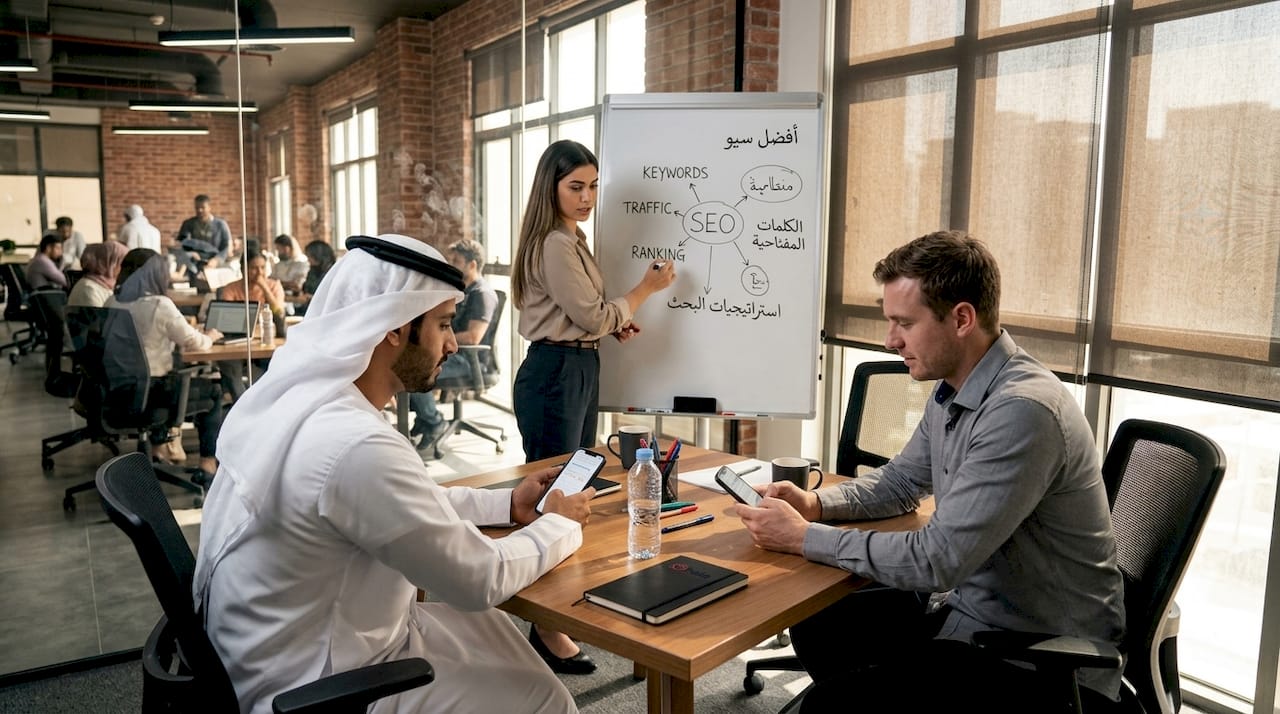
Hybrid English-Arabic search intent is a real behavior in the UAE. A user might search “best Arabic restaurant Dubai” in English but use full Arabic phrases when searching for legal or healthcare services. Your job is to meet them in both places.
Here is a direct comparison of what monolingual versus multilingual SEO looks like in practice:
| Factor | Monolingual SEO | Multilingual SEO |
|---|---|---|
| Keyword coverage | English only | English + Arabic variants |
| Audience reach | Partial | Full local market |
| Search engine trust | Limited signals | Stronger regional relevance |
| Content adaptability | One tone, one style | Culturally adapted messaging |
| Conversion potential | Lower for Arabic speakers | Higher across all segments |
Tactics that work well for UAE multilingual SEO include:
- Separate URL structures for English and Arabic versions (e.g., /en/ and /ar/) so Google can index them independently.
- Keyword research in both languages: Do not just translate keywords. Research what Arabic speakers actually type into Google, since direct translations often miss how people naturally phrase searches.
- Culturally relevant content: Images, tone, and navigation should reflect local values and expectations. What works for a Western audience may feel off to UAE residents.
- Avoid auto-translation tools: Machine-translated Arabic reads poorly and can damage trust quickly. Invest in human translation for your core pages.
For deeper guidance, exploring multilingual SEO strategies can help you structure your site for both languages correctly from the start.
Integrating SEO with UX and digital channels for better conversions
Here is the hard truth: SEO alone will not grow your revenue. It is a foundation, and foundations only matter when you build something solid on top of them. The real conversion gains come when SEO, UX (user experience), and your other digital channels work together.
Let’s look at how integration affects key business metrics:
| Integration level | Organic traffic | Conversion rate | Brand trust score |
|---|---|---|---|
| SEO only | High | Low (+0.37%) | Moderate |
| SEO + UX | High | Moderate to high | High |
| SEO + UX + Social | Very high | High | Very high |
| Full channel integration | Maximum | Optimized | Peak |
The pattern is clear. Each layer you add multiplies the impact of the one before it.
Practically, this means your website needs to be fast, mobile-friendly, and easy to navigate before SEO can deliver real results. It also means your content needs to do more than target keywords. Google’s E-E-A-T framework actively rewards genuine SME stories and value-driven UX over generic or AI-only content. Sharing your team’s expertise, real client outcomes, and your business journey builds the kind of trust signals that rank and convert.
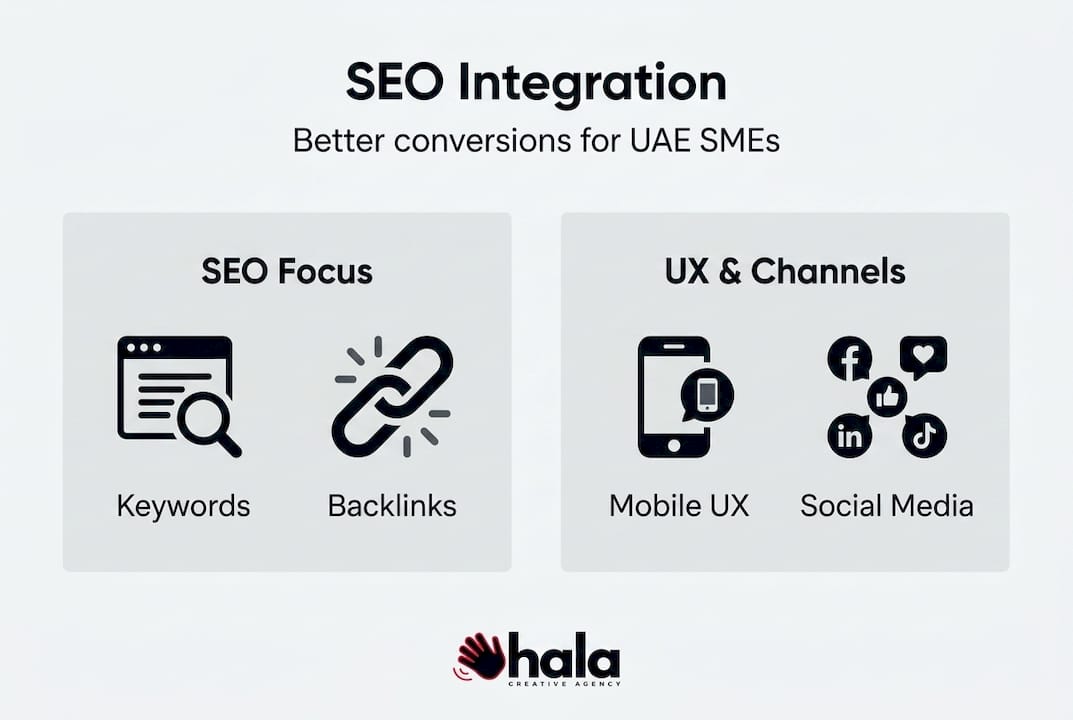
Social media plays a supporting role too. While social media for Dubai SMEs does not directly affect Google rankings, it drives brand searches, earns shares, and builds the audience that later converts from organic search.
Looking at digital marketing examples from the Middle East shows how the most successful local brands combine content, community, and search to build resilient growth engines.
Pro Tip: Prioritize mobile UX and page speed above almost everything else. Voice search and AI-assisted search results favor pages that load fast and structure their content clearly. A one-second delay in load time can drop conversions by 7%.
Perspective: The reality of SEO in the UAE—What most ‘experts’ don’t tell you
After working with businesses across Dubai and the wider UAE, we have noticed a consistent pattern: most SME owners are sold on SEO through the lens of rankings and traffic. Few are told the uncomfortable truth that rankings without clarity do not pay salaries.
The quantity-of-backlinks approach is heavily oversold. What actually moves the needle in the UAE is local relevance: being cited by regional directories, covered by local press, and referenced by industry peers. These signals carry far more weight than 50 low-quality backlinks from unrelated international sites.
The hybrid English-Arabic approach is not a bonus feature for ambitious brands. It is table stakes for any sector serving UAE residents. Skipping Arabic SEO is leaving a significant portion of your potential customers invisible to your business.
Perhaps the most underrated truth: your business story is an SEO asset. The more genuinely you communicate your expertise, your journey, and your results, the more you align with what Google actually rewards. Generic content, even if well-structured, rarely builds the trust that converts. Choosing the right SEO approach starts with accepting that SEO is a long game built on real substance, not ranking tricks.
Get expert help growing your digital presence
Ready to take the next step in your digital marketing journey? Understanding SEO is one thing. Executing it consistently, across languages, channels, and an ever-changing search landscape, is a different challenge entirely.
At Hala Creative Agency, we work with Dubai and UAE SMEs to build marketing services that go beyond surface-level tactics. From multilingual SEO and content strategy to UX and channel integration, our team brings local expertise and data-driven thinking to every project. Whether you are starting from scratch or refining an existing strategy, our proven Dubai engagement strategies and SEO strategy tailored for UAE SMEs are built to deliver results that actually matter to your bottom line.
Frequently asked questions
Why is SEO more challenging for SMEs in Dubai than large competitors?
SMEs operate with tighter budgets and smaller teams while competing against well-funded brands, making it essential to focus on quality local SEO signals and niche keyword strategies rather than trying to outspend the competition.
How can I make my website SEO-friendly for both English and Arabic users?
Use a bilingual site structure with separate URL paths for each language, conduct keyword research in both languages independently, and ensure the tone and cultural references in your Arabic content feel natural to native speakers rather than translated.
Does SEO alone guarantee higher sales for my business?
No. SEO drives relevant traffic, but conversion growth depends on aligning your site’s UX, page speed, and calls-to-action with what visitors expect when they arrive.
What is E-E-A-T and why does it matter in the UAE?
E-E-A-T stands for Experience, Expertise, Authority, and Trust. Google uses these signals to evaluate content quality, and genuine SME experience such as real case studies and specialist knowledge helps UAE businesses rank higher and build lasting credibility.