
TL;DR:
- Inconsistent branding erodes customer trust and hampers sales in Dubai’s highly competitive market. A structured workflow from brand assessment to ongoing optimization ensures consistent messaging, emotional resonance, and measurable digital growth. Building brand equilibrium first creates a foundation that amplifies innovation and sustains long-term success.
Inconsistent branding quietly bleeds customer trust before you ever notice the damage. A business that looks one way on Instagram, another way on its website, and yet another way on a printed flyer sends a subconscious signal: we’re not quite sure who we are. For Dubai’s small and medium-sized businesses (SMBs), where competition is fierce and consumer expectations are exceptionally high, that uncertainty costs sales. Branding is far more than a logo or a color palette. It is the structured system that shapes how customers perceive, remember, and choose your business. This guide walks you through a practical, research-backed workflow that takes you from brand confusion to measurable digital growth.
Table of Contents
- Assess your business and brand landscape
- Define your brand archetype and niche for Dubai market
- Map out workflow steps from brand concept to digital presence
- Measure and optimize your workflow for ongoing growth
- The real advantage: Brand workflow vs innovation cycles in Dubai
- Empower your Dubai brand with expert workflow support
- Frequently asked questions
Key Takeaways
| Point | Details |
|---|---|
| Audit before action | Start by analyzing your current brand landscape and digital assets to set realistic goals. |
| Choose archetype wisely | Selecting the right brand archetype and niche is essential for building trust and credibility in Dubai’s market. |
| Follow a clear process | Execute your branding workflow step-by-step from concept to digital presence for maximum impact. |
| Measure and refine | Track performance metrics and optimize your workflow regularly to ensure ongoing growth. |
| Workflow enables innovation | A strong branding workflow provides a platform for scaling new digital tactics and sustainable growth. |
Assess your business and brand landscape
Now that we’ve set the stage, let’s walk through how to assess your brand and lay the groundwork for an effective workflow.
Before you build anything, you need to understand what you’re working with. A brand audit sounds formal, but the process is straightforward. You are simply asking three questions: How visible is my brand right now? What do customers actually think about us? And what do our digital assets look like compared to competitors?
Start by reviewing these key elements:
- Brand recognition: Can people identify your business by name or visuals without context?
- Customer perception: What emotions, words, and associations come up in reviews and comments?
- Digital assets: Website quality, social profile consistency, content frequency, and SEO rankings.
- Competitive positioning: Where do you rank against similar Dubai businesses in search and social?
Use this simple benchmark table to organize your findings:
| Metric | Current status | Industry benchmark | Priority |
|---|---|---|---|
| Website traffic (monthly) | Baseline | 1,000+ sessions | High |
| Social media engagement rate | Baseline | 2.5%+ | High |
| Brand search volume | Baseline | Growing month over month | Medium |
| Customer sentiment (reviews) | Baseline | 4.2+ average rating | High |
| Visual consistency across channels | Yes/No | 100% consistent | Critical |
Dubai’s digital ecosystem is one of the most competitive in the region. Businesses here are investing heavily in digital presence, and consumers have grown accustomed to polished, trustworthy brand experiences. Research spanning 63 branding studies from 2012 to 2023 confirms that strong brands consistently boost sales and financial performance, and even targeted strategies like vehicle branding have delivered a 55% visibility increase alongside a 30% web traffic boost. That kind of result does not happen by accident. It starts with knowing your current position before spending a single dirham.
Pro Tip: Run a simple Google search of your brand name and screenshot the results. Then ask three loyal customers what three words they would use to describe your business. The gap between how you intend to appear and what actually shows up is your starting problem to solve. Understanding how a branding agency drives growth in Dubai can also reveal benchmarks you may not have considered. For a deeper look at building a digital identity for SMBs, these resources are worth exploring early in your audit.
Define your brand archetype and niche for Dubai market
With your brand’s status clear, the next step is defining your unique archetype and niche, especially for Dubai’s diverse, multicultural market.
A brand archetype is a personality framework borrowed from psychology that helps businesses communicate in a consistent, emotionally resonant way. There are twelve classic archetypes, from the Hero to the Caregiver to the Sage. For Dubai SMBs, picking the right one is not a creative exercise. It is a strategic decision with real financial consequences. Research into brand archetypes and trust development shows that a Sage-Creator combination builds scalable trust over time, while a Sage-Innocent pairing risks credibility problems as the business scales. Meanwhile, going visual-first without defining your archetype first can waste 60 to 80% of your budget on assets that don’t connect emotionally with your target audience.
The table below maps common archetypes to Dubai market scenarios:
| Archetype | Best suited for | Trust-building strength | Risk if misapplied |
|---|---|---|---|
| Sage + Creator | Consulting, tech, education | Scalable, long-term trust | Can feel dry without emotional warmth |
| Hero + Ruler | Premium services, finance | Strong authority signal | Seen as arrogant if inconsistent |
| Explorer + Outlaw | F&B, lifestyle, fashion | Strong differentiation | Can alienate conservative segments |
| Caregiver + Innocent | Healthcare, family services | High relatability | Innocent archetype risks credibility at scale |
The Gap rebrand failure in 2010 is a cautionary example that cost the company an estimated $100 million, largely because the strategic rationale behind the identity shift was ignored in favor of a purely visual update. Dubai businesses face the same trap regularly.
Here is a numbered workflow for choosing your archetype and niche:
- List your top five competitors and identify the archetypes they project consciously or not.
- Survey 10 to 20 existing customers on what feeling your brand gives them.
- Match your business values and founder story to two or three archetype candidates.
- Test messaging from your shortlisted archetypes in low-cost social content for two weeks.
- Pick the archetype combination that generates the highest engagement and feels authentic.
- Define your niche within that archetype: for example, Sage + Creator for Emirati women in tech consulting, rather than a generic consulting brand.
Pro Tip: The perception gap is the single most powerful metric at this stage. It measures the distance between the brand personality you intend to project and what customers actually experience. Closing this gap by even 20% consistently translates into stronger repeat purchase rates. Use a free tool like a Google Form survey sent to recent customers to get honest, quantitative feedback fast. Reviewing a digital marketing checklist for Dubai can also help ensure your positioning translates correctly across digital channels.
Map out workflow steps from brand concept to digital presence
Once you’ve chosen your archetype and niche, it is time to design and implement a workflow that brings your brand to life online.

A branding workflow is not a one-time project. It is a repeatable sequence of actions that ensures every new piece of content, every campaign, and every customer touchpoint reinforces the same brand identity. This consistency is what builds the mental availability (the quick, instinctive association consumers make when they need your product category) that converts recognition into revenue.
Here is the complete workflow from concept to launch:
- Brand concept validation: Confirm archetype, brand promise, and core messaging pillars with internal team and a small customer focus group.
- Visual system creation: Develop logo, color palette, typography, and imagery guidelines based on validated archetype, not personal preference.
- Messaging framework: Write your tagline, elevator pitch, social bio, and key marketing messages using your archetype’s language patterns.
- Website foundation: Build or update your website to reflect the new identity, ensuring mobile-first design, fast load times, and SEO-optimized structure.
- Social media alignment: Update all profiles, cover images, and bio copy to match the new visual and messaging system consistently.
- Content calendar launch: Plan the first 30 days of content across channels using themes that reinforce your archetype’s core traits.
- Paid amplification: Use targeted ads on Meta or Google to push your strongest archetype-aligned content to your ideal Dubai audience segment.
- Review and checkpoint: After 30 days, measure perception gap, engagement rates, and web traffic changes before scaling.
Tools and solutions for each phase include:
- Concept validation: Google Forms, Typeform, or face-to-face customer interviews
- Visual system: Canva Pro for SMBs, Adobe Creative Suite for agencies
- Messaging framework: ChatGPT (with human editorial oversight), brand messaging templates
- Website: WordPress, Webflow, or Shopify depending on business model
- Analytics: Google Analytics 4, Meta Business Suite, Semrush for SEO
- Scheduling: Buffer, Later, or Hootsuite for content calendar execution
Structuring this process inside a clear digital marketing workflow for SMEs removes guesswork and keeps every team member or agency partner aligned. A well-organized workflow also makes it far easier to implement your social media marketing strategies because every post draws from the same strategic foundation instead of being created in isolation.
“Businesses that execute structured branding workflows, including targeted offline and online brand activations, have recorded a 55% increase in visibility and a 30% boost in web traffic — results that isolated campaigns rarely replicate.”
Measure and optimize your workflow for ongoing growth
After launching your workflow, ongoing measurement and optimization are crucial for sustained brand impact and digital growth.
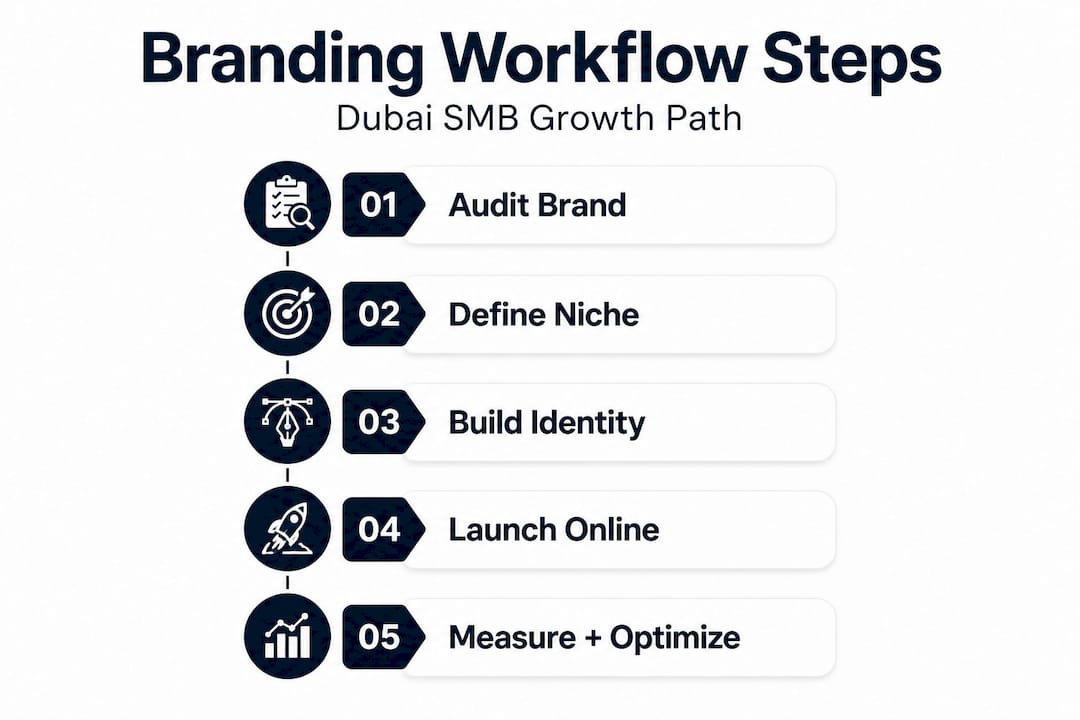
Most SMBs stop at launch. They update the logo, refresh the website, run a few campaigns, and then wait. That waiting is where growth stalls. Brand building is iterative. Every 30 to 90 days, you should be collecting data, identifying what is reinforcing your archetype and what is drifting away from it, and making calculated adjustments.
Key metrics to track consistently:
- Perception gap score: Survey customers quarterly and compare their descriptions of your brand to your intended archetype. Track whether the gap is narrowing.
- Brand engagement rate: Monitor likes, shares, saves, and comments relative to reach, not just raw follower counts.
- Direct and branded search traffic: Growth in people searching for your business name specifically is one of the clearest signals of brand strength.
- Conversion rate from brand touchpoints: Track how often visitors from social or branded search actually convert to leads or sales.
- Customer sentiment trends: Review ratings and comment themes monthly to catch perception shifts early.
- Return visitor rate: Indicates whether your content and brand are creating habitual interest.
Research confirms that perception gap reduction is the most predictive metric for long-term brand trust development in SMEs. At the same time, empirical benchmarks across industries consistently show that strong brands outperform weaker ones on both revenue and financial resilience, especially during economic fluctuations. In Dubai, where market conditions can shift quickly based on global events and tourism cycles, that resilience is a genuine competitive advantage.
Understanding the full scope of social media marketing advantages specifically for Dubai SMEs gives you a clearer picture of which platforms deserve priority in your measurement framework.
Pro Tip: Set up a simple automated dashboard using Google Looker Studio (formerly Data Studio). Connect it to your Google Analytics 4, Search Console, and Meta Ads accounts. Set it to email you a weekly summary every Monday morning. This removes the friction of manually checking data and ensures you never miss a trend shift that needs a tactical response.
The real advantage: Brand workflow vs innovation cycles in Dubai
With data in hand, it is worth reflecting on what truly differentiates high-performing Dubai SMBs in branding and digital innovation.
There is a popular belief in the business community that constant innovation, launching new products, trying new platforms, running fresh campaigns, is what keeps a brand relevant. This view has surface appeal. But it is incomplete, and for many SMBs it is actually harmful. When your team is perpetually chasing the next trend or testing the next channel, you rarely build the deep brand recognition that creates stable, recurring revenue.
The more useful mental model comes from a distinction between transient advantage and brand equilibrium. Transient advantage describes the short-term gains from innovation cycles, which are real but temporary. Brand equilibrium describes the state where your business occupies a clear, trusted position in the minds of your target customers. In that state, new campaigns and digital tactics work harder because they land on prepared mental ground.
A structured branding workflow is what builds that equilibrium. It is not the opposite of innovation. It is the foundation that makes innovation more efficient and more impactful. When your brand identity is clear and consistent, a new TikTok campaign or Google Ads push carries the weight of everything you’ve already built. Without that foundation, each new tactic starts from near zero in terms of trust.
For Dubai SMBs specifically, the lesson is this: invest first in building brand equilibrium through a repeatable workflow, then layer in innovation. The businesses that do this consistently will outperform those that chase trends reactively. Explore more on creative branding for SMBs to see how this principle applies across different regional industries.
Empower your Dubai brand with expert workflow support
If you’re ready to accelerate your progress, tailored support can bring your branding workflow to life faster and more efficiently.
Building and executing a full branding workflow takes time, expertise, and a clear view of what works in the Dubai market specifically. At Hala Creative Agency, we combine data-driven analysis with creative strategy to help SMBs move from brand confusion to measurable digital growth without wasting budget on tactics that don’t fit their archetype or audience.
Whether you need help auditing your current brand position, defining your archetype, or launching a content-driven campaign, our marketing solutions for Dubai businesses are designed around your growth goals. We also specialize in developing a distinctive brand voice that resonates with your local and regional audience. Ready to see what structured branding can do for your business? Explore our digital engagement strategies proven across Dubai’s most competitive industries.
Frequently asked questions
What is the most important step in a branding strategy workflow for SMBs?
Defining a clear brand archetype and niche is the most critical foundational step, since research shows it drives scalable trust development and reduces the risk of costly identity misalignment later.
How can Dubai businesses measure branding workflow success?
Track the perception gap metric alongside digital engagement rates and sales conversion trends, as closing the perception gap is the most predictive indicator of long-term brand trust and revenue growth.
What common mistakes should Dubai SMBs avoid in branding workflows?
Avoid prioritizing visual design before strategic positioning, because visual-first branding can consume 60 to 80% of your budget on assets that fail to build emotional connection with your audience.
Why does a structured workflow matter more than sporadic digital campaigns?
A structured workflow builds brand equilibrium, which means each new campaign benefits from accumulated trust, unlike transient innovation cycles that generate short-term gains without compounding brand value over time.