
TL;DR:
- Most UAE SMEs confuse digital branding with marketing, risking wasted resources and weaker brand presence. Building a consistent, culturally adapted digital identity before marketing efforts enhances trust and long-term growth. Regularly tracking brand perception metrics allows continuous refinement and more effective digital strategies.
Most business owners in the UAE use “digital branding” and “digital marketing” interchangeably. That mix-up is quietly costing them real money. The businesses winning long-term in Dubai and across the Emirates are not just the ones running the smartest ad campaigns. They are the ones that built a recognizable, trusted online identity first, then used marketing to amplify it. This guide breaks down exactly what digital branding is, how it differs from digital marketing, and what practical steps you can take right now to build an online identity that compounds in value over time.
Table of Contents
- Defining digital branding: The foundation for online business success
- Digital branding vs. digital marketing: What’s the real difference?
- How digital branding works: Key mechanics for UAE SMEs
- Maintaining consistency across digital touchpoints
- Measuring the impact: How to track digital branding success
- Why most SMEs overlook digital branding and how to get it right
- Ready to level up your digital brand? Next steps for UAE businesses
- Frequently asked questions
Key Takeaways
| Point | Details |
|---|---|
| Branding vs. marketing | Branding builds long-term trust, while marketing focuses on short-term results. |
| Consistency is critical | Keeping your voice and visuals unified across channels boosts recognition and loyalty. |
| Actionable steps matter | Start with clear positioning, activate consistently, and track your digital brand performance. |
| UAE specifics count | Localizing your brand for UAE culture and language gives you a stronger market advantage. |
Defining digital branding: The foundation for online business success
Before spending a single dirham on ads or social media content, you need to understand what you are actually building. A lot of SME owners think branding is just about a nice logo. It goes much deeper than that.
“Digital branding is the strategic process of shaping how people perceive your business online through consistent identity, messaging, and experiences across digital touchpoints.”
That definition covers a lot of ground. Your “digital touchpoints” include every place a customer encounters your business online: your website, your Instagram profile, your Google Business listing, your email newsletters, and even your WhatsApp response time. Each one either reinforces your brand or contradicts it.
Traditional branding once meant billboards on Sheikh Zayed Road, printed brochures, and business cards. Digital branding operates in a much faster, more measurable environment. A potential customer in Dubai can go from not knowing your business exists to making a purchase decision within a few minutes online. That window is shaped almost entirely by your digital brand.
For UAE SMEs specifically, a clear digital brand builds trust before a conversation even starts. In a market this competitive, trust is currency. The key components of a digital brand include:
- Visual identity: Logo, color palette, typography, and imagery style used consistently across all platforms
- Brand voice: The tone and language your business uses in all written and spoken content
- Brand story: The narrative behind why your business exists and who it serves
- Online experience: How easy, enjoyable, and reliable it is to interact with you online
- Reputation signals: Reviews, testimonials, media mentions, and social proof
Getting these basics right from the start is what separates businesses that grow steadily from those that run expensive campaigns with disappointing results. If you are just starting to explore digital branding basics, understanding these core elements is your first step.
Digital branding vs. digital marketing: What’s the real difference?
This is where most SME owners get confused, and the confusion is understandable. Both involve online activity, both require content, and both influence sales. But they operate on completely different timelines and with different goals.
As one useful framework puts it, “branding focuses on long-term perception and consistency; marketing focuses on driving measurable conversions and results.” Think of it this way: branding is building a reputation, and marketing is spending that reputation to drive action.
Here is a practical comparison to make this concrete:
| Factor | Digital branding | Digital marketing |
|---|---|---|
| Primary goal | Build perception and trust | Drive conversions and leads |
| Time horizon | Long-term (months to years) | Short-term (days to weeks) |
| Key activities | Identity design, storytelling, content strategy | Paid ads, email campaigns, SEO, promotions |
| Success metrics | Brand recall, search volume, engagement quality | Click-through rate, cost per lead, ROAS |
| Audience relationship | Emotional and identity-based | Transactional and intent-based |
| Investment type | Builds compounding value | Produces immediate but temporary results |
The practical takeaway here is significant. If you run a Google Ads campaign before you have a clear brand identity, you are essentially sending paid traffic to a storefront with no signage and a confusing layout. The clicks cost the same, but far fewer convert.
Pro Tip: Most UAE SMEs blend both activities in their budgets, which is smart. But the common mistake is allocating 90% to marketing and almost nothing to branding. Flip that ratio during your first year, and you will spend less on marketing in year two because your brand does more of the heavy lifting.
To see how businesses in the region are approaching this, looking at digital marketing examples in the Middle East reveals a consistent pattern: the ones with the best results have a defined brand identity sitting underneath their campaigns.
How digital branding works: Key mechanics for UAE SMEs
Understanding the theory is one thing. Knowing how to actually build and activate your digital brand is where most SMEs need practical guidance. There is a clear framework that works well in the UAE market.
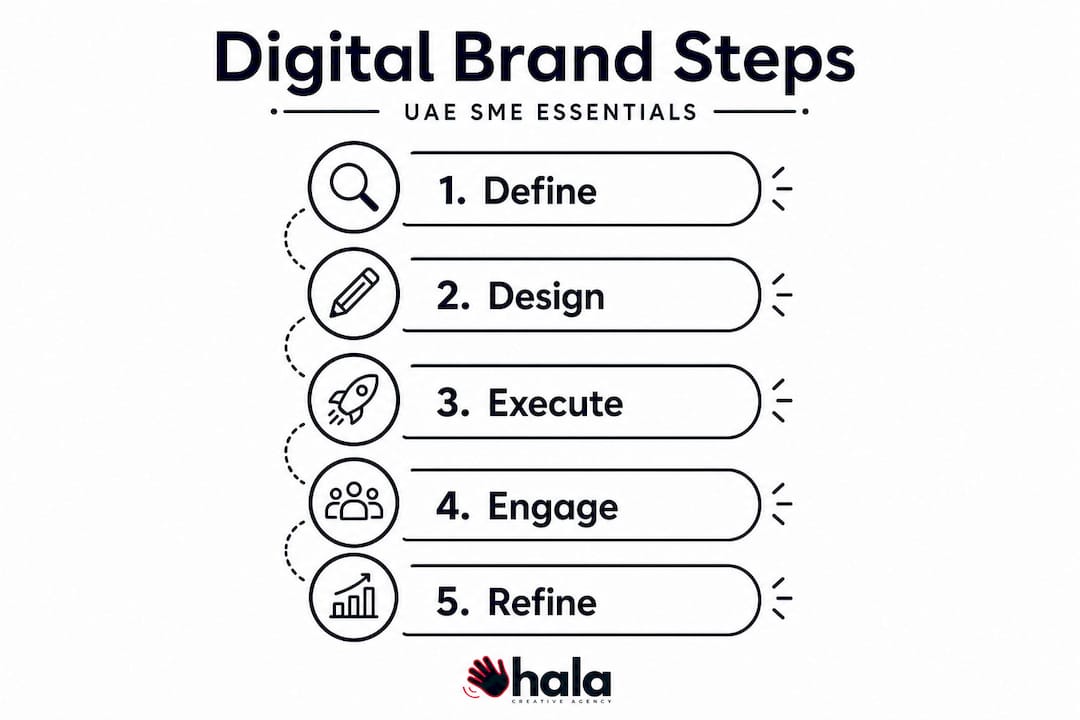
According to research on SME branding strategies, the core mechanics you can apply follow three stages: define your positioning and brand identity, activate it consistently across your digital channels, and track performance to refine your approach over time.
Here is how that looks in practice:
-
Define your positioning: Decide what your brand stands for, who it serves, and what makes it different. Write this down in a one-page brand guide. Answer these questions: What problem do you solve? What tone do you use? What do you never want to be associated with?
-
Build your visual and verbal identity: Create a logo, pick two or three brand colors, and choose fonts. Write down your brand voice guidelines. Even a one-page document that says “we are friendly but professional, we never use jargon, and we always respond within 24 hours” is enough to start.
-
Activate across all channels: Apply your identity consistently everywhere. Your Instagram bio, your website homepage, your email signature, and your Google Business profile should all feel like they come from the same brand.
-
Localize for the UAE context: This is critical and often skipped. The UAE is a multicultural market. Around 89% of the UAE population is made up of expatriates, according to government data. Your brand may need to communicate in both Arabic and English. Your visuals should be culturally respectful during religious periods like Ramadan, and your tone should reflect local norms around hospitality and trust.
-
Track and refine: Use data to see which channels and messages are building the strongest brand perception. Adjust quarterly.
| Branding stage | Key action | UAE-specific tip |
|---|---|---|
| Define | Write a brand positioning statement | Include both Arabic and English versions |
| Activate | Apply identity to all digital channels | Prioritize Instagram and WhatsApp in the UAE |
| Track | Monitor engagement and brand search volume | Track Arabic and English search terms separately |
Consistent execution of these steps is what builds the brand engagement strategies that turn browsers into loyal customers.
Maintaining consistency across digital touchpoints
You can have a beautifully designed brand identity document and still lose customers if your actual online presence is inconsistent. This is where the rubber meets the road.
Consistent identity, messaging, and experience across every digital channel is what creates the recognition and trust that makes customers choose you over a competitor. When your Instagram looks premium but your website looks outdated, or your emails use a completely different tone than your social posts, customers notice. They may not be able to name what feels off, but they feel it.
Here are practical ways to keep your digital brand consistent:
- Create a simple brand style guide that includes your logo usage rules, color codes, approved fonts, and tone of voice examples. Share it with everyone who creates content for your business.
- Use templates for social media posts, email headers, and presentations so every piece of content starts from the same visual foundation.
- Audit your channels every quarter. Visit your own website, social profiles, and Google listing as if you were a new customer. Does everything feel cohesive?
- Maintain consistent response times and tone in customer communications. Your WhatsApp responses are part of your brand too.
- Keep profile photos, bios, and brand descriptions updated and identical across platforms.
Pro Tip: In the UAE, your brand will often reach both Arabic-speaking and English-speaking audiences. Do not just translate your content word for word. Adapt the tone and cultural references for each audience while keeping the visual identity the same. This is called transcreation, and it makes a significant difference in how local audiences connect with your brand.
The risks of inconsistency are real. A customer who sees a polished LinkedIn page but then visits a slow, outdated website loses confidence in your business. A review on Google that goes unanswered contradicts any brand message about customer care. These friction points erode trust before you ever get a chance to sell. Investing in creative branding strategies specifically designed for the Middle East market can help you get this right the first time.
Measuring the impact: How to track digital branding success
One reason SMEs neglect branding is that it feels harder to measure than marketing. You can see how many clicks a Facebook ad generated. Brand impact feels more abstract. But there are concrete metrics you can track.
Research confirms that you should track performance to refine your messaging and channel mix over time. Here is how to make that practical:
- Brand search volume: Use Google Search Console or Google Trends to track how often people search your business name directly. Rising branded search volume means your brand is building awareness.
- Direct website traffic: Visitors who type your URL directly into a browser already know you. Watch this number in Google Analytics. A steady increase means brand recall is improving.
- Social media engagement rate: Not just follower count, but the percentage of followers who actually like, comment, and share. High engagement signals strong brand connection.
- Social mentions and sentiment: Track when people mention your brand online. Free tools like Google Alerts can do this at no cost.
- Customer lifetime value: As your brand strengthens, customers spend more and return more often. This is the compounding effect of brand investment in action.
A useful stat to keep in mind: businesses with consistent branding across all channels see an average revenue increase of 23%, according to research cited widely in brand strategy literature. Consistency is not just aesthetically pleasing. It is financially significant.
You do not need expensive software to start. Google Analytics is free. Instagram and Facebook both provide audience insights at no cost. The goal is to set a baseline, measure monthly, and look for trends over six to twelve months. Understanding measuring digital growth is itself a skill that pays dividends when you can see exactly where your branding efforts are building real business value.
Why most SMEs overlook digital branding and how to get it right
Here is an uncomfortable truth we see repeatedly when working with businesses across Dubai and the UAE. Most SME owners are not ignoring branding because they think it is unimportant. They are ignoring it because someone told them to focus on leads first and worry about branding later.
That advice is understandable on a tight budget. But it creates a trap. When you spend on ads without a clear brand, you are buying attention you cannot keep. You stop paying, the attention disappears, and you are back to zero. Brand equity, on the other hand, compounds. Every piece of consistent, well-executed brand content adds to a cumulative asset that keeps working even when you are not running campaigns.
The mental model we find most useful is this: think of your digital brand as a container, and your marketing as the water you pour into it. A leaky container, which is an unclear or inconsistent brand, means most of your marketing spend drains away. A solid container means every marketing effort fills it higher.
We have seen this play out with UAE businesses across sectors. A retail brand in Dubai that shifted its budget to nail down its visual identity, create a consistent Instagram presence, and clarify its brand voice for a bilingual audience saw organic engagement triple within eight months, before increasing its paid ad spend at all. By the time it did invest in creative brand engagement, the foundation was strong enough to make every dirham work harder.
The opportunity for UAE SMEs right now is real. Many local businesses are still running fragmented, inconsistent digital presences. The bar for standing out through clear, consistent branding is not as high as you might think. You do not need a massive budget. You need clarity, consistency, and patience.
Ready to level up your digital brand? Next steps for UAE businesses
Building a strong digital brand identity takes a clear strategy, consistent execution, and regular refinement. The good news is that you do not have to figure it out alone.
At Hala Creative Agency, we specialize in helping UAE and Dubai-based SMEs build digital brands that actually convert curiosity into loyalty. Whether you are starting from scratch or refreshing an existing identity, our team combines data-driven insight with creative expertise to deliver results you can measure. Explore our approach to winning with digital branding or browse our full range of UAE marketing solutions to find the right fit for your business. If you want a practical starting point, our Dubai marketing guide walks you through each step with local context built in.
Frequently asked questions
How is digital branding different from a logo or website?
Digital branding includes your logo and website, but also covers your voice, messaging, and how customers experience your business online. As the definition makes clear, it is the full process of shaping how people perceive you across every digital touchpoint.
Can a small business compete with big brands in digital branding?
Yes, and often more effectively because small businesses can be more authentic and responsive. The core mechanics of defining your identity, activating it consistently, and tracking performance are equally accessible to SMEs and large corporations.
What are the most important channels for digital branding in the UAE?
A professional website and active social media profiles are the foundation, especially Instagram and WhatsApp given local usage patterns. These channels let you shape brand perception through consistent experiences in the spaces where UAE audiences spend their time.
How often should I update my digital branding strategy?
Review your digital branding strategy at least once a year, or whenever your market positioning or business goals shift significantly. Tracking performance over time will show you when messaging or channel choices need refinement before a full annual review.