
TL;DR:
- SEO for small businesses is a cost-effective strategy to increase visibility through technical, on-page, and off-page optimizations without paid ads. Local SEO, especially optimizing Google Business Profile and maintaining NAP consistency, provides the fastest results for geographic markets. Long-term success relies on at least six months of consistent effort, focusing on foundational improvements and customer-centric content.
If you’ve been told that SEO is only for big companies with deep pockets, that’s simply not true. Understanding what is SEO for small business is one of the most practical things you can do to grow your visibility without paying for every click. Google’s algorithms prioritize relevance, usability, and location to surface the best results, which means a well-optimized small business can outrank a larger competitor. This guide breaks down how SEO works, what you actually need to do, and how to get started without being overwhelmed.
Table of Contents
- Key Takeaways
- What SEO for small business actually means
- The three pillars of SEO every owner should know
- Local SEO: the fastest win for most small businesses
- How long SEO actually takes
- Practical SEO strategies you can start today
- My honest take on SEO for small businesses
- Ready to grow your search visibility?
- FAQ
Key Takeaways
| Point | Details |
|---|---|
| SEO drives free, lasting traffic | Unlike paid ads, organic rankings keep sending visitors even after you stop actively working. |
| Three core areas matter most | Technical SEO, on-page content, and off-page authority work together to improve your rankings. |
| Local SEO is your fastest win | Optimizing your Google Business Profile gets your business in front of nearby buyers immediately. |
| Results take time but compound | Most small businesses see meaningful SEO gains after six months of consistent effort. |
| Free tools make DIY SEO possible | Keyword research, performance tracking, and content audits are all achievable without a big budget. |
What SEO for small business actually means
SEO stands for search engine optimization. At its core, it is the practice of making your website easier for Google and other search engines to find, understand, and recommend to searchers. When someone in Dubai types “best bakery near me” or “affordable accountant in Deira,” the businesses that show up are not there by accident. They have put in the work to signal relevance to Google.
The difference between SEO and paid advertising is fundamental. Google does not accept payment for organic search rankings. Paid ads appear at the top of results with a clear label, but organic results are earned entirely through quality signals. This matters for small businesses because organic traffic delivers long-term ROI with visitors who keep coming even when your ad budget is zero.
SEO is not one single thing you do once. It is a collection of ongoing improvements across your website, your content, and your online reputation. The good news is that you do not need to master all of it at once. Starting with the right fundamentals gives you compounding returns over time.
The three pillars of SEO every owner should know
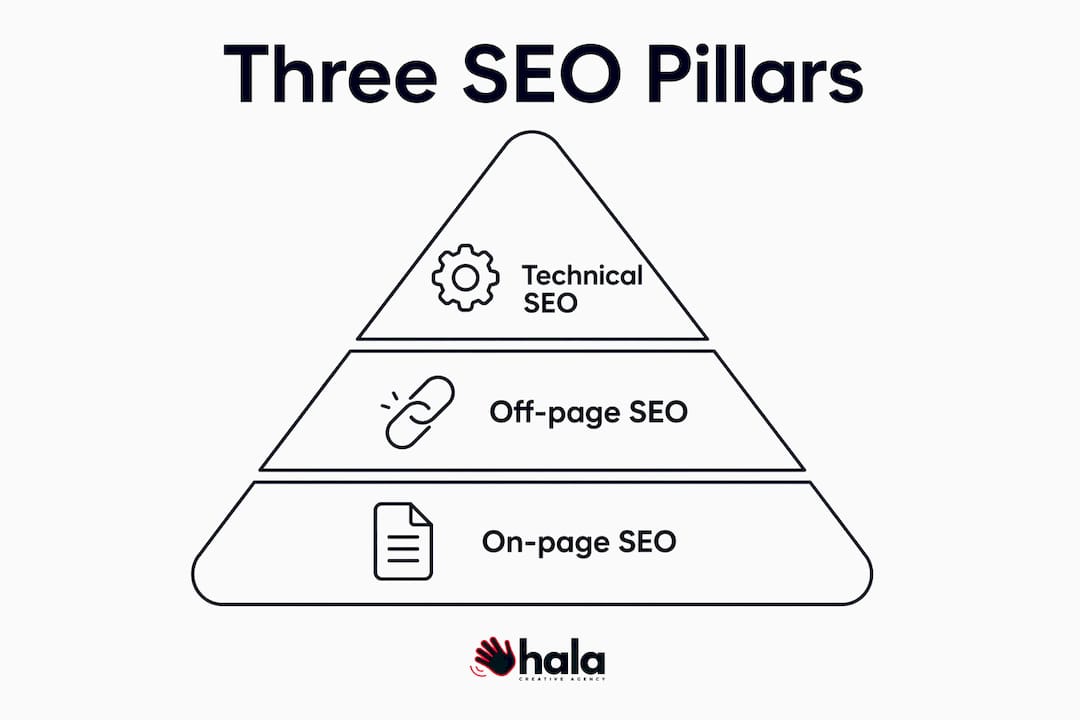
Semrush identifies three core areas of SEO that every small business owner needs to understand: technical SEO, on-page SEO, and off-page SEO. Think of them as the foundation, the interior, and the reputation of your business.
Technical SEO is about making sure search engines can actually access and read your site. The most common issues for small business websites include:
- Slow page load times (anything over 3 seconds loses users fast)
- Not being mobile-friendly, which is critical since most searches now happen on phones
- Broken links or pages that return errors
- Missing or duplicate page titles
On-page SEO covers everything on the actual pages of your site. This includes using the right keywords in your page titles, headers, and body content, writing clear meta descriptions, and making sure each page covers one topic well. The goal is to match what customers are searching for with content that genuinely answers their questions.
Off-page SEO is about credibility. Google treats backlinks, which are links from other websites pointing to yours, as votes of trust. The more relevant and reputable sites that link to you, the more authority your site carries. Focus on ethical link building through local directories, partnerships, and earned press coverage rather than buying links in bulk.
Pro Tip: Don’t try to fix everything at once. Audit your site for the biggest technical issues first, then move to content, then links. One solid improvement at a time beats a scattered approach every time.
Local SEO: the fastest win for most small businesses
If your business serves customers in a specific city or neighborhood, local SEO is where you will see results the fastest. Local SEO differs from general SEO in one key way: it is designed to surface your business when someone nearby is actively looking to buy.
Your Google Business Profile (GBP) is the single most powerful local SEO asset you have. GBP’s primary category selection is the most influential factor in local search rankings. Businesses that fill out every field, including categories, hours, photos, and a business description, get significantly more search interactions than those with incomplete profiles.
Here is a practical checklist to optimize your GBP:
- Claim and verify your Google Business Profile if you have not already
- Select the most accurate primary category for your business
- Add at least 10 high-quality photos showing your space, products, or team
- Write a 250-word business description using your core service keywords naturally
- Set up regular posts (weekly if possible) to show Google your profile is active
- Respond to every review, both positive and negative, within 48 hours
NAP consistency means your business name, address, and phone number should appear exactly the same across every online directory: Google, Yelp, Apple Maps, Facebook, and any local listings. Even small variations like “St.” versus “Street” can confuse search engines and hurt your rankings.
Pro Tip: Search your business name on Google and audit every listing you find. Fix inconsistencies one by one, starting with the highest-traffic platforms.
Here is a quick comparison to clarify how local SEO differs from general SEO:
| Factor | General SEO | Local SEO |
|---|---|---|
| Target audience | Anyone, anywhere | People in a specific area |
| Key ranking signals | Content quality, backlinks | GBP, NAP, reviews, proximity |
| Primary tool | Your website | Google Business Profile |
| Result type | Organic blue links | Map Pack + local results |
Local SEO best practices built on your GBP, consistent directory listings, and active review management are non-negotiable if you want to compete for foot traffic and local service queries in markets like Dubai.
How long SEO actually takes
This is where most small business owners get frustrated. They put in work for two months, see no dramatic change, and assume SEO does not work. The reality is that SEO takes at least six months for small businesses to see meaningful results. That is not a bug in the system. It is how trust and authority are built.

Think of it like compound interest. The first few months of effort build a foundation: fixed technical issues, better content, a few backlinks. By month four or five, Google has crawled and re-evaluated your site multiple times. By month six and beyond, the improvements start stacking, and your rankings climb in ways that accelerate over time.
The mistakes that derail small business SEO efforts most often include:
- Stopping all activity after the first month of no visible results
- Making multiple large site changes at once and not being able to identify what helped
- Chasing high-volume keywords that large competitors already dominate instead of targeting specific, buyer-intent queries
- Publishing content once and never updating it, even as information becomes outdated
SEO results compound the longer you work at them. A page you optimize today and improve six months from now will almost always outperform a page you set and forget. Plan for at least 12 months of consistent effort before evaluating whether your SEO strategy is working or needs to shift.
Practical SEO strategies you can start today
You do not need to hire a specialist to get your SEO moving in the right direction. Here are specific, manageable actions that small business owners can take without a large technical background.
Start with keyword research. Free tools like Google Search Console and Google’s autocomplete feature reveal exactly what your customers are typing. Focus on keywords that combine a service with a location, like “web designer Dubai” or “catering company Abu Dhabi.” These are high-intent searches from people ready to spend money.
Optimize your page titles and headers. Every page on your site should have a unique title that includes the keyword you are targeting. Headers (H1, H2, H3) should reflect the structure of your content and naturally include related terms. Matching search intent in your page structure does more for your rankings than any trick or shortcut.
Auditing your existing content before creating new pages is a step most small businesses skip. Check which pages Google has already indexed, identify any thin or duplicate content, and create a plan for what each page should rank for. This gives your site coherent architecture instead of a collection of disconnected pages.
Pro Tip: Install Google Search Console for free and check the “Performance” report. It shows which search queries already bring visitors to your site. Optimize those pages first. You are already halfway there.
Here is a quick-reference table of free and low-cost SEO tools worth knowing:
| Tool | What it does | Cost |
|---|---|---|
| Google Search Console | Tracks rankings, clicks, and crawl issues | Free |
| Google Analytics | Monitors traffic and user behavior | Free |
| Ubersuggest | Keyword research and competitor analysis | Free tier available |
| PageSpeed Insights | Tests mobile and desktop load speeds | Free |
| Screaming Frog (lite) | Audits site structure and technical issues | Free up to 500 pages |
For a fuller picture of how SEO fits within your overall digital presence, Halacreative’s guide on digital marketing for Dubai businesses walks through how different channels work together to drive growth in the region.
My honest take on SEO for small businesses
I have worked with dozens of small business owners who came to us convinced that SEO was either magic or a scam. Neither is true, but I understand where both feelings come from.
The magic myth comes from watching a competitor appear at the top of Google and assuming they must have some secret weapon. What they usually have is consistency and patience. They published useful content, fixed their technical issues, asked for reviews, and did not give up after two months. That is it.
The scam myth comes from business owners who paid someone for SEO services, saw no results after 90 days, and felt burned. Quite often the problem was not SEO itself. It was either unrealistic expectations, a service provider focused on vanity metrics like generic traffic instead of actual leads, or shortcuts like buying cheap backlinks that eventually triggered a Google penalty.
What I have found actually works is simpler than most guides suggest. Start with what your customers are literally typing into Google. Build pages that directly answer those queries. Fix the technical issues that prevent your site from loading fast on mobile. Then get your GBP in order and start asking satisfied customers to leave reviews. That is 80% of what moves the needle for most small businesses.
The other 20%, things like advanced link building strategies and structured data, matters eventually. But I have seen business owners obsess over that 20% while completely neglecting the fundamentals. Do not make that mistake.
— Hisham
Ready to grow your search visibility?
Understanding SEO is one thing. Having a team execute it consistently while you run your business is another. At Halacreative, we work with Dubai and UAE small businesses to build SEO strategies that are grounded in real customer data, not guesswork. From technical site audits to Google Business Profile management and content planning, we handle the work that turns rankings into revenue.

If you are ready to stop leaving customers to your competitors and start showing up where buyers are searching, explore our marketing services for SMBs and find out what a focused SEO strategy could look like for your business. We have helped businesses across the region move from invisible to in-demand. Yours could be next.
FAQ
What is SEO for small business in simple terms?
SEO is the process of making your website more visible in search engine results so customers can find you without paid ads. It combines technical improvements, content quality, and online authority to earn higher rankings organically.
How long does it take for SEO to work for small businesses?
Most small businesses start seeing meaningful SEO results after six months of consistent effort. Results compound over time, so the businesses that stay consistent for 12 or more months tend to see the strongest returns.
What is the difference between local SEO and regular SEO?
Local SEO targets customers in a specific geographic area and relies heavily on your Google Business Profile, NAP consistency, and reviews. Regular SEO focuses on organic rankings for a broader audience through content and backlinks.
How do I start SEO for my small business with no budget?
Start with free tools like Google Search Console to find what searches already drive traffic to your site. Claim and complete your Google Business Profile, fix any technical errors on your website, and create content that directly answers the questions your customers are asking.
Is SEO worth it for a small business in Dubai?
Yes. In a market as competitive as Dubai, organic search visibility gives small businesses a cost-effective way to reach buyers who are actively looking for exactly what you offer, without paying for every click.