
TL;DR:
- Traditional SEO strategies are now outdated as AI-powered search tools favor structured, answer-focused content over ranked link lists. Small and medium-sized UAE businesses must adopt Generative Engine Optimization (GEO) techniques—creating direct, factual responses early in content—to ensure AI systems cite them as trusted sources. Implementing localized, answer-first content strategies, leveraging data-driven measures, and partnering with regional experts are essential for sustainable digital growth in 2026.
If you’ve been pouring budget into traditional SEO and wondering why your growth has plateaued, you’re not alone. Across Dubai and the wider UAE, small and medium-sized businesses are discovering that the rules of online visibility shifted dramatically in the past 18 months. AI-powered search tools now surface answers directly, bypassing the ranked link lists that SEO was built to conquer. The businesses that understand this shift early will capture significant market share. This guide breaks down exactly what you need to do, in plain language, with real steps you can action today.
Table of Contents
- Understanding the new digital marketing landscape in 2026
- How Generative Engine Optimization (GEO) reshapes visibility
- Core digital strategies UAE SMBs need in 2026
- Measuring and optimizing results: Data-driven decision making
- Why following trends isn’t enough: Lessons from the UAE market
- Partner with experts to accelerate your digital growth
- Frequently asked questions
Key Takeaways
| Point | Details |
|---|---|
| GEO is the new SEO | Appearing in AI-generated answers is now crucial for digital visibility. |
| Answer-first content wins | Directly addressing questions boosts your chances of being cited by AI. |
| Local adaptation matters | Tailoring strategies to UAE audiences delivers the best results. |
| Measure AI inclusion | Track how often your content appears in AI answers to refine strategy. |
Understanding the new digital marketing landscape in 2026
The digital marketing environment in 2026 looks nothing like it did three years ago. Traditional SEO was built on a simple premise: create pages, earn backlinks, and rank in search engine results. The higher you ranked, the more clicks you received. That model worked well when users clicked blue links. The problem is that millions of users now get their answers directly from AI tools like ChatGPT, Google’s AI Overviews, and Perplexity.
This is where Generative Engine Optimization, or GEO, enters the picture. GEO focuses on being cited in AI-generated answers, not just ranking as a blue link. Instead of asking “how do I rank on page one?”, you now need to ask “how does an AI decide to cite my business as a trusted source?” That is a fundamentally different challenge, and it requires a fundamentally different strategy.
Structured data and schema markup (code that tells search engines exactly what your content means) have also become critical. When AI systems pull answers together, they favor content that is clearly structured, factually accurate, and written for human readers rather than keyword algorithms. The AI marketing benefits for UAE businesses are real and measurable, but only for those who adapt quickly.
| Marketing approach | Traditional SEO | GEO in 2026 |
|---|---|---|
| Primary goal | Rank in search results | Be cited in AI-generated answers |
| Content format | Keyword-optimized pages | Answer-first, structured responses |
| Success metric | Keyword rankings, click-through rates | Citation frequency in AI outputs |
| Technical focus | Backlinks and meta tags | Schema markup, factual accuracy |
| Audience behavior | User clicks links | User reads AI-generated summaries |
“The shift from SEO to GEO is not incremental. It is a structural change in how information surfaces online. Businesses that treat GEO as optional are effectively choosing to become invisible to AI-assisted searchers.”
For UAE SMBs, the urgency is amplified by the region’s exceptionally high smartphone penetration and the rapid adoption of AI tools among younger, affluent consumers in Dubai and Abu Dhabi. Your competition is already moving. The question is whether you move faster.
How Generative Engine Optimization (GEO) reshapes visibility
GEO is not a replacement for SEO. Think of it as a layer that sits on top of your existing digital strategy. Where SEO earns you a spot in a list, GEO earns you a voice in a conversation. AI systems read your content, evaluate its accuracy, assess its authority, and decide whether to quote it when answering a user’s question. If your content passes that test, you get cited. If it doesn’t, you’re invisible to that growing segment of search traffic.
The core mechanic is straightforward. Directly answering queries in your content increases your chances of being cited by AI systems. This means leading with the answer, then providing supporting context. A restaurant in Dubai JBR asking “how do I attract more families?” should not bury the answer in paragraph six. The answer should appear in the first two sentences.
Here’s a practical comparison between how a typical business page reads versus a GEO-optimized page:
| Element | Typical page | GEO-optimized page |
|---|---|---|
| Opening | Background about the company | Direct answer to a common customer question |
| Structure | Long paragraphs with keywords | Short sections with clear subheadings |
| Language | Promotional, brand-focused | Informative, user-focused |
| Data use | Generic claims (“best in the region”) | Specific, verifiable facts and figures |
| Authority signals | Client logos | Expert quotes, citations, verified data |
For UAE businesses, this means auditing your existing content and restructuring it. A page about your HVAC services in Dubai should open with: “A central air conditioning system in a Dubai apartment requires servicing every six months because of the high particulate levels from desert dust.” That is answerable, specific, and local. An AI system will cite that. A generic “we offer the best AC services” will not get cited by anyone, human or machine.
Pro Tip: Run your top five website pages through a simple test. Ask ChatGPT a question your customer would ask, then see if your content would logically appear in that answer. If the answer is no, rewrite the opening paragraph to front-load a specific, factual response.
Updating your approach to traditional SEO doesn’t mean abandoning it. It means adding a GEO layer: direct answers, structured headings, local context, and verified data.
Core digital strategies UAE SMBs need in 2026
With a clear understanding of GEO, the next step is building the practical strategy stack that drives real growth for UAE businesses. The following tactics are not theoretical. They are the approaches that are generating measurable results for SMBs in competitive Dubai markets right now.
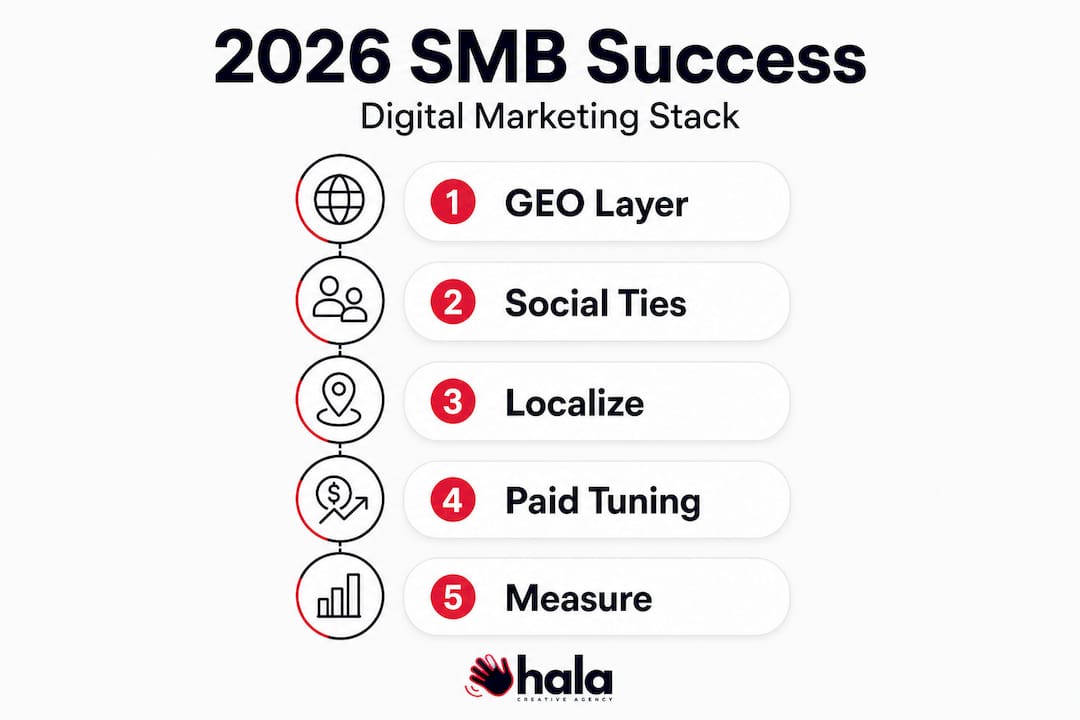
Shifting to GEO means using answer-first content to drive citation density and win inclusion in AI summaries. Here’s how that translates into daily marketing activity:
Content strategy:
- Write FAQ-format blog posts built around the exact questions your customers type into AI tools
- Publish “how-to” content specific to UAE regulations, culture, and consumer behavior
- Create comparison pages (e.g., “Renting vs. buying a co-working space in Dubai in 2026”) that AI tools love to summarize
- Update your Google Business Profile with current, specific information including hours, services, and recent photos
- Develop short-form video content on Instagram Reels and TikTok that answers common questions in under 60 seconds
Social and influencer partnerships:
Working with micro-influencers (5,000 to 50,000 followers) in the UAE delivers stronger engagement than big-name celebrity deals for most SMBs. A fitness studio in Jumeirah partnering with three local wellness creators will consistently outperform a single campaign with a major influencer whose audience spans multiple countries. The digital engagement strategies that consistently work in this market are built on community trust, not reach numbers alone.
Localization is not optional. UAE consumers, particularly in Dubai, engage with content that reflects their daily reality. Use Arabic phrases in captions even if the primary language is English. Reference local events, neighborhoods, and cultural moments. A post tied to DSF (Dubai Shopping Festival) or National Day will always outperform a generic promotional post.
Paid advertising adjustments:
Meta and Google ads remain powerful tools, but bidding strategies must now account for the fact that top-of-funnel awareness often happens through AI search, not paid clicks. Shift a portion of your ad budget toward retargeting users who have already discovered your brand through organic or AI channels. Real-world marketing examples from the Middle East show that this two-stage approach, organic or AI discovery followed by targeted paid retargeting, dramatically reduces cost per acquisition.
Pro Tip: Build a simple content calendar with at least two “answer-first” pieces per week. Each piece should target one specific question your ideal customer is asking right now. Over 90 days, this builds a library of citable content that AI systems will start referencing in answers.
For businesses at the beginning of this journey, a structured digital marketing guide for Dubai SMEs can help prioritize which tactics to implement first based on your sector and budget.
Measuring and optimizing results: Data-driven decision making
Strategy without measurement is guesswork. UAE SMBs that are winning in 2026 are not just running campaigns. They are running experiments with clear hypotheses, defined KPIs (Key Performance Indicators, which are specific metrics that tell you if a campaign is working), and rapid adjustment cycles.
Here is a step-by-step measurement framework for a typical UAE SMB:
- Set your GEO baseline. Manually test 10 to 15 questions your customers commonly ask in ChatGPT, Google AI Overviews, and Perplexity. Document whether your content appears. This is your starting point.
- Track organic traffic by page. Use Google Analytics 4 or a similar tool to identify which pages are driving traffic. Cross-reference with your GEO tests to see if cited pages perform differently.
- Monitor engagement depth. Average session duration, scroll depth, and return visits all signal whether your content satisfies intent. If users leave in under 30 seconds, the page is not answering their question.
- Measure conversion by channel. Break down conversions (leads, purchases, bookings) by traffic source. This tells you whether your GEO and content efforts are generating real business outcomes.
- Iterate monthly. GEO campaigns thrive by tracking content inclusion in AI answers and adjusting strategies for higher citation density. Set a monthly review where you update the weakest-performing pages with improved answers.
Statistic to note: Businesses that run structured measurement and optimization cycles on a monthly basis see 3 to 4 times better ROI from their digital marketing budgets compared to those that set campaigns and leave them running without adjustment.
A practical starting point for UAE SMBs is a clear digital marketing checklist that covers every channel from GEO content to paid social. Having a reference document prevents the common mistake of optimizing one channel while ignoring others, which creates gaps that competitors exploit.
The data-driven mindset also applies to budget allocation. If your analytics show that 70% of your leads come from organic search and GEO citations, and only 15% from paid ads, that’s a signal to rebalance. Many UAE SMBs continue spending heavily on channels because “that’s what we’ve always done,” while the data clearly points toward better-performing alternatives.
Why following trends isn’t enough: Lessons from the UAE market
Here’s an uncomfortable truth we’ve observed working with businesses across Dubai and the broader UAE: copying a trend without understanding your market is one of the fastest ways to waste your marketing budget.
GEO is a real shift. The data supports it. But we’ve seen businesses pivot entirely to GEO-focused content while abandoning the WhatsApp-based customer relationships that were actually driving 60% of their repeat business. The trend was real. The blind adoption was the mistake.
The UAE market has specific characteristics that imported strategies often miss. Consumers here are among the most digitally active in the world, but trust is earned through personal recommendation and community endorsement more than through algorithmic visibility. A Google AI Overview citing your business builds awareness. A recommendation from a trusted community group or local influencer closes the sale.
GEO is about earning trust from AI as a source, not chasing algorithm tweaks. That framing matters enormously in the UAE context, because trust, whether from an AI system or a human network, is built the same way: through consistent, accurate, genuinely useful information delivered over time.
The businesses we’ve seen thrive are not the ones who implemented every new tactic. They are the ones who identified the two or three strategies that aligned with their customers’ actual behavior and executed those strategies with discipline. The AI marketing wisdom worth internalizing is this: technology accelerates what is already working. It does not fix a strategy that was misaligned from the start.
Hyper-local adaptation will always outperform imported trends in this market. Build authoritative content that reflects the reality of your UAE customers’ lives, and the algorithms, whether traditional or AI-powered, will follow.
Partner with experts to accelerate your digital growth
Navigating GEO, structured content, analytics cycles, and localized social strategy simultaneously is a significant operational load for any SMB team. Most businesses have the ambition but not the bandwidth to execute all of it at once.

Hala Creative Agency works specifically with UAE and Dubai-based SMBs to build and implement digital strategies that combine GEO-readiness, brand authority, and measurable growth. From Middle East marketing examples that show what works in your specific sector, to understanding how branding agency expertise drives real business results, our team brings both regional knowledge and data-driven frameworks to every engagement. Whether you need help structuring your content for AI citation or building a full social media marketing strategy for your business, we build solutions that match where your customers actually are.
Frequently asked questions
What is the main difference between GEO and traditional SEO?
GEO focuses on being cited as a trusted source in AI-generated answers, while SEO aims to rank websites in traditional search results. As GEO targets citation in AI answers rather than ranked lists, the content strategy, structure, and success metrics are fundamentally different.
How can small businesses in the UAE increase their chances of being cited in AI-generated answers?
Structure your content to provide direct, specific answers at the very start of each page or section, and focus on factual accuracy and local relevance. Front-loading direct answers significantly boosts your citation rates in AI-generated responses.
What KPIs should I track for digital marketing success in 2026?
Track your inclusion frequency in AI answers, web traffic growth by channel, engagement depth (scroll depth and session duration), and conversion rates broken down by source. Measuring GEO impact through citation tracking and adjusting for higher density is the key to ongoing improvement.
Are traditional social media and influencer marketing still relevant?
Yes, both remain highly effective, especially in the UAE, but they work best when the content they promote is built on direct answers and factual authority rather than purely promotional messaging. Content accuracy and trust are now the core drivers of visibility across every digital channel.