
TL;DR:
- Most Dubai SMBs focus on logos and visuals, neglecting the deeper, experiential elements of brand identity. True brand identity encompasses visual, verbal, customer experience, values, and digital presence, shaping customer perceptions across all touchpoints. Consistently activating these layers operationalizes brand trust and facilitates sustainable growth in a competitive digital market.
Most business owners in Dubai have spent real money on a logo, picked their brand colors, and called it done. That instinct is understandable, but it leaves serious growth on the table. True brand identity goes far deeper than any visual element, and in a crowded, fast-moving market like Dubai, the businesses that grow are the ones that understand this difference. This guide will show you exactly what brand identity means, how to build it with proven frameworks, and how to activate it across digital channels to drive measurable results for your business.
Table of Contents
- What is brand identity? More than just a logo
- The pillars of brand identity: Visual, verbal, and beyond
- Frameworks for building your brand identity: The Aaker model
- Common pitfalls: Why “logo-only” thinking holds you back
- How to activate your brand identity for digital growth in Dubai
- Our take: The overlooked power of everyday brand moments
- Need help taking your brand identity further?
- Frequently asked questions
Key Takeaways
| Point | Details |
|---|---|
| Brand identity scope | Brand identity combines visuals, messaging, and experience—not just a logo. |
| Consistency is power | Consistency across all channels strengthens recognition and trust for Dubai SMBs. |
| Strategic frameworks matter | Proven models like the Aaker system make defining and activating your identity manageable. |
| Common pitfall | Focusing only on design elements limits growth; experience and messaging are equally critical. |
| Action drives results | Applying your brand identity daily across digital platforms fuels engagement and business growth. |
What is brand identity? More than just a logo
The most common misconception we see with Dubai SMBs is simple: they treat brand identity as a design project. You get a logo, maybe a color palette, and a business card template. Then you move on. The problem is that customers do not experience your brand through a logo. They experience it through a social media reply at 9 PM, a confusing checkout page, a warm greeting from your team, or an email that sounds nothing like your Instagram bio.
According to Investopedia, brand identity is the complete set of visible and experiential elements that represent a business, including how customers perceive it across every interaction. That definition matters because it shifts the entire conversation from “what does our brand look like” to “what does our brand feel like and how does it behave.”
“Brand identity is not a logo. It is every signal your business sends to the world, across every channel, every day.”
When businesses limit their thinking to visuals, they miss the entire experiential layer. And in Dubai, where consumers are sophisticated, internationally exposed, and quick to switch loyalties, that missed layer costs you customers directly. Here is what brand identity actually includes:
- Visual identity: Logo, color palette, typography, photography style, and graphic design elements
- Verbal identity: Your brand name, tagline, tone of voice, and how you write everything from ads to customer service replies
- Customer experience: Every touchpoint from first discovery to post-purchase support
- Brand values and personality: What you stand for, how you behave, and why customers should trust you
- Digital presence: How consistently all of the above come together on your website, social channels, and paid advertising
Building a strong digital identity for Middle East SMBs requires treating all of these layers as one interconnected system, not separate projects managed by different people.
The pillars of brand identity: Visual, verbal, and beyond
Now that we have established that brand identity is broader than design, it helps to understand each pillar in concrete terms. Many expert frameworks confirm this approach. Brand-building frameworks from HBS Online describe brand identity as strategy translated into consistent visuals, messaging, and customer experiences across all channels. Each pillar plays a specific role.
Visual identity is the most recognizable layer. It is what people see on your packaging, your store signage, your Instagram grid, and your website header. Consistency here is non-negotiable. If your Instagram uses warm, earthy tones but your website looks cold and corporate, customers register that disconnect subconsciously, even if they cannot name it.
Verbal identity is often neglected. This includes the actual words you use, the personality behind your copy, your taglines, and the tone across every written or spoken communication. A luxury real estate brand in Dubai needs formal, aspirational language. A casual food delivery startup needs something more relaxed and energetic. Getting this right means customers feel the same “presence” whether they read your SMS notification or your LinkedIn post.

Customer and digital experience is the pillar that most businesses ignore completely. It is also the most impactful. Every step a customer takes when interacting with your brand, from finding your Google listing to loading your website to waiting for a support response, shapes their overall impression of who you are.
| Brand identity pillar | What it includes | Why it matters |
|---|---|---|
| Visual identity | Logo, colors, typography, imagery | First impressions and recognition |
| Verbal identity | Tone, taglines, messaging, copy | Emotional connection and clarity |
| Customer experience | Website UX, service quality, speed | Trust and repeat business |
| Brand values | Purpose, culture, positioning | Long-term loyalty and differentiation |
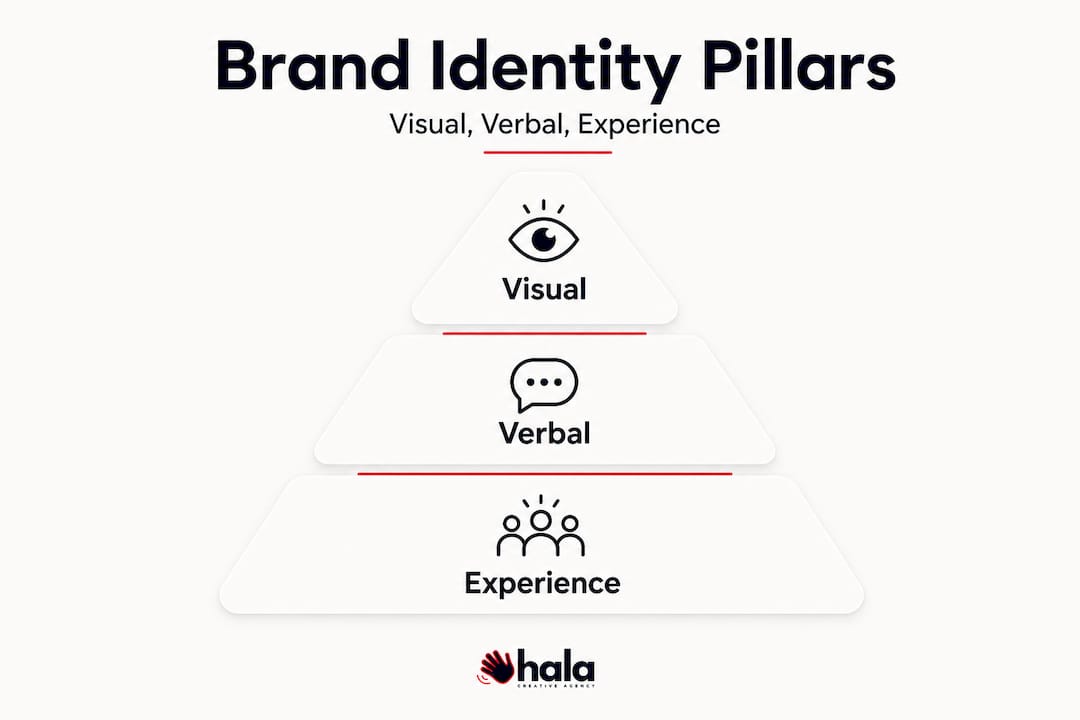
Developing a consistent brand voice for your Dubai business is one of the highest-leverage things you can do because it influences every other pillar. When your tone is clear, content creation becomes faster, messaging stays consistent, and customers start recognizing you by how you sound, not just how you look.
Pro Tip: Audit one week of your customer-facing communications, including emails, social posts, and website copy. Check whether they all sound like the same brand. If they do not, your verbal identity needs attention before anything else.
Here is a practical sequence to build all three pillars in order:
- Define your brand values and positioning first
- Build your visual identity to reflect those values
- Establish your verbal identity with documented tone-of-voice guidelines
- Map every customer touchpoint and apply both visual and verbal guidelines
- Review your digital experience against your brand promise regularly
Following a clear branding workflow for Dubai SMBs removes the guesswork from this process entirely.
Frameworks for building your brand identity: The Aaker model
Frameworks turn abstract ideas into actionable plans. One of the most respected in the industry is the Aaker Brand Identity System, developed by marketing professor David Aaker. This framework is especially useful for SMBs because it forces you to think about brand identity at multiple levels, not just the surface.
The Aaker Brand Identity Model separates identity into two layers: core identity and extended identity. Core identity includes the elements that remain constant no matter how the brand evolves, your values, your unique purpose, what you fundamentally stand for. Extended identity includes the elements that can flex over time, like sub-brands, product-specific messaging, or campaign themes.
| Layer | What it covers | Flexibility |
|---|---|---|
| Core identity | Brand values, purpose, key differentiator | Fixed. Should never change. |
| Extended identity | Taglines, campaigns, personality facets | Can evolve with market or audience shifts |
| Value proposition | Functional, emotional, and self-expressive benefits | Informed by core, adjusted by research |
For a Dubai SMB, here is why this matters practically. Many businesses rebrand every few years because they never established what the core is. They update logos and websites but skip the foundational work of defining what they stand for. Then, every new campaign feels disconnected from the last one, and customers cannot build a clear mental picture of who you are.
The Aaker model also connects your identity to your value proposition, the specific bundle of benefits you offer to customers. This is where brand identity meets business strategy. When your identity is clear, pricing decisions, partnership choices, and content strategy all become more straightforward because you have a clear internal compass.
Pro Tip: Write your core identity on a single card. It should answer three questions: What do we do? Who do we do it for? What do we stand for that others do not? If your team cannot answer all three consistently, your core identity needs more work.
Understanding the advantages a branding agency brings in Dubai can make a significant difference when you are trying to apply frameworks like this without losing momentum in your day-to-day operations.
Common pitfalls: Why “logo-only” thinking holds you back
Even after reading about all these layers, many business owners still default to design-first thinking. It is familiar, it is tangible, and it produces something you can physically show. But the risk is real. Treating brand identity as only design almost always underperforms, because customers experience your brand through messaging, service, and behavior just as much as they do through visuals.
Here are the most common pitfalls we see Dubai SMBs fall into:
- Inconsistent messaging across platforms: Your Instagram sounds fun and approachable, but your website reads like a corporate manual from 2005. Customers notice the mismatch, even if they do not say so.
- Neglecting the post-sale experience: Most brand investment goes into acquisition. But the experience after someone becomes a customer, how you handle problems, how you follow up, how you reward loyalty, shapes whether they come back or recommend you.
- Ignoring digital touchpoints: A beautiful logo means nothing if your website loads slowly, looks broken on mobile, or has a confusing navigation structure. The website is your brand in action.
- No documented brand guidelines: Without a documented style guide, every new team member, freelancer, or agency interprets your brand differently. The result is fragmentation.
- Chasing trends over identity: Dubai’s market moves fast. Businesses that copy trending aesthetics without grounding them in a clear identity end up looking inconsistent after every campaign cycle.
“Your brand is not what you say it is. It is what customers experience when they interact with you, and that experience extends far beyond what any design file can capture.”
Solid web development for brand impact is one practical area where many Dubai businesses can close the gap between their visual identity and their actual digital experience. Similarly, ensuring that creative advertising for Dubai SMBs reflects a unified brand voice rather than a one-off campaign idea makes each advertising effort compound over time.
How to activate your brand identity for digital growth in Dubai
Having a defined brand identity is only valuable if you put it to work. Activation means taking everything you have defined and making it consistently present across every digital channel your customers use.
Here is a proven sequence for activating brand identity in the Dubai market:
- Audit your current digital presence. Review your website, social channels, Google Business profile, and any paid ads. Do they all look and sound like the same brand? Document every inconsistency you find.
- Create a brand style guide. This document should cover your logo usage rules, color codes, typography choices, tone-of-voice examples, and messaging templates. Make it accessible to everyone on your team.
- Update your website first. Your website is the anchor of your digital presence. It is where most brand decisions get tested. Make sure it reflects your current identity in both visual and verbal dimensions.
- Align your social media content strategy. Each platform has a different tone, but your core identity should be recognizable across all of them. Establish content pillars that reflect your brand values, not just promotional messages.
- Train your team. Brand identity is not a marketing department issue. Every person who interacts with a customer, including your sales team, your customer service staff, and even your delivery partners, represents your brand in practice.
- Measure and adjust. Track engagement rates, customer feedback, and conversion data across platforms. If certain brand touchpoints consistently underperform, revisit whether they are aligned with your identity.
The HBS framework reinforces that real brand-building happens when strategy translates into consistent visuals, messaging, and experiences across every channel, not just in one well-designed campaign. Leveraging the advantages of social media marketing for Dubai SMEs becomes far more powerful when your brand identity is solid enough to give every post a recognizable personality.
Pro Tip: Pick one platform where your target audience is most active and use it as your brand identity testing ground for 30 days. Post with consistent tone, visuals, and messaging. Review the engagement data. You will quickly learn which brand signals resonate most with your specific audience.
Our take: The overlooked power of everyday brand moments
Here is something most brand guides will not tell you. The high-concept work, the brand strategy decks, the mood boards, the positioning workshops, none of it matters as much as what happens in your everyday brand moments. The WhatsApp reply that takes three hours. The invoice that has a different font from your website. The social media comment you ignored. These micro-interactions are your brand in practice, and they tell customers far more than any professionally designed asset ever could.
We have seen Dubai businesses spend six figures on a rebrand and then quietly undo all of it within two months because the team was not aligned on how to behave. The new logo launched beautifully. The brand voice document sat unread in a Google Drive folder. Customer service kept operating the same way it always had. Within a few weeks, the “rebrand” was invisible, because brand identity is not a campaign. It is a daily habit.
The businesses that build enduring brands in this market are the ones that treat brand consistency as an operational discipline, not a creative one. It means holding your team accountable to tone-of-voice guidelines during customer service training. It means reviewing your digital channels monthly to catch drift before it becomes a full-scale inconsistency. It means making brand decisions from a position of values, not just aesthetic preference. The creativity in digital campaigns that actually converts comes from brands with this kind of internal coherence.
If you are serious about growth, the most valuable thing you can do this month is not commission a new design. It is to map every touchpoint in your customer journey and ask honestly: does this reflect who we say we are? A structured branding workflow for Dubai SMBs gives you the exact process to do this systematically.
Need help taking your brand identity further?
Building brand identity is strategic work that compounds over time, and doing it right the first time saves you from expensive corrections later.
At Hala Creative Agency, we help Dubai SMBs define, build, and activate brand identities that perform across every digital channel. Whether you are starting from scratch or need to realign a brand that has drifted, we bring together the strategic frameworks and creative execution to get you there faster. Explore our resources on creative branding for Middle East SMBs, or use our digital marketing guide for Dubai SMEs to map out your next move. When you are ready for a partner who knows the Dubai market, our branding agency for Dubai growth approach is built specifically for businesses like yours.
Frequently asked questions
What are the main components of brand identity?
The main components are visual identity, verbal identity (messaging and tone), and the overall customer experience. Expert frameworks treat brand identity as strategy expressed through all three consistently across every channel.
How is brand identity different from brand image?
Brand identity is how you intentionally present your business to the world; brand image is how customers actually perceive you based on all their experiences. Investopedia defines brand identity as the full set of visible and experiential elements that shape customer perception.
How can a small Dubai business improve its brand identity?
Start by defining a clear value proposition, then document your visual and verbal guidelines and apply them consistently across all platforms. Consistent brand frameworks show that the gap between strategy and execution is usually the biggest barrier for growing businesses.
Why is just focusing on a logo not enough for brand identity?
Customers form opinions through every interaction, not just what they see. Treating identity as only design reliably underperforms because service quality, messaging tone, and channel behavior carry as much weight as your visual assets.
Is brand identity important for digital marketing success?
Absolutely. A unified brand identity gives every piece of digital content a consistent personality, which builds recognition and trust faster. Consistent brand-building across visuals, messaging, and experience is what separates brands that grow from brands that get lost in the noise.