
TL;DR:
- A digital advertising workflow for real estate integrates ad platforms, CRM, middleware, and lead capture to convert inquiries efficiently.
- In the UAE, rapid response via WhatsApp is vital, and automation ensures leads are qualified and routed instantly for better conversion.
A digital advertising workflow for real estate is the coordinated system of ad creation, lead capture, CRM integration, and follow-up automation that determines how fast and how well you convert property inquiries into closed deals. In the UAE market, where buyers expect instant responses and WhatsApp is the default communication channel, a poorly connected workflow costs you leads every single day. Platforms like Meta Lead Ads and Google Ads generate volume, but without automation connecting them to your CRM and sales team, that volume becomes noise. This article breaks down every layer of an effective workflow, from tool selection to attribution, with specific guidance for Dubai and UAE agents.
What are the essential tools for a real estate digital advertising workflow?
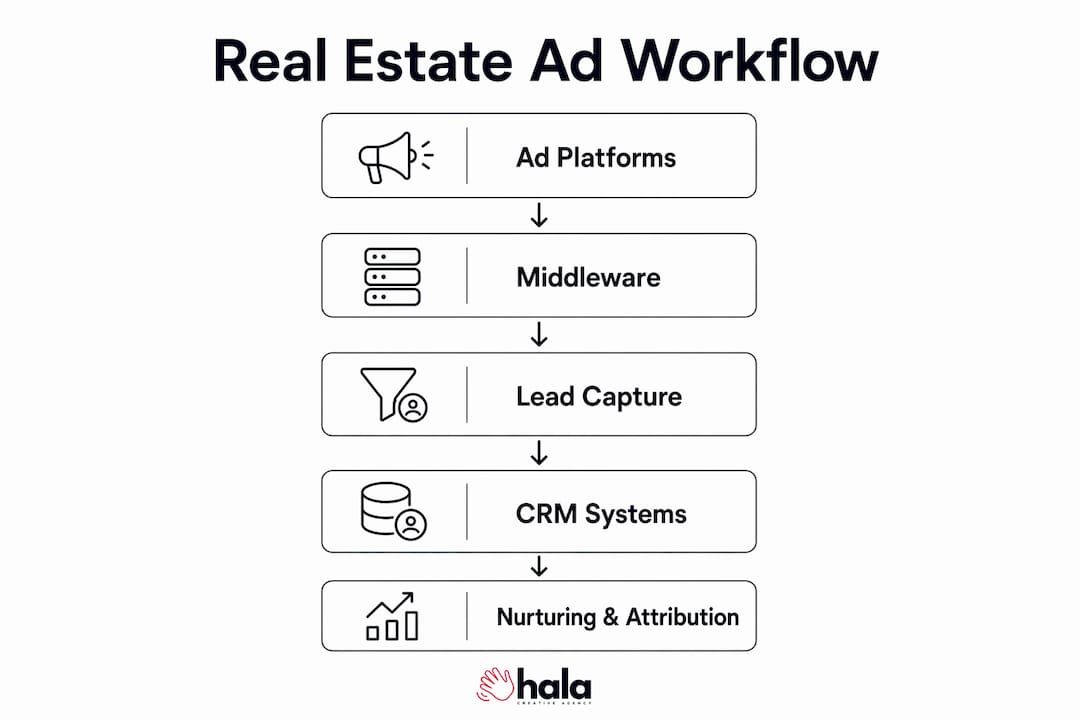
The foundation of any real estate advertising workflow rests on four tool categories: ad platforms, CRM systems, middleware, and lead capture interfaces. Getting these four layers connected correctly is what separates agents who chase leads manually from those who close deals while the system runs itself.

Ad platforms are your traffic source. Meta Lead Ads and Google Ads are the two primary channels for UAE real estate. Meta Lead Ads capture interest directly inside Facebook and Instagram without requiring a landing page visit, which reduces friction and increases volume. Google Ads captures buyers with active purchase intent, making the leads fewer but often warmer.
CRM systems are your lead database and sales pipeline. Salesforce and HubSpot both offer native Meta integrations that pull lead form submissions directly into contact records without manual CSV downloads. For smaller agencies, HubSpot’s free tier with a Meta connection is a practical starting point before investing in Salesforce.
Middleware tools sit between your ad platforms and CRM to apply logic before a lead enters your pipeline. Make, Zapier, and n8n each serve this function. Make and n8n are particularly strong for conditional routing because they support multi-step logic without requiring code. You can filter leads by budget range, property type preference, or timeline before they ever reach a sales rep.
Lead capture interfaces are the forms or quizzes that collect buyer information. Standard Meta Instant Forms work, but interactive tools add qualification depth. GD LeadFlow, built specifically for the Dubai market, routes leads to WhatsApp instantly and supports ten languages, which matters in a city where buyers arrive from dozens of countries.
| Tool category | Primary function | UAE-relevant examples |
|---|---|---|
| Ad platforms | Traffic and lead generation | Meta Lead Ads, Google Ads |
| CRM systems | Lead storage and pipeline management | HubSpot, Salesforce |
| Middleware | Filtering, routing, and enrichment | Make, Zapier, n8n |
| Lead capture | Qualification at point of contact | GD LeadFlow, Meta Instant Forms |
How to set up real-time lead capture and qualification
Speed-to-lead is the single most important variable in UAE real estate conversion. A buyer who submits a form at 11 PM and receives a WhatsApp message within two minutes is far more likely to book a viewing than one who gets a call the next morning.
The first configuration decision is your Meta Instant Form type. Meta offers two options: More Volume and Higher Intent. More Volume forms are pre-filled with Facebook profile data and submit with one tap, maximizing quantity. Higher Intent forms add a review screen and an optional open-ended question, which reduces volume but improves quality. For luxury properties above AED 2 million, Higher Intent forms consistently produce better-qualified contacts.
Setting up real-time delivery requires either a native CRM integration or a webhook. Meta’s Leads API delivers submissions in seconds via webhooks, which means your CRM or middleware receives the data almost instantly after a form is submitted. Native integrations inside HubSpot or Salesforce handle this without custom code. Webhook-based delivery through Make or n8n gives you more control over what happens to the data before it reaches your CRM.
Once the data arrives at your middleware layer, apply three filters before creating a CRM record:
- Budget verification. If the form asks for budget range, only create a record if the answer meets your minimum threshold. A lead stating a AED 300,000 budget for a property listed at AED 1.5 million wastes your team’s time.
- Timeline check. Leads with a purchase timeline beyond 12 months can be tagged for long-term nurture rather than immediate follow-up, keeping your active pipeline clean.
- Deduplication. Check whether the phone number or email already exists in your CRM before creating a duplicate record. Make and n8n both support lookup steps for this.
After passing these filters, middleware routes high-value leads to an immediate WhatsApp notification for your sales team, while lower-priority leads enter an automated email sequence.
Pro Tip: Set up a separate pipeline stage in your CRM called “Pending Qualification” for leads that pass budget filters but haven’t confirmed timeline. This prevents them from cluttering your active pipeline while keeping them visible for weekly review.
How to automate ad creation and management at scale
Managing ads for a real estate portfolio manually breaks down the moment you have more than 20 active listings. A property that sells while its ad is still running wastes budget and damages your brand. Automation at the campaign level requires a specific architecture.
The core of this architecture is a staging database that acts as your single source of truth for all listing data. Every property record in this database carries its current status (active, under offer, sold), its key attributes (location, price, type, photos), and the corresponding ad platform IDs generated when the campaign was created. Storing platform entity IDs such as campaign_id, ad_group_id, and ad_id in this database is what makes safe, repeatable lifecycle management possible.
When a new listing is added to your database, the automation triggers a sequential API workflow:
- Create the campaign and store the returned campaign_id.
- Create the ad group or ad set within that campaign and store the ad_group_id.
- Upload the creative assets and create the ad, storing the ad_id.
- Set the campaign to active and log the timestamp.
When a property status changes to “sold” or “under offer,” the same database record triggers a pause or deactivation call to the ad platform using the stored IDs. This prevents the common and costly mistake of running ads for properties that are no longer available.
Just-listed campaigns should publish across Facebook, Instagram, and email within 48 hours of listing to capture peak buyer attention. Automating this timing through your staging database and a scheduling layer in Make or n8n removes the dependency on a team member remembering to push the campaign live.
Pro Tip: Normalize all listing data before it enters your staging database. Standardize price formats, trim whitespace from addresses, and resize images to platform specifications. Inconsistent data is the most common cause of failed API calls in automated ad creation systems.
What are best practices for lead nurturing and attribution?
Capturing a lead is step one. Attributing that lead to the correct campaign and nurturing it to a closed deal is where most UAE real estate teams lose money and momentum.
Lead nurturing strategy should differ based on where the lead originated. Meta leads often require email nurture sequences before a direct sales call, because the buyer was browsing passively rather than actively searching. Website form leads, particularly those who requested a callback or property brochure, warrant an immediate phone call or WhatsApp message. Treating both lead types with the same follow-up sequence is one of the most common and fixable mistakes in real estate digital marketing.
For Google Ads attribution, the GCLID (Google Click Identifier) is your most important data point. Capture it at the landing page level and store it in your CRM alongside the lead record. When that lead converts to a sale, Google Ads offline conversion imports link the closed deal back to the original keyword and campaign, feeding that signal into Smart Bidding. This means Google’s algorithm learns which searches produce actual buyers, not just form fills, and adjusts your bids accordingly over time.
CRM attribution for Meta campaigns requires storing the campaign name, ad set name, and ad name on every lead record at the point of capture. Without this, you cannot determine which creative or audience produced your best leads. Most native integrations pass this data automatically, but webhook-based setups require you to map these fields explicitly.
- Assign lifecycle stages at the integration layer, not manually. Use “New Lead,” “Contacted,” “Qualified,” and “Opportunity” as minimum stages.
- Score leads based on budget, timeline, and property type match. High-scoring leads trigger immediate sales notifications through your middleware.
- Review attribution data weekly. If one ad set consistently produces leads that never progress past “Contacted,” pause it and reallocate budget.
- Addressing integration pitfalls such as wrong field mapping and missing campaign attribution has produced a six-fold increase in marketing qualified leads in documented case studies.
The SEO and digital strategy layer also feeds into attribution. Organic leads from search often have higher intent than paid leads and should be tracked separately in your CRM to give you an accurate picture of total cost per acquisition across channels.
Key takeaways
A well-built digital advertising workflow for real estate connects ad platforms, CRM systems, and middleware into a single automated pipeline that captures, qualifies, and routes leads without manual intervention.
| Point | Details |
|---|---|
| Use middleware for quality control | Apply budget and timeline filters before leads enter your CRM to keep your pipeline clean. |
| Store ad platform IDs in a staging database | Tracking campaign_id and ad_id enables safe automated updates and deactivation when properties sell. |
| Differentiate nurture by lead source | Meta leads need email sequences first; website leads with high intent warrant immediate outreach. |
| Capture GCLID for Google Ads attribution | Offline conversion imports teach Smart Bidding which keywords produce real buyers, not just clicks. |
| Route UAE leads to WhatsApp instantly | Tools like GD LeadFlow connect form submissions to WhatsApp in real time, matching local buyer expectations. |
What I’ve learned building real estate ad workflows in the UAE
The biggest mistake I see UAE real estate teams make is treating automation as a one-time setup rather than a system that needs ongoing maintenance. They connect Meta Lead Ads to HubSpot, celebrate for a week, and then wonder why their CRM is full of leads with no phone numbers and no budget context three months later.
Speed-to-lead in this market is genuinely a competitive advantage. Dubai buyers are often comparing three or four agencies simultaneously. The agent who responds within five minutes via WhatsApp wins the viewing, regardless of whether their listing is slightly better or worse. I’ve seen teams cut their cost per qualified lead by more than half simply by adding a WhatsApp routing step to an existing workflow, without changing their ad spend or creative at all.
My practical advice: start with native integrations before adding middleware complexity. Connect Meta Lead Ads directly to HubSpot or Salesforce first, run it for 30 days, and audit the lead quality. Only then add Make or n8n to apply filters and routing logic. Trying to build the full architecture on day one leads to configuration errors that are hard to diagnose.
The data accuracy challenge is real and underestimated. A staging database with inconsistent property data will produce failed API calls, duplicate ads, and campaigns running for sold properties. Invest time in data normalization before you automate anything. The social media workflow principles that apply to Dubai SMBs apply directly here: clean inputs produce clean outputs.
— Hisham
How Hala Creative Agency builds your real estate ad workflow
Real estate agents in Dubai and across the UAE need more than a connected tool stack. They need a workflow that reflects how local buyers actually behave, from WhatsApp-first communication to multilingual lead forms and campaign structures that match the pace of the UAE property market.
Hala Creative Agency designs and implements digital advertising workflows for real estate clients that cover every layer: ad platform setup, CRM integration, middleware configuration, and lead nurturing sequences. The agency’s hybrid AI-human approach means your campaigns run with automation efficiency while your brand voice stays consistent across every touchpoint. If you’re managing listings across Dubai, Abu Dhabi, or the wider UAE and want a workflow that converts at scale, the digital marketing guide for Dubai SMEs is a strong starting point, and the team at Hala Creative Agency is ready to build the rest.
FAQ
What is a digital advertising workflow for real estate?
A digital advertising workflow for real estate is the connected system of ad platforms, lead capture forms, CRM integrations, and automated follow-up sequences that moves a prospect from first click to qualified conversation. It replaces manual lead handling with automated routing and nurturing.
How do Meta Lead Ads connect to a CRM for real estate?
Meta Lead Ads connect to CRMs like HubSpot and Salesforce through native integrations or webhook-based delivery via the Meta Leads API, which sends form submissions in near real time. Middleware tools like Make or n8n can filter and enrich this data before it creates a CRM record.
Why is WhatsApp routing important for UAE real estate leads?
WhatsApp is the primary communication channel for buyers in the UAE, and instant routing from a lead form to a WhatsApp notification dramatically reduces response time. Tools like GD LeadFlow handle this routing automatically and support multiple languages to match Dubai’s international buyer base.
How do I prevent ads from running for sold properties?
Store your ad platform IDs (campaign_id, ad_group_id, ad_id) in a staging database linked to each property record. When a listing status changes to sold, an automated trigger uses those stored IDs to pause or deactivate the corresponding campaign through the platform’s API.
What is GCLID and why does it matter for real estate Google Ads?
GCLID is the Google Click Identifier appended to landing page URLs when a user clicks a Google Ad. Capturing and storing it in your CRM allows you to import offline conversions (closed sales) back into Google Ads, improving Smart Bidding accuracy and revealing which keywords produce actual buyers.