
TL;DR:
- Creating a clear, single objective campaign is essential to prevent budget waste and achieve measurable results. Proper setup, including precise audience targeting, conversion tracking, and pre-launch testing, is vital for campaign success in the UAE market. Continuous data-driven optimization and gradual scaling are key to maintaining profitability and growth over time.
Spending money on ads without a clear plan is one of the fastest ways to burn through a marketing budget. Many small and medium-sized business owners in the UAE discover this the hard way, watching campaigns run for weeks with little to show for them. Learning how to create ad campaigns the right way, from goal-setting to launch to optimization, is what separates businesses that grow through advertising from those that simply pay for impressions. This guide gives you a practical, no-fluff roadmap built specifically for the UAE market.
Table of Contents
- Key takeaways
- How to create ad campaigns: prerequisites and preparation
- Step-by-step campaign setup on Google Ads and Meta
- Launching campaigns and verifying your setup
- Optimizing and scaling campaigns based on data
- My honest take on what actually works for UAE SMBs
- Let Halacreative handle the heavy lifting
- FAQ
Key takeaways
| Point | Details |
|---|---|
| Start with one objective | A single, clearly defined campaign goal prevents budget fragmentation and keeps measurement focused. |
| Set up tracking before launch | Install pixels and conversion tags first. Data collected from day one is irreplaceable. |
| Separate your audiences | Test cold audiences and retargeting lists in different ad sets to get clean performance data. |
| Group keywords by intent | Mixing transactional and informational keywords in one ad group weakens algorithm learning. |
| Optimize with real data | Use CTR, CPC, and conversion data to cut what underperforms and scale what works. |
How to create ad campaigns: prerequisites and preparation
Before you write a single line of ad copy, you need a clear foundation. Skipping this step is why so many campaigns underperform despite decent creative.
Define one objective first. Research confirms that single-objective campaigns reduce budget fragmentation and make results far easier to measure. The so-called “Rule of One” means you pick one goal per campaign: brand awareness, lead generation, website conversions, or app installs. Trying to accomplish three things at once just confuses the algorithm and splits your budget inefficiently.
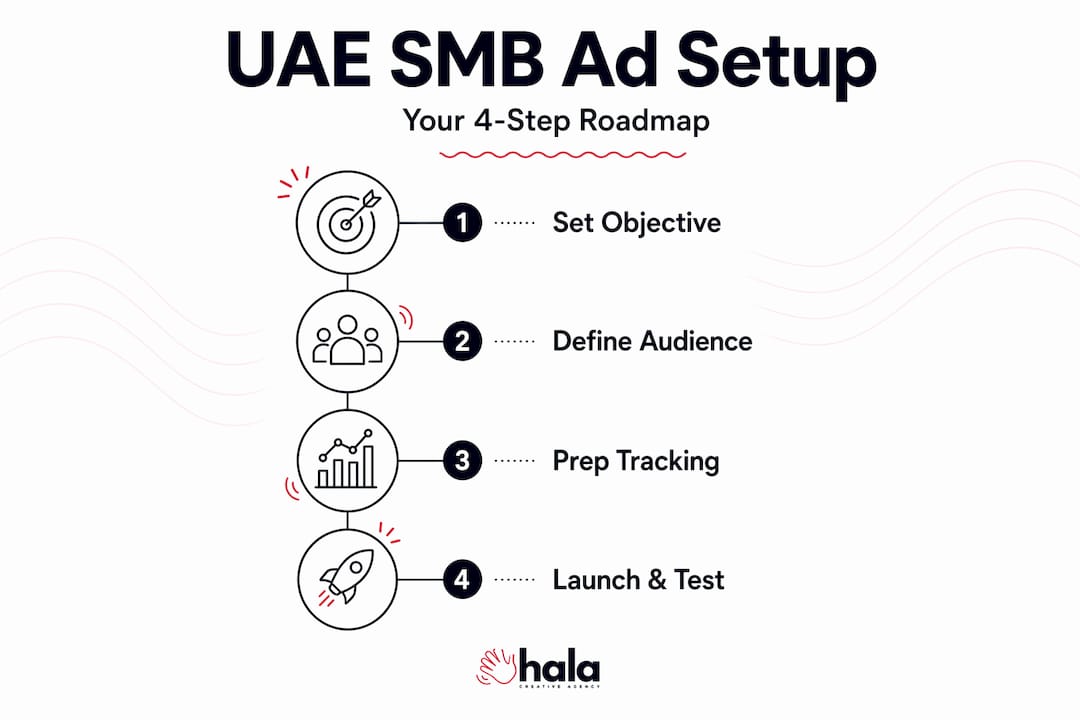
Use SMART goals to make that objective concrete. Instead of “get more customers,” try “generate 50 qualified leads in Dubai at under AED 30 per lead within 30 days.” That specificity determines which platform you use, how you bid, and what you measure.
Know your audience before you target them. Pull data from your existing customers: location, device, browsing behavior, age range. If you are a retail business in Dubai Marina, you need to know whether your buyers are residents, tourists, or corporate professionals. Each segment needs a different message and possibly a different platform.
Here is what you need in place before you create a single campaign:
- A verified Google Ads or Meta Business Manager account
- A working website or landing page with a clear call to action
- Conversion tracking installed (Google Ads Tag or Meta Pixel)
- A realistic daily or monthly budget aligned with your goal
- A defined geographic target (Dubai only? All of UAE? GCC?)
Pro Tip: Set up your conversion tracking pixel and test it before you spend a dirham. Use Google Tag Assistant or Meta’s Pixel Helper browser extension to confirm events are firing correctly.
A useful reference as you build out your workflow is this digital marketing workflow for SMEs, which covers pre-launch steps in detail.
| Preparation Step | Tool to Use | Time Required |
|---|---|---|
| Define campaign objective | Pen and paper or a goal doc | 30 minutes |
| Audience research | Google Analytics, Meta Insights | 1 to 2 hours |
| Conversion tracking setup | Google Tag Manager, Meta Events Manager | 1 to 2 hours |
| Landing page review | Your website CMS | 30 to 60 minutes |
| Budget planning | Spreadsheet or Google Ads estimator | 30 minutes |
Step-by-step campaign setup on Google Ads and Meta
Once your foundation is solid, you are ready to build. Here is how to set up campaigns on the two platforms UAE SMBs use most.
Setting up Google Ads
- Log into Google Ads and click “New Campaign.”
- Select your campaign goal (sales, leads, website traffic, brand awareness).
- Choose your campaign type: Search, Display, or Video.
- Set your daily budget and bidding strategy. For new campaigns, “Maximize Clicks” works well until you have enough conversion data to switch to “Target CPA.”
- Define your geographic targeting. The Google Ads “presence in targeted locations” setting outperforms the broader “presence or interest” option because it only shows ads to people physically in your target area.
- Build your ad groups. Group keywords by search intent. Separating transactional from informational keywords into distinct ad groups helps the algorithm learn more accurately and keeps your quality scores high.
- Write your ads. Each ad group should have at least three responsive search ads with different headlines that match the keyword intent.
- Add ad extensions. Sitelinks, callouts, and structured snippets improve visibility and give users more reasons to click without increasing cost per click.
For video campaigns, note that Google supports up to 50 ads per video campaign and provides an asset library for building creatives. Your campaign goal selection also controls which ad formats and optimization options are available to you.
Pro Tip: Never mix Arabic-language keywords with English-language keywords in the same ad group. UAE audiences search in both languages, but combining them blurs match-type performance data.
Setting up Meta Ads (Facebook and Instagram)
Meta Ads work differently. Audience targeting in Meta is configured at the ad set level, not at the campaign or ad level. This matters because testing two audiences in the same ad set gives you contaminated data. You cannot tell which audience drove performance.
Here is a clean structure:
- Campaign level: Set your objective (conversions, traffic, engagement, reach).
- Ad set level: Define one audience per ad set. Run cold audiences separately from retargeting audiences.
- Ad level: Create your creative. Test at least two ad formats per ad set (carousel vs. single image, for example).
For UAE businesses, Instagram tends to outperform Facebook for B2C brands targeting 25 to 45 year olds in Dubai and Abu Dhabi. Facebook still performs well for lead generation across broader GCC audiences. Test both placements and let the data guide your spend.
A deeper breakdown of this process is available in this guide on running social media ads for UAE businesses specifically.

Launching campaigns and verifying your setup
A campaign going live without proper verification is one of the most common and expensive mistakes SMBs make. Here is your pre-launch checklist.
- Confirm your conversion tracking pixel is firing on the correct page (thank you page, form submission, purchase confirmation).
- Tag all campaign URLs with UTM parameters. A standard UTM string should include source, medium, campaign name, and content. This is how you trace exactly which ad drove which result in Google Analytics.
- Pre-launch QA using a geo and UTM matrix means testing your tracking setup across different locations and traffic sources before spending any budget. This prevents wasted spend caused by broken attribution.
- Double-check geographic targeting. Confirm you are not accidentally targeting global traffic when you only serve Dubai.
- Add negative keywords before launch. Common examples for UAE businesses: “free,” “jobs,” “salary,” and competitor brand names if you do not want to pay for those clicks.
- Link your Google Ads account to Google Analytics 4 and confirm data is flowing.
Post-launch, monitor these metrics daily for the first two weeks:
- Impressions: Are ads showing? Low impressions signal budget, bid, or audience issues.
- Click-through rate (CTR): Below 2% on Search usually means weak ad copy or poor keyword match.
- Cost per click (CPC): Spikes in CPC often mean increased competition or low quality scores.
- Conversion rate: The real measure of whether your landing page and offer are working.
Combining pixel and URL tracking methods gives you more reliable performance data than relying on a single method. Both can fail independently. Together, they create redundancy.
Pro Tip: Set a calendar reminder for day 14 post-launch. This is when you should have enough data to make your first meaningful optimizations. Acting too early (before day 7) often leads to decisions based on noise, not trends.
Optimizing and scaling campaigns based on data
Launching is the beginning, not the finish line. The businesses that win in paid advertising are the ones that treat optimization as a continuous habit.
Start with what the data tells you, not what you feel. Pull your performance report after the first two weeks and look at metrics that matter beyond vanity numbers. CTR tells you how compelling your ad is. Conversion rate tells you how effective your landing page is. Cost per acquisition tells you whether the campaign is profitable. Impressions and reach tell you very little on their own.
A/B testing ad creatives, landing pages, and audiences is the single most reliable way to improve ROI over time. Run one variable at a time. Change the headline and keep everything else the same. Then change the image. Then test a new audience. Changing multiple things at once makes it impossible to know what drove the improvement.
Retargeting is one of the most underused tools among UAE SMBs. Build a custom audience from website visitors who did not convert, then show them a different ad with a stronger offer. This audience already knows your brand. Conversion rates on retargeting campaigns are consistently higher than cold traffic at a fraction of the cost.
Scaling works best when done gradually. Once a campaign is hitting your target cost per acquisition consistently for at least seven days, increase the daily budget by no more than 20% at a time. Larger jumps can reset the algorithm’s learning phase and spike your costs.
| Optimization Action | When to Do It | Expected Impact |
|---|---|---|
| Pause underperforming ads | After 7 to 14 days of data | Reduces wasted spend |
| Add negative keywords | Weekly during first month | Improves CTR and lowers CPC |
| Test new creatives | Every 3 to 4 weeks | Prevents ad fatigue |
| Expand to lookalike audiences | After 50+ conversions collected | Scales reach efficiently |
| Increase budget on winners | After 7 consecutive days of target CPA | Grows volume without breaking performance |
You can also reference a useful marketing automation checklist to build repeatable optimization workflows that save time each month.
My honest take on what actually works for UAE SMBs
I have worked with enough UAE small businesses to see a clear pattern. The ones that get results are not always the ones with the biggest budgets. They are the ones who were disciplined enough to set up properly before going live.
The most common mistake I see is launching a campaign before tracking is confirmed. You spend two weeks of budget, see zero conversion data, and have no idea why. It is not that the campaign did not work. You just could not measure it.
My take on platform selection: in the UAE, Instagram is frequently underestimated by B2B businesses. I have seen professional service firms in Dubai generate solid leads through Instagram Story ads targeting by job title and industry. Do not assume it is only for fashion and food.
One thing I always tell clients: start with one campaign, one audience, one offer. Not three campaigns at once trying to cover everything. Starting narrow gives you clean data fast. Once you know what works, scaling feels obvious because the numbers tell you exactly where to put the money.
The other thing I push hard is the pre-launch QA process. Testing your UTM parameters and pixels before spending feels tedious, but it has saved clients from weeks of wasted attribution data. Think of it as five hours of setup protecting 30 days of budget.
If you want a deeper look at what effective campaigns look like in this region, check out these digital marketing examples from Middle East businesses that got it right.
— Hisham
Let Halacreative handle the heavy lifting
Running effective ad campaigns takes time, precision, and the kind of platform knowledge that only comes from doing it daily. At Halacreative, we work with UAE SMBs to design, launch, and manage digital ad campaigns that are built on data from the start.
From campaign strategy and audience research to creative production and tracking setup, our team handles the full process so you do not have to learn everything from scratch. We have helped businesses across Dubai and the wider UAE cut their cost per acquisition while growing qualified traffic. Whether you are starting your first campaign or fixing one that is not performing, our marketing services are built for businesses exactly like yours. Reach out and let us show you what a properly built campaign looks like.
FAQ
What is the first step to create an ad campaign?
Define a single, clear campaign objective before anything else. A specific goal like “generate 40 leads in Dubai at AED 25 each” determines your platform, budget, and measurement approach.
How long does it take to see results from a new campaign?
Most campaigns need at least 7 to 14 days before delivering statistically meaningful data. Evaluate performance trends after two full weeks before making major changes.
Which platform is better for UAE SMBs: Google Ads or Meta Ads?
Both serve different purposes. Google Ads captures active search intent and works well for service businesses. Meta Ads are stronger for awareness and retargeting, especially on Instagram for B2C brands in the UAE.
How do I know if my ad campaign is performing well?
Look beyond impressions. Track CTR, cost per click, conversion rate, and cost per acquisition against your original SMART goal. These metrics tell you whether your campaign is actually profitable.
What is A/B testing in ad campaigns?
A/B testing means running two versions of an ad while changing only one variable, such as the headline or image, to determine which performs better. Continuous A/B testing is one of the most reliable methods for improving campaign ROI over time.