
TL;DR:
- Effective SEO for Dubai SMBs requires a structured process covering technical health, localized keyword targeting, on-page content optimization, and authoritative link-building, all monitored through regular performance reviews. Prioritizing technical audits, local citations, schema markup, and AI-friendly content strategies ensures higher search rankings in a competitive UAE market. Establishing documented workflows and systems delivers consistent results, transforming SEO from guesswork into sustainable growth.
SEO optimization is the process of improving your website’s visibility and ranking on search engines by refining your technical setup, content quality, and authority signals. For small and medium-sized businesses in Dubai and the UAE, this is not optional. The top 3 organic results capture 54.4% of all clicks, which means if your business is not ranking on the first page, you are handing customers to competitors. This seo optimization guide breaks down every step you need, from technical audits to local search dominance, using 2026 best practices built specifically for the UAE market. Tools like Google Search Console, GA4, and Screaming Frog are your starting points.
How to conduct a technical SEO audit for 2026
Fixing your technical foundation is the highest-return first step before you write a single piece of content. A site that search engines cannot crawl or load quickly will not rank, regardless of content quality. Start here before anything else.
Step 1: Crawl your entire website. Use Screaming Frog or a similar crawler to map every URL, identify broken links, redirect chains, and orphaned pages. Crawl budget matters especially for larger sites. Pages that waste crawl budget on thin or duplicate content pull resources away from your most valuable pages.

Step 2: Fix indexation and canonicalization issues. Duplicate content without canonical tags confuses Google and splits ranking signals. Audit your canonical tags, check your robots.txt file, and confirm your XML sitemap only includes pages you want indexed.
Step 3: Optimize Core Web Vitals. LCP must load within 2.5 seconds for 75% of page visits. Compress images, use a CDN, and defer non-critical JavaScript. A one-second delay in load time can reduce conversions by up to 20%, which is a direct revenue impact for any e-commerce or lead-generation site in Dubai.
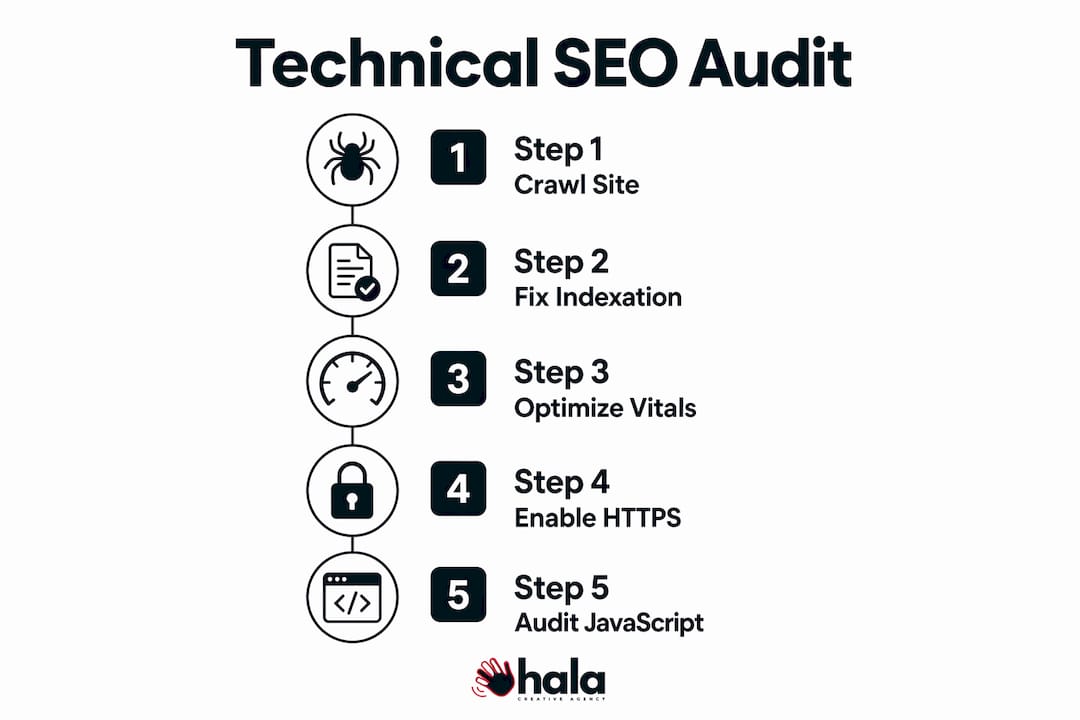
Step 4: Confirm HTTPS is active across every page. HTTPS now covers 95% of Google traffic. Any page still running on HTTP signals untrustworthiness to both users and search engines, increasing bounce rates immediately.
Step 5: Audit JavaScript rendering. If your site relies heavily on JavaScript frameworks, Google may not render your content correctly. Use Google Search Console’s URL Inspection tool to verify what Googlebot actually sees versus what your browser displays.
Pro Tip: Run your crawl on a staging environment first if your site has over 10,000 pages. This prevents accidental server overload and gives you a clean baseline before touching production.
Key technical issues to prioritize by impact:
- Broken internal links and 404 errors that block crawl paths
- Redirect loops and chains longer than two hops
- Missing or duplicate title tags and meta descriptions
- Pages blocked by robots.txt that should be indexed
- Mobile usability errors flagged in Google Search Console
What keyword research looks like for UAE SMBs in 2026
Keyword research for a Dubai-based business is not the same as generic keyword research. Local intent, language variation between Arabic and English queries, and voice search behavior all shape which terms actually drive revenue.
Start by building a keyword universe across four types:
| Keyword Type | Example for Dubai Business | Primary Intent |
|---|---|---|
| Short-tail | “SEO agency Dubai” | Awareness |
| Long-tail | “affordable SEO services for restaurants in Dubai” | Consideration |
| Question-based | “how do I rank my business on Google in UAE?” | Research |
| Transactional | “hire SEO consultant Dubai” | Purchase |
Tools like SEMrush, Ahrefs, and Google Search Console each serve a different purpose. SEMrush excels at competitor gap analysis, showing you which keywords your competitors rank for that you do not. Ahrefs is stronger for backlink-informed keyword difficulty scoring. Google Search Console shows you what queries already bring traffic to your site, which is your fastest win.
Voice search is used by about 50% of consumers daily for local business discovery. This shifts keyword targeting toward natural language phrases like “best accountant near me in Dubai” rather than “Dubai accountant.” Build question-based keywords into your content to capture these queries.
Map every keyword to a specific page and a specific business goal. A keyword without a mapped page is just a list. Your SEO optimization workflow should include a living keyword map that gets updated quarterly as search behavior shifts.
Pro Tip: Filter Google Search Console queries by position 8 to 20. These are pages almost ranking on page one. A targeted content update on these pages often produces faster ranking gains than building new pages from scratch.
On-page SEO strategies that target AI Overviews
On-page SEO in 2026 goes beyond title tags. Google’s AI Overviews now pull answers directly from web pages, and AI citations favor content that answers queries directly within the first 100 to 200 words. If your page buries the answer in paragraph five, you are invisible to AI-generated results.
Follow this sequence for every page you publish or update:
- Write a title tag between 50 and 60 characters with the primary keyword near the front. Title tags kept at 50 to 60 characters avoid truncation in search results and maintain full click-through visibility.
- Use one H1 per page containing the primary keyword. Multiple H1 tags dilute the signal and confuse both users and crawlers.
- Answer the core query in your opening paragraph. State the definition, answer, or key claim immediately. This is what gets pulled into AI Overviews and featured snippets.
- Build a logical heading hierarchy from H2 through H4. A structured heading progression increases your chances of AI Overview citations because it signals organized, authoritative content.
- Implement schema markup. FAQ schema, HowTo schema, and Article schema give Google structured data to parse. A Dubai real estate agency using HowTo schema on a “how to buy property in Dubai” page has a measurable advantage over a competitor with no schema.
Compare two content approaches for the same topic:
| Approach | Structure | AI Overview Eligibility |
|---|---|---|
| Keyword-stuffed page | Dense paragraphs, no schema, buried answers | Low |
| Topical authority page | Direct answer up front, schema, H2-H4 hierarchy | High |
Topical authority built with pillar pages and clusters outperforms targeting individual keywords. A pillar page on “Dubai business setup” supported by cluster pages on visas, licensing, and banking signals broader expertise to Google than ten disconnected pages each targeting one keyword.
Off-page SEO and local optimization for UAE businesses
Authority signals from outside your website remain one of the strongest ranking factors in 2026. Backlinks from authoritative, relevant sites are a top ranking factor, particularly for local businesses competing in dense markets like Dubai.
Quality beats quantity every time. One link from a UAE-based business publication carries more weight than fifty links from unrelated directories. Focus your link-building efforts on:
- Digital PR campaigns that earn coverage in Gulf News, Khaleej Times, or industry-specific UAE publications
- Guest contributions to relevant UAE business blogs and trade associations
- Partnerships with complementary local businesses for contextual cross-linking
- Listings in authoritative UAE directories like the Dubai Chamber of Commerce member directory
Your Google Business Profile is your most underleveraged local SEO asset. Complete every field, add photos weekly, respond to every review, and post updates at least twice per month. Businesses with fully optimized Google Business Profiles appear in the local pack, which sits above organic results and captures high-intent clicks.
NAP consistency matters more than most Dubai SMBs realize. Your business name, address, and phone number must be identical across your website, Google Business Profile, and every directory listing. Even minor variations like “St.” versus “Street” create entity confusion for Google.
Pro Tip: Search your business name in Google and audit the first two pages of results. Every listing that shows incorrect NAP data is a local ranking liability. Fix these before building new citations.
For deeper context on digital marketing strategies for UAE SMBs, local SEO and off-page authority work together as a system, not separate tactics.
How to monitor SEO performance and iterate for growth
Tracking SEO without a structured system produces noise, not insight. Set measurable KPIs before you start, not after. Common KPIs for Dubai SMBs include organic traffic growth, keyword ranking movement for target terms, conversion rate from organic traffic, and Core Web Vitals scores.
Follow this monitoring sequence monthly:
- Review Google Search Console for impressions, clicks, average position, and crawl errors. Pay attention to pages losing impressions month over month. These are early warning signals before rankings drop.
- Analyze GA4 for user engagement metrics. Bounce rate, session duration, and pages per session tell you whether traffic is converting or leaving. High traffic with low engagement means your content is attracting the wrong audience.
- Audit Core Web Vitals scores in Google Search Console’s Page Experience report. Flag any pages that fail LCP or Cumulative Layout Shift thresholds and prioritize fixes.
- Run a quarterly content audit. Updating underperforming content yields higher ROI than publishing new pages when existing pages already have link equity. Identify pages with declining traffic and refresh them with updated information, better structure, and new internal links.
- Prune thin or cannibalizing content. Pages that compete with each other for the same keyword split your ranking signals. Consolidate or redirect them to strengthen your topical authority.
The SEO best practices checklist for agencies is a useful reference for building a repeatable monthly review process that keeps your team accountable.
Key takeaways
A structured SEO optimization workflow covering technical health, keyword intent, on-page authority, local signals, and regular performance monitoring is the only reliable path to sustained organic growth for Dubai SMBs.
| Point | Details |
|---|---|
| Technical foundation first | Fix crawl, indexation, and Core Web Vitals before creating new content. |
| Intent-mapped keywords | Build a keyword universe tied to specific pages and business goals, including voice search terms. |
| AI Overview eligibility | Answer queries directly in the first 100 to 200 words and use schema markup on every key page. |
| Local SEO is non-negotiable | Optimize your Google Business Profile and maintain NAP consistency across all UAE directories. |
| Monitor and refresh regularly | Update underperforming pages quarterly rather than only publishing new content. |
Why SEO without a system is just expensive guessing
I have worked with enough Dubai businesses to say this plainly: most SEO failures are not strategy failures. They are workflow failures. SEO programs fail most often due to a lack of repeatable processes, not a lack of ideas. A business that publishes great content once every few months and never audits its technical health will consistently lose to a competitor running a documented monthly SEO rhythm, even if that competitor’s content is less creative.
The businesses I see winning in the UAE market treat SEO like operations, not marketing. They have documented SOPs for keyword research, content publishing, link outreach, and monthly reporting. Every team member knows their role. Nothing falls through the cracks because the system catches it.
The AI tools available in 2026 are genuinely useful for automating keyword clustering, content briefs, and rank tracking. But human expertise in content creation remains irreplaceable. Google’s quality raters and AI systems both reward content that demonstrates real experience and specific knowledge. A generic AI-generated page about “SEO tips for Dubai businesses” will not outrank a page written by someone who actually understands the UAE market, the local competitive dynamics, and the specific search behavior of Arabic and English-speaking users in the Gulf.
My honest advice: invest in the system before you invest in more content. Build your audit schedule, your keyword map, your content calendar, and your reporting dashboard first. Then create content that fills the gaps your data identifies. That sequence produces results. The reverse produces a lot of published pages and very little traffic.
— Hisham
Ready to grow your Dubai business with expert SEO?
Ranking on Google in a competitive market like Dubai requires more than a checklist. It requires a partner who understands the UAE market, the technical demands of modern search, and how to build authority that compounds over time.
Hala Creative Agency delivers end-to-end SEO and marketing services built specifically for SMBs in Dubai and the UAE. From technical audits and keyword strategy to content production and local citation building, the team handles every layer of your SEO program. If you want a customized plan that maps directly to your business goals and the competitive realities of your market, reach out to the team today.
FAQ
What is an SEO optimization guide?
An SEO optimization guide is a structured framework covering technical setup, keyword research, on-page content, off-page authority, and performance monitoring to improve a website’s search engine rankings. For Dubai SMBs, a localized guide also addresses Google Business Profile optimization and UAE-specific keyword behavior.
How long does SEO take to show results?
SEO typically takes 6 to 12 months to produce significant ranking improvements, though technical fixes and content updates on near-ranking pages can show results faster. Businesses in competitive Dubai markets should plan for a sustained 12-month commitment before evaluating full ROI.
What are the most important SEO ranking factors in 2026?
The top ranking factors in 2026 are Core Web Vitals performance, topical authority through pillar and cluster content, quality backlinks from relevant sources, and structured on-page signals including schema markup and direct query answers in the opening content.
How does local SEO differ for UAE businesses?
Local SEO for UAE businesses requires optimizing a Google Business Profile with complete and consistent NAP data, earning citations in UAE-specific directories, and targeting bilingual keyword variations that reflect how Arabic and English speakers search for local services in Dubai and the wider Gulf region.
Which SEO tools should Dubai SMBs use?
Dubai SMBs should use Google Search Console and GA4 for free performance monitoring, Screaming Frog for technical audits, and SEMrush or Ahrefs for keyword research and competitor analysis. The top SEO tools for agencies guide provides a current comparison of paid platforms worth evaluating.