
TL;DR:
- Advertising in the UAE builds mental availability by reinforcing memory structures that influence purchase decisions. Consistent, cross-channel branding maintains brand recognition and trust, driving long-term growth. Stopping advertising leads to rapid decline in brand recall, damaging market share and increasing sales cycles.
Most business owners think advertising is about getting noticed. Run enough ads, build enough awareness, and the sales follow. That framing is not wrong exactly, but it is dangerously incomplete. The real role of advertising in branding runs deeper than impressions or recall scores. Advertising shapes the mental structures that determine whether your brand even enters a customer’s mind at the moment they are ready to buy. For UAE small and medium-sized businesses competing in one of the world’s most crowded commercial markets, understanding this distinction is the difference between a brand that compounds in value and one that quietly fades.
Table of Contents
- Key takeaways
- The role of advertising in branding: mental availability explained
- How advertising shapes brand identity and customer perception
- Advertising strategies for brand awareness that actually work
- Pitfalls that kill advertising’s impact on branding
- Applying these insights: a practical framework for UAE SMBs
- My honest take on advertising and brand building in the UAE
- Ready to build a brand that actually sticks?
- FAQ
Key takeaways
| Point | Details |
|---|---|
| Advertising builds memory, not just awareness | Effective advertising creates mental links that surface your brand during buying moments, not just during ad exposure. |
| Stopping ads causes measurable decline | Brands that pause advertising lose memory linkages fast, especially among buyers who purchase infrequently. |
| Consistency multiplies brand identity | Repeating visual and messaging cues across channels strengthens brand recognition and can increase revenue significantly. |
| Measurement needs two layers | Track short-term ad exposure metrics alongside long-term brand health indicators for accurate attribution. |
| Internal alignment drives results | Separated brand and performance teams with siloed budgets actively reduce advertising effectiveness and ROI. |
The role of advertising in branding: mental availability explained
Most marketing conversations anchor on awareness. Did people see your ad? Do they recognize your logo? These questions matter, but they miss the mechanism that actually drives purchase behavior.
The Ehrenberg-Bass Institute defines a concept called mental availability: mental availability is not awareness, but the probability that a buyer notices or thinks of a brand in a relevant buying situation. This is a critical distinction. A consumer might recognize your brand name when prompted and still never think of you when they are standing in a store, scrolling a marketplace, or asking a colleague for a recommendation. Recognition is passive. Mental availability is active.
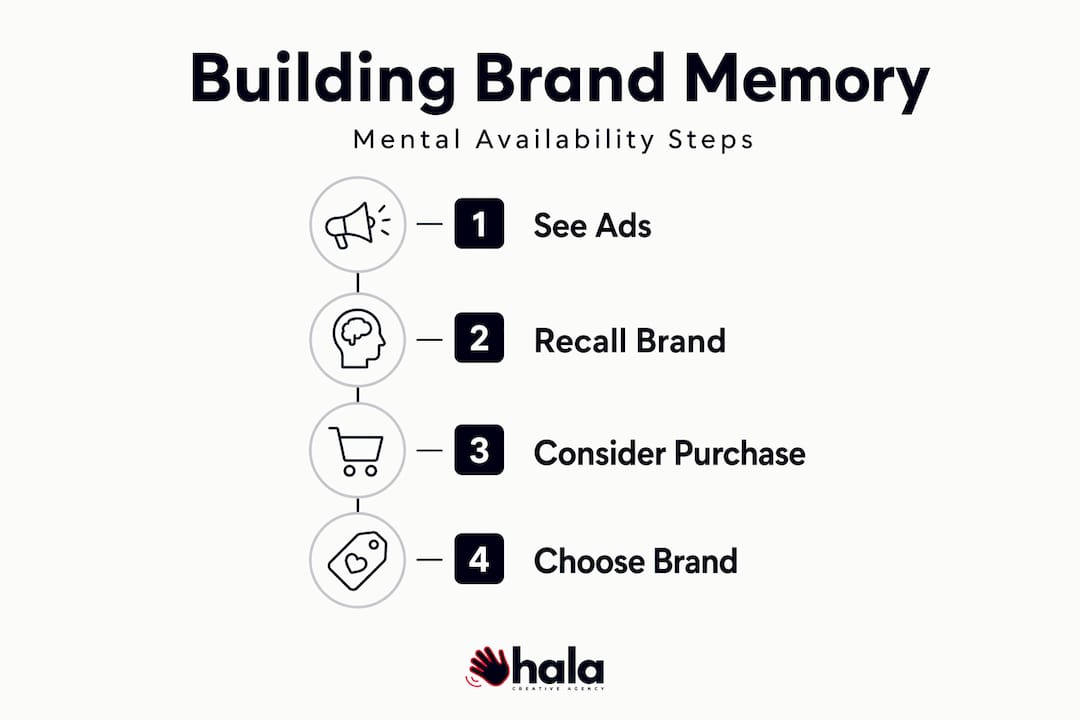
Advertising builds mental availability by creating and reinforcing memory structures. Think of these as networks of associations: your brand name connected to specific colors, sounds, emotions, problems it solves, and contexts where it shows up. Every ad exposure strengthens those connections. Every gap in advertising lets them weaken.
Here is what makes this so consequential for UAE SMBs specifically. Dubai and the broader UAE market are category-dense. Whether you are in food and beverage, B2B services, retail, or real estate, your buyers are exposed to dozens of competing brands daily. The brand that occupies the most mental space at the moment of purchase does not need to be the cheapest or even the most feature-rich. It just needs to be the most accessible thought.
- Mental availability is built through repeated, consistent exposure over time, not through a single viral campaign.
- Light-category buyers, the people who purchase infrequently, are the most vulnerable to memory decay. These buyers are often the majority of your customer base.
- Advertising builds memory structures by linking your brand to the right usage occasions and emotional cues, not just by asserting that you exist.
- Mental availability explains why market leaders advertise continuously even when their sales are strong. They are not trying to convince anyone. They are maintaining occupancy in the mind.
Pro Tip: Map two or three specific buying situations your customers face, such as “finding a caterer for a corporate event” or “choosing an accounting firm for tax season,” and check whether your advertising creative explicitly connects your brand to those exact moments.
The risk of stopping advertising is not theoretical. Sales decline on average by 16% after one year without advertising, according to Ehrenberg-Bass Institute research. For a UAE SMB, that kind of erosion does not announce itself loudly. It shows up as slightly longer sales cycles, slightly lower conversion rates, slightly more price sensitivity from buyers who no longer feel the pull of brand familiarity.
How advertising shapes brand identity and customer perception
Mental availability explains the cognitive mechanism. But advertising also does something more visible: it builds the emotional and symbolic identity of your brand. This is the impact of advertising on branding that most business owners intuit but few manage deliberately.

Every ad you run carries signals. The colors, the tone of voice, the characters or scenarios you choose, the music, the pacing. Over time, these signals accumulate into a perception. Customers who have never bought from you form opinions based on your advertising before they ever interact with your product or service. That perception either lowers or raises the friction they feel when they are finally ready to purchase.
Consistent brand presentation across channels can increase revenue by up to 23%, and this figure reflects more than aesthetics. It reflects the trust compression that happens when every touchpoint, from your Instagram ads to your Google Display banners to your outdoor media, feels coherent. Buyers read consistency as reliability.
- Visual consistency: Your logo, color palette, and design style should be recognizable across every ad format, so even a three-second scroll still registers your brand.
- Tone consistency: Whether your brand voice is authoritative, warm, or playful, it must stay stable across campaigns. Tone shifts between campaigns confuse the memory associations you have spent money building.
- Emotional storytelling: Ads that connect your brand to a feeling, not just a feature, build stronger and more durable memory associations. This is especially true in the UAE, where aspirational identity and community belonging carry significant purchase weight.
- Category entry points: Deliberately connect your brand to the specific moments, occasions, or problems that trigger purchase in your category.
The internal dimension of this challenge is underappreciated. Many UAE SMBs run marketing through a founder who approves creative, a social media manager who creates content, and an agency that runs paid ads. These three parties frequently operate with different briefs. The result is a brand that looks one way organically and sounds different in paid media. Understanding how brand identity breaks down at the operational level is as important as understanding the strategy.
Pro Tip: Create a one-page brand standards document covering your core visual assets, tone descriptors, and three approved emotional themes. Share it with every content creator and agency partner before any campaign launches.
Brand familiarity reduces friction in buying processes and shortens sales cycles. For B2B SMBs in the UAE, this translates directly: a prospect who has seen your advertising before your sales call already trusts you more, asks fewer basic questions, and moves to a decision faster.
Advertising strategies for brand awareness that actually work
Understanding what advertising does is one thing. Knowing how to structure it is another. Here are the approaches that consistently outperform for UAE SMBs focused on brand growth.
-
Advertise continuously, not in bursts. The instinct to run a campaign for Ramadan, go quiet, and then resurface for a mid-year sale works against the memory structure logic. Distinctive assets decay without reinforcement, which means every dark period costs you brand equity you paid to build. A modest always-on budget outperforms a larger periodic spend.
-
Coordinate paid and owned media. Coordinating paid advertising with consistent brand messaging across owned channels creates stronger brand perception than either approach alone. When your Instagram content, email newsletter, and paid ads all carry the same visual language and message, each channel amplifies the others.
-
Use UAE-specific measurement. YouGov’s UAE BrandIndex measures ad awareness as share of consumers who saw your brand’s ad in the past two weeks. This gives UAE SMBs a local benchmark to track real advertising impact rather than relying on platform-reported metrics that often overcount.
-
Give campaigns time to wear in. Creative needs repeated exposure before it fully registers. Switching ads too frequently resets the memory-building process. Commit to a campaign for long enough that the creative becomes associated with your brand before you retire it.
| Approach | Short-term effect | Long-term brand effect |
|---|---|---|
| Burst campaigns | High initial awareness | Low. Memory decays quickly after dark period |
| Always-on advertising | Steady moderate awareness | High. Memory structures strengthen over time |
| Paid media only | Dependent on budget continuity | Moderate. Stops when spend stops |
| Paid plus owned media coordination | Amplified reach at lower cost | High. Cross-channel reinforcement builds equity |
| Frequent creative rotation | Fresh feel, low recognition | Low. Prevents brand associations from forming |
You can find practical channel-by-channel guidance in this digital advertising guide built specifically for Dubai businesses navigating these decisions.
Pitfalls that kill advertising’s impact on branding
Even businesses that understand the theory make structural mistakes that prevent advertising from delivering brand results. These patterns show up constantly in UAE SMBs.
The most damaging is the short-term pressure trap. When revenue is tight, advertising is usually the first budget cut. This feels logical but is counterproductive. 90% of ads do not get enough time to achieve full impact, and cutting before an ad has had time to wear in guarantees a poor return on the investment already made.
The second pitfall is organizational: separated teams. 49% of organizations maintain separate teams for brand and performance marketing, each with their own budgets and KPIs. This creates advertising that pulls in different directions. Performance ads optimize for clicks while brand campaigns build awareness, and neither team knows what the other is doing. The result is a fragmented brand experience that confuses buyers.
“60% of marketers say the role of advertising is not fully understood by the C-suite, and only 21% say advertising objectives align with C-suite priorities.” — WARC, 2026
The third pitfall is measuring the wrong things. Relying entirely on click-through rates, cost per lead, or ROAS tells you nothing about brand health. These metrics capture short-term transactional behavior, not the slow accumulation of mental availability that determines your brand’s long-term growth ceiling.
Applying these insights: a practical framework for UAE SMBs
Turning theory into practice does not require a large team or a large budget. It requires a different set of decisions.
-
Treat advertising as a recurring cost, not a project. Budget for it monthly, the same way you budget for rent or payroll. The role of marketing in brand development is cumulative, and it requires consistent investment to generate compound returns.
-
Build a two-layer measurement system. Use short-window metrics like YouGov’s ad awareness methodology to track whether your ads are reaching people. Layer that with quarterly brand health tracking: prompted and unprompted awareness, perception scores, and purchase intent among your category buyers.
-
Unify your brand and performance objectives. Brief your performance campaigns with brand guardrails: the same visual identity, the same tone, the same three to five emotional associations. Performance and brand advertising are not opposites. They are the same message delivered at different stages of the buying journey.
-
Lock in your distinctive assets and protect them. Pick two or three brand assets, whether that is a color, a tagline, a character, or a sonic logo, and use them in every ad. Changing these frequently is one of the most expensive mistakes a growing brand can make.
Pro Tip: Before your next campaign, measure brand awareness baselines using AI analytics tools so you know exactly what shift your advertising is producing over time.
My honest take on advertising and brand building in the UAE
I’ve watched a lot of UAE SMBs pour money into advertising and walk away frustrated. The campaigns looked good, the impressions were there, but the brand did not move. What I’ve found is that the problem is almost never the creative. It’s the model people are using to understand what advertising is supposed to do.
Most founders I speak with treat advertising as demand generation. They expect a direct line from ad spend to sales. When that line isn’t obvious within 90 days, they cut the budget. What they are missing is that stopping advertising causes brand memory decay, and the damage is invisible until it shows up as a market share problem six months later.
The businesses I’ve seen build real brand equity in this market are not spending more. They are spending smarter and staying consistent. They pick a lane visually and emotionally, they maintain presence even at reduced budgets, and they measure brand health alongside conversion metrics. That combination is rare, and it’s the reason those businesses seem to grow more easily as time passes. Their advertising compounds. Everyone else’s resets with every new campaign.
The UAE market rewards recognizable brands. Organic reach and paid advertising working together creates the kind of visibility that feels earned rather than rented. That is what brand-building advertising actually produces when done with patience.
— Hisham
Ready to build a brand that actually sticks?
Understanding the mechanics of advertising and brand identity is the easy part. Executing it consistently, across the right channels, with the right creative discipline, is where most UAE SMBs need real support.
Halacreative works with Dubai and UAE-based businesses to integrate brand and performance advertising into a single, coherent strategy. From full-service marketing programs to brand identity development and digital campaign management, the team brings data, creativity, and local market knowledge to every engagement. If you want to stop treating advertising as a one-off expense and start treating it as a compounding asset, explore the step-by-step digital marketing guide built specifically for UAE SMBs, or reach out to discuss a strategy tailored to your category and growth stage.
FAQ
What is the role of advertising in branding?
Advertising builds and maintains the memory structures that make your brand come to mind during buying situations. It shapes brand identity, perception, and loyalty over time through repeated, consistent exposure.
How does advertising affect brand perception in the UAE?
Advertising signals your brand’s personality, values, and quality before a customer ever interacts with your product. Consistent visual and emotional cues across paid and organic channels create the trust that lowers buyer hesitation.
What happens when a brand stops advertising?
Research from the Ehrenberg-Bass Institute shows that sales decline by an average of 16% after one year without advertising, as memory linkages weaken and competitors occupy the mental space your brand vacated.
How can UAE SMBs measure advertising’s impact on branding?
Use a two-layer approach: track short-term ad awareness using tools like YouGov’s UAE BrandIndex alongside longer-term brand health metrics including purchase intent and unprompted awareness scores.
Why do advertising strategies for brand awareness fail in SMBs?
The most common reasons are campaign bursts with dark periods in between, separated brand and performance teams with misaligned objectives, and measuring only transactional metrics rather than brand health indicators.