
TL;DR:
- Content creation involves producing strategic digital content to attract and retain specific audiences for profitable results. It is a long-term, inbound marketing practice that benefits businesses by building trust and generating leads without excessive ad spend. Success relies on clear strategy, consistent execution, content pillars, platform adaptation, and ongoing performance analysis.
Content creation is the end-to-end process of researching, planning, producing, and distributing strategic digital content designed to attract, engage, and retain a clearly defined audience. The Content Marketing Institute defines it as creating and distributing relevant, consistent content to drive profitable customer action. That word “profitable” is doing a lot of work. It separates intentional content from noise. The creator economy has surpassed $250 billion in 2026, with 207 million creators worldwide, and the brands winning in this space treat content creation as a business function, not a side task. Tools like Adobe Firefly and Midjourney have made visual production faster, while formats like short-form video and blogging continue to dominate marketing results.
What is content creation and why does it matter?
Content creation is the structured practice of producing digital material that serves a specific audience and business goal. It covers every format you can publish online: blog posts, videos, podcasts, infographics, social posts, and email newsletters. The process starts with research and ends with performance analysis. Without that full loop, you are publishing, not creating.

The distinction matters because content creation is a long-term inbound marketing practice. Inbound means your audience finds you because your content answers their questions. That is fundamentally different from paid advertising, where you interrupt people. Done right, content compounds over time. A blog post published today can drive traffic for three years. A YouTube video can generate leads long after you filmed it.
For businesses in Dubai and across the UAE, this compounding effect is especially valuable. Digital competition is high, ad costs are rising, and audiences are increasingly selective about what they engage with. Content creation gives you a way to build trust before a prospect ever contacts you.
What are the main types of content creation formats?
The format you choose determines where your content lives, who sees it, and how much effort it takes to produce. Here is a breakdown of the most common types:
- Blog posts and articles: The foundation of SEO-driven content. 56% of marketers prioritize blogging as a core content format. Long-form posts rank in search engines and establish authority.
- Short-form video: Reels, TikToks, and YouTube Shorts. Short-form video delivers the highest ROI for 49% of marketers. Low production cost, high reach.
- Long-form video: YouTube tutorials, webinars, and brand documentaries. Higher production investment, but builds deeper audience trust.
- Podcasts: Audio content for audiences who consume on the go. Strong for thought leadership and niche communities.
- Infographics: Visual summaries of data or processes. High shareability, low time commitment from the reader.
- Email newsletters: Direct access to your audience without algorithm interference. High conversion rates for warm leads.
| Format | Engagement Level | Production Complexity | Typical ROI |
|---|---|---|---|
| Short-form video | Very high | Low to medium | High |
| Blog posts | Medium | Low | High (long-term) |
| Long-form video | High | High | Medium to high |
| Podcasts | Medium | Medium | Medium |
| Infographics | Medium | Low | Medium |
| Email newsletters | High | Low | High |
Video streaming accounts for 91% of global internet traffic in 2026. That number tells you where attention lives. If you are not producing video in some form, you are competing for a shrinking slice of the audience.
Pro Tip: Pick the format that matches your natural strengths first. If you write well, start with blogging. If you are comfortable on camera, start with video. Mastering one format before adding others produces better results than spreading yourself thin across six platforms at once.
What is the standard content creation process?
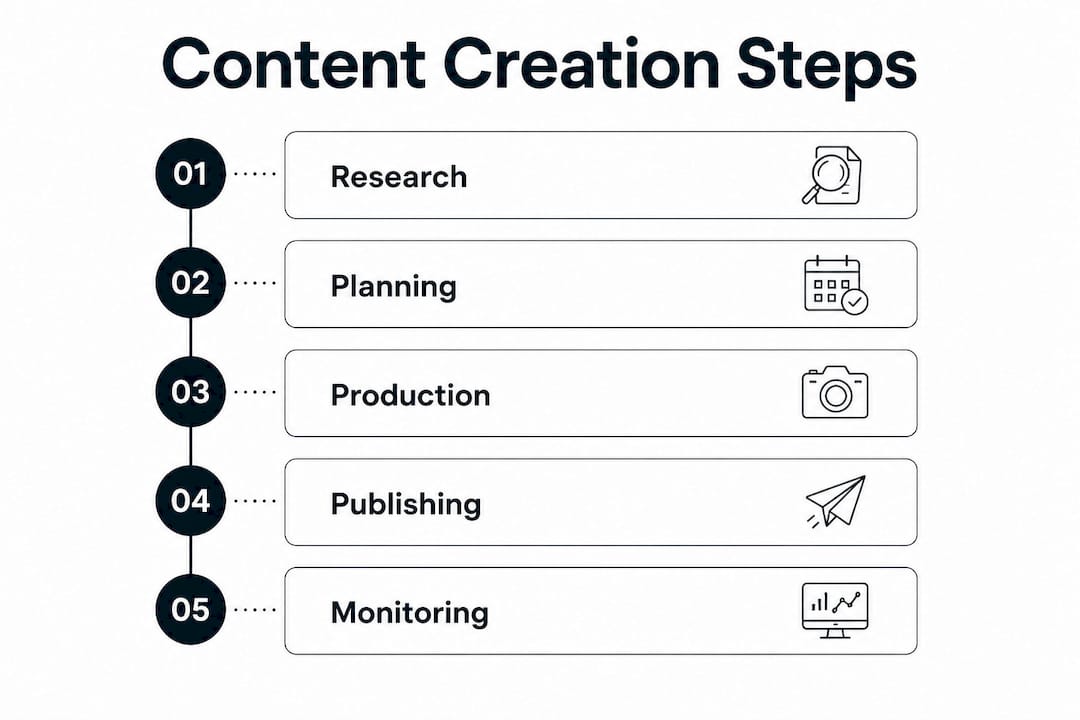
The content creation process is a repeatable workflow, not a one-time event. Every successful content operation follows the same core stages, even if the tools and team size differ.
- Research and ideation: Identify what your audience is searching for, what questions they have, and what your competitors are not answering well. Tools like Google Search Console, AnswerThePublic, and SEMrush surface real search demand.
- Strategic planning: Map your content to a calendar. Decide on format, target keyword, distribution channel, and the business goal each piece serves. This step prevents random publishing.
- Production: Write, film, design, or record. This is where most people spend all their time, but it should represent roughly 40% of your total effort. Research and planning deserve equal weight.
- Publishing and distribution: Post the content and push it through every relevant channel. A blog post should also become a LinkedIn article, a newsletter excerpt, and a social media thread.
- Performance analysis: Check your metrics after two to four weeks. Track traffic, engagement, conversions, and time on page. Use what you learn to improve the next piece.
The biggest mistake most content teams make is skipping step five entirely. They publish and move on. Performance monitoring and ongoing refinement are essential for long-term content success. Without analysis, you repeat the same mistakes at scale.
AI tools have changed step three significantly. Adobe Firefly and Midjourney reduce visual production time by generating on-brand images and graphics in minutes rather than hours. This is especially relevant for small teams managing a digital marketing workflow without a full design department.
Pro Tip: Batch your content work by task type, not by piece. Spend one day on research for five pieces, another day scripting all five, and a third day recording or writing. Batching ideation, scripting, and production on separate days prevents burnout and keeps output consistent.
Why is content creation important for business growth?
Content creation is the most scalable way to build audience trust and generate inbound leads. A single well-researched article or video can reach thousands of people without additional spend. That is the core economic argument for content as a marketing channel.
The numbers support the investment. The creator economy surpasses $250 billion in 2026, reflecting how much commercial value flows through content. Businesses that treat content creation as a strategic function, not a marketing afterthought, consistently outperform those that do not.
“Content creation must be strategically tied to business goals to avoid viral posts that don’t convert.” — Content Creation Guide (2026)
That quote captures the most common failure mode. A brand posts a meme that gets 50,000 shares and zero sales. Reach without relevance is vanity. Every piece of content you produce should connect to a specific audience segment, a specific problem, and a specific next step you want that audience to take.
Here is what separates content that converts from content that just gets views:
- Audience specificity: Content written for everyone reaches no one. Define your reader’s role, industry, and pain point before you write a single word.
- Consistency: Publishing once a month and going quiet for six weeks destroys audience trust. A predictable schedule matters more than perfect execution.
- Relevance to the buyer journey: Top-of-funnel content builds awareness. Middle-of-funnel content builds consideration. Bottom-of-funnel content drives decisions. You need all three.
- Clear calls to action: Every piece should tell the reader what to do next. Read another article, download a guide, book a call. Without direction, even great content produces no business outcome.
For social media content specifically, consistency and relevance are the two variables that most directly predict engagement growth over time.
How do you choose content pillars and adapt across platforms?
Content pillars are the three to five core topics your brand covers repeatedly. Successful creators build 3–5 content pillars at the intersection of their expertise, their audience’s demand, and their business products. Pillars give you a framework for generating ideas without starting from scratch every week.
A simple test for a strong pillar: can you generate five content ideas for it in under ten minutes? If yes, it has enough depth to sustain ongoing production. If you struggle to think of three ideas, the pillar is too narrow or too far from your actual expertise.
Once you have your pillars, platform adaptation is how you scale without burning out. The “loop” method works like this: produce one high-value core asset, then reshape it for every relevant platform by adjusting length, tone, and format. A 2,000-word blog post becomes a LinkedIn article, a five-slide Instagram carousel, a three-minute YouTube video, and a newsletter section. Platform adaptation of a core content asset provides volume without extra ideation.
Here is how to apply this practically:
- LinkedIn: Long-form text posts, professional insights, data-driven observations. Audiences here respond to specificity and credibility.
- Instagram: Visual carousels, short Reels, and Stories. Lead with a strong visual hook in the first frame.
- X (formerly Twitter): Short, opinionated takes. Pull a single insight from your long-form content and post it as a standalone thought.
- YouTube: Long-form tutorials or explainers. This is where depth wins. Shallow content gets abandoned quickly.
Choosing one anchor format aligned with your strengths and expanding from there is the most sustainable growth strategy. Launching five formats simultaneously is the most common mistake new content creators and marketing teams make.
Pro Tip: Use ad creative inspiration sources to spark ideas when your content pillars feel stale. Seeing what works in paid creative often reveals angles your organic content is missing.
Key takeaways
Effective content creation requires a defined strategy, a repeatable workflow, and consistent execution tied directly to measurable business goals.
| Point | Details |
|---|---|
| Define before you produce | Tie every piece of content to a specific audience segment and business goal before writing or filming. |
| Format follows strength | Start with one format that matches your natural skills, then expand after you have built a consistent output rhythm. |
| Pillars prevent burnout | Build 3–5 core content pillars so idea generation becomes systematic, not stressful. |
| Adapt, do not duplicate | Reshape one core asset across platforms instead of creating separate content for each channel from scratch. |
| Measure and refine | Review performance data every two to four weeks and use it to improve the next content cycle. |
Content creation in 2026: what i have learned the hard way
I have worked with enough brands in Dubai and across the region to spot the same pattern repeatedly. A business invests in content, publishes for six weeks, sees modest early results, and then stops. They call it “content doesn’t work for us.” What actually happened is they never defined their pillars, they tried to be on every platform at once, and they never reviewed a single performance metric.
The brands that win with content do something boring and effective: they pick two platforms, commit to a publishing schedule they can actually maintain, and review their numbers every month. That is it. No secret formula.
What has changed in 2026 is the role of AI in the production stage. Tools like Adobe Firefly and Midjourney have genuinely compressed timelines for visual content. At Hala Creative Agency, we use a hybrid AI-human approach that keeps brand voice intact while cutting production time significantly. AI handles the repetitive visual work. Humans handle strategy, tone, and judgment.
My honest observation on format trends: short-form video is not going anywhere, but the brands building real authority are pairing it with long-form written content. Short video gets you discovered. Long-form content gets you trusted. You need both, but you do not need both on day one.
Start with your strongest format. Build the habit. Then layer in the rest.
— Hisham
How hala creative agency builds content strategies that convert
Content creation without a clear strategy is just publishing. Hala Creative Agency works with businesses across Dubai and the UAE to build content systems that connect directly to growth goals, whether that means branded content that builds recognition or a full social media workflow that runs without burning out your team.
Our team combines data-driven planning with AI-assisted production to help SMEs produce consistent, high-quality content at a fraction of the traditional cost. From pillar strategy to platform adaptation to performance tracking, we handle the full content creation process. If you are ready to turn your content into a real marketing asset, explore our marketing services or reach out directly to start a conversation about what your brand needs in 2026.
FAQ
What is content creation in simple terms?
Content creation is the process of producing and sharing digital material, such as blog posts, videos, or social posts, designed to attract and engage a specific audience. The goal is always to drive a profitable action, not just views.
How many types of content creation are there?
The main types include blog posts, short-form video, long-form video, podcasts, infographics, and email newsletters. Each format suits different audiences, platforms, and production budgets.
What is the content creation process step by step?
The standard content creation process runs through five stages: research and ideation, strategic planning, production, publishing and distribution, and performance analysis. Skipping the final stage is the most common reason content programs stall.
How do content pillars help with content creation strategies?
Content pillars give creators 3–5 recurring topics that align expertise, audience demand, and business goals. They make idea generation systematic and prevent the blank-page problem that kills consistency.
Why is content creation important for businesses in dubai?
Content creation builds inbound audience trust without ongoing ad spend, which matters in a high-competition market like Dubai. Consistent, relevant content positions your brand as the authority in your category before a prospect ever contacts you.