
TL;DR:
- Content marketing involves creating relevant, valuable content to attract and retain customers by solving their problems. It builds trust over time through consistent, audience-focused approaches, unlike interruptive traditional advertising. Implementing a documented strategy, measuring business outcomes, and repurposing content are key for SMB success.
Content marketing is defined as the strategic creation and distribution of valuable, relevant, and consistent content to attract, engage, and retain a clearly defined audience. Unlike paid ads that interrupt, this approach earns attention by solving real problems before asking for a sale. For small and medium-sized businesses in Dubai and across the Middle East, understanding what is content marketing means recognizing it as the foundation of long-term digital growth. Formats range from blog posts and newsletters to YouTube videos, podcasts, and social media content, each designed to build trust and generate qualified leads over time.
What is content marketing, and how does it work?
Content marketing is a pull strategy that cultivates interest by solving customer problems rather than pushing product features. A customer searching “how to stage my apartment for sale in Dubai” is already in research mode. A real estate agency that publishes a detailed guide answering that exact question earns trust before the customer ever picks up the phone. That is the mechanism: create content that matches what your audience is already searching for, and let them come to you.
The Content Marketing Institute defines the practice as a long-term approach focused on building a strong relationship with your audience by consistently delivering high-quality content that is deeply relevant to them. This is not a campaign. It is an ongoing commitment to being useful. The payoff compounds over time as your content library grows, your search rankings improve, and your brand becomes the go-to resource in your category.
How does content marketing differ from traditional advertising?
Traditional advertising pushes a message at an audience whether they want it or not. A billboard on Sheikh Zayed Road, a pre-roll YouTube ad, a sponsored post that interrupts a scroll. Content marketing works the opposite way. It builds long-term trust by providing relevant, valuable information that people actively seek out. One approach rents attention; the other earns it.
Social media is a distribution channel, not a content strategy. Posting on Instagram or LinkedIn is how you deliver content to your audience. The strategy is the decision about what to create, for whom, and why. Many SMBs confuse the two and end up posting inconsistently without a clear purpose, then wonder why engagement stays flat.
| Dimension | Traditional advertising | Content marketing |
|---|---|---|
| Approach | Push: interrupts the audience | Pull: attracts the audience |
| Cost model | Pay per impression or click | Invest once, compound over time |
| Trust building | Low: perceived as self-serving | High: perceived as helpful |
| Shelf life | Ends when budget ends | Content can rank and convert for years |
| Audience relationship | Transactional | Relational |
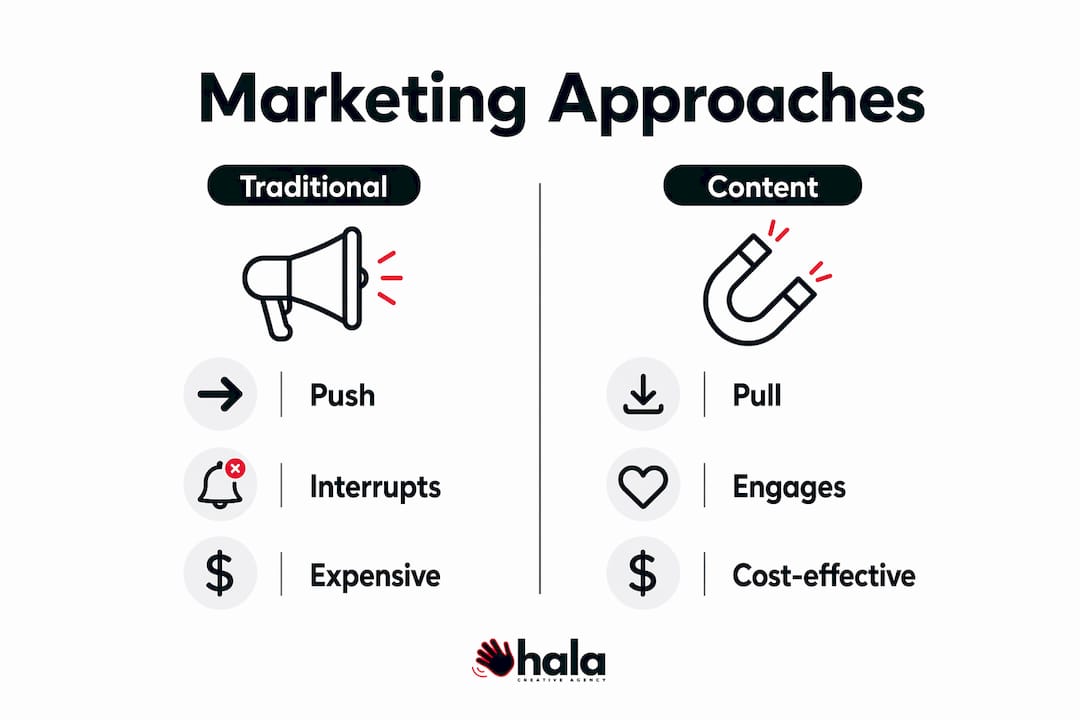
The table above makes the business case clear. For an SMB with a limited budget, content marketing offers a fundamentally different return profile than paid advertising. You build an asset, not just buy exposure.
Why content marketing matters for small and medium-sized businesses
The numbers behind content marketing’s impact are hard to ignore. 87% of marketers report that content marketing increases brand awareness, and 76% see more qualified leads as a direct result. These are not vanity metrics. Brand awareness and lead quality are the two variables that most directly determine whether a small business grows or stagnates.
Cost is the other critical factor. Content marketing costs 62% less than traditional advertising while delivering stronger long-term results. For a Dubai-based SMB spending AED 10,000 per month on paid ads, a shift toward content could free up significant budget while building a more durable pipeline. The savings compound because content, unlike ads, does not stop working when you stop paying.
Consumer behavior reinforces this shift. 82% of shoppers prioritize brands whose values align with their own. Content is the primary vehicle through which a brand communicates its values. A hospitality brand in Dubai that publishes content about sustainable travel, local culture, and authentic experiences is not just filling a blog. It is signaling to a specific type of customer that this is the right brand for them.
Key benefits for SMBs specifically include:
- Organic search visibility that reduces dependence on paid traffic over time
- Lead nurturing through content that answers questions at every stage of the buying journey
- Brand differentiation in crowded markets where product features are often similar
- Customer retention through newsletters and ongoing content that keeps your audience engaged after the first purchase
What types of content work best for SMB marketing strategies?
Content formats include written, audio, video, and images, each serving different audience needs and platform contexts. The right mix depends on where your audience spends time and what format they prefer when researching your category.

Written content remains the highest-ROI format for most SMBs. Blog posts, long-form articles, email newsletters, and case studies all drive organic search traffic and can be repurposed across other channels. A single well-researched article can generate leads for three to five years with minimal maintenance.
Video content on YouTube, TikTok, and Instagram Reels reaches audiences who prefer visual learning and tends to generate higher engagement rates on social platforms. For a restaurant in Dubai, a 60-second video showing the kitchen process or the sourcing of ingredients builds trust faster than any written description.
Audio content through podcasts and audiograms is growing rapidly in the Middle East. A B2B services firm that launches a weekly podcast interviewing local business owners builds authority and a loyal audience simultaneously.
Image content including infographics and data visualizations works well for breaking down complex information. An infographic comparing visa types for UAE residents, published by a legal services firm, can generate thousands of shares and backlinks from a single piece.
Pro Tip: Start with one format you can produce consistently before expanding. A blog published twice a month beats a podcast launched with five episodes and then abandoned.
Content marketing best practices for small and medium-sized businesses
Effective content marketing starts before you write a single word. Setting documented goals before creating content is the single most critical practice to prevent wasted effort. Without a goal, you cannot measure success, and without measurement, you cannot improve.
Follow this sequence to build a content marketing strategy that actually works:
-
Define 1-2 specific KPIs. Choose metrics that connect directly to business outcomes. Lead form submissions, email subscribers, or organic search traffic are more useful than likes or impressions. Setting 1-2 specific KPIs before you start prevents publishing into the void.
-
Research your audience’s actual questions. Use Google’s “People Also Ask” feature, Reddit threads, and customer service logs to find the exact language your audience uses. Content tailored to your audience’s questions dramatically outperforms content created around what the brand wants to say.
-
Build content pillars. Content pillars organize your topics around the core themes your brand wants to own. A digital marketing agency might build pillars around SEO, social media, and branding. Every piece of content maps back to one of these pillars, creating a coherent body of work rather than a scattered collection of posts.
-
Match content to search intent. A person searching “what is content marketing” wants a definition and overview. A person searching “content marketing agency Dubai” wants to hire someone. The same topic requires completely different content depending on where the searcher is in their decision process.
-
Prioritize quality and consistency over volume. Two well-researched articles per month outperform eight thin posts. Consistency matters more than frequency. Pick a publishing cadence you can sustain for 12 months without burning out.
-
Repurpose systematically. One long-form article becomes a LinkedIn post, an email newsletter section, three social media captions, and a short video script. Repurposing multiplies the return on every piece of content you create without multiplying the workload proportionally.
Pro Tip: Before publishing any piece of content, read it aloud. If it sounds like a press release or a product brochure, rewrite it. Your audience wants to feel like a person wrote it for them, not a committee.
For Dubai-specific guidance, the content marketing practices for Dubai brands article from Hala Creative Agency covers how to adapt these principles to local audience behavior and platform preferences.
How do you measure content marketing success?
Measurement is where most SMBs fall short. They publish content, check likes, and conclude it is not working. The problem is not the content. It is the metrics. Engagement metrics like likes and shares measure attention. Business metrics like leads, conversions, and revenue measure impact. You need both, but you need to know which is which.
The most useful KPIs for SMB content marketing fall into three categories:
- Awareness metrics: Organic search impressions, website traffic, social reach, and branded search volume
- Engagement metrics: Time on page, scroll depth, email open rates, and video completion rates
- Conversion metrics: Lead form submissions, email sign-ups, consultation requests, and direct sales attributed to content
Google Analytics 4, Google Search Console, and your email platform’s built-in analytics cover most of these without additional cost. The key is to review them monthly, identify which content pieces are driving the most conversions, and produce more content in that format and on those topics.
Regularly updating existing content is as important as creating new content. A blog post published in 2023 that ranks on page two of Google can often be pushed to page one with a content refresh, updated statistics, and improved internal linking. This is one of the highest-ROI activities in content marketing and one of the most consistently overlooked.
Key takeaways
Content marketing succeeds when it prioritizes audience needs over brand messaging, pairs consistent publishing with documented goals, and measures business outcomes rather than vanity metrics.
| Point | Details |
|---|---|
| Pull over push | Content marketing attracts customers by solving their problems, not interrupting them with ads. |
| Cost advantage | Content marketing costs 62% less than traditional advertising with stronger long-term returns. |
| Audience-first creation | Tailoring content to real customer questions and preferred formats drives measurably higher results. |
| Documented goals matter | Setting 1-2 specific KPIs before creating content prevents wasted effort and enables ROI measurement. |
| Repurpose for efficiency | One strong piece of content can be adapted into multiple formats, multiplying reach without multiplying cost. |
Why most content marketing fails before it starts
The most common mistake I see SMBs make is creating content for themselves instead of their audience. A restaurant owner writes about their awards. A law firm publishes articles about their team. A real estate agency posts listings with no context. None of this answers a single question the customer is actually asking.
Empathy-led content that addresses customer pain points early in the buying journey consistently outperforms brand-centric content. This is not a soft principle. It is a measurable difference in traffic, engagement, and conversion rates. When I review underperforming content for businesses, the root cause is almost always the same: the content was written for the brand, not the buyer.
The second failure mode is over-relying on AI-generated drafts without human editing. AI tools can accelerate research and structure, but they produce generic output that sounds like every other article on the topic. The brands that win with content marketing use AI as a starting point and then apply genuine editorial judgment, brand-specific examples, and a distinct voice. A blind-read test is useful here: if you removed the logo, would a reader know which brand wrote it? If not, the content is not doing its job.
My honest advice: pick one audience problem, write the most useful piece of content that exists on that topic, and publish it consistently for six months before judging results. Content marketing is not a sprint. It is the most patient and most rewarding growth strategy available to a small business.
— Hisham
How Hala Creative Agency helps SMBs build content that converts
Building a content marketing strategy from scratch takes time, expertise, and consistency that most small business owners simply do not have available alongside running their operations.

Hala Creative Agency works with SMBs across Dubai and the wider Middle East to develop content strategies grounded in audience research, search intent, and measurable business goals. The team combines a hybrid AI-human approach to produce content that is both cost-efficient and genuinely on-brand. From content pillar development and SEO-optimized blog writing to social media content and email campaigns, the agency handles execution so business owners can focus on growth. Explore the full range of marketing services or review digital marketing examples from businesses in the region to see what results look like in practice.
FAQ
What is content marketing in simple terms?
Content marketing is the practice of creating and sharing useful, relevant content to attract and retain customers, rather than directly promoting a product or service. It builds trust by answering the questions your audience is already asking.
How is content marketing different from social media marketing?
Social media is a distribution channel for your content. Content marketing is the strategy that determines what you create, for whom, and why. You can use social media as part of a content marketing strategy, but posting on social media without a content strategy is not content marketing.
What are the main benefits of content marketing for small businesses?
Content marketing increases brand awareness for 87% of marketers and costs 62% less than traditional advertising. For small businesses, the primary benefits are lower customer acquisition costs, stronger organic search visibility, and higher-quality leads over time.
How long does content marketing take to show results?
Most businesses see measurable organic search improvements within three to six months of consistent publishing. Lead generation and revenue impact typically become clear at the six to twelve month mark, depending on publishing frequency and content quality.
What is a content strategy, and do I need one?
A content strategy is the documented plan that defines your goals, audience, content pillars, formats, publishing schedule, and success metrics. Without one, content marketing becomes random and unmeasurable. Every business that wants results from content needs a documented strategy before publishing a single piece.