
TL;DR:
- Hybrid marketing integrates traditional and digital channels into a coordinated strategy, enhancing trust and conversions. It leverages both channels’ strengths, enabling flexible budgets and amplifying campaign performance. Successful implementation requires unified ownership, strong team communication, and continuous measurement across all touchpoints.
Most marketing professionals have spent the last decade treating digital and traditional channels as separate decisions. You either invest in Facebook ads or you sponsor an industry event. You run Google campaigns or you print a brochure. That framing is the problem. Hybrid marketing dissolves that false choice by integrating online and offline tactics into a single, coordinated strategy. The result is a customer experience that builds genuine trust, meets buyers wherever they are, and converts at a higher rate than either channel could alone.
Table of Contents
- Key takeaways
- What is hybrid marketing and why it matters
- Hybrid marketing team structures
- The real advantages of hybrid marketing
- How to plan and execute a hybrid campaign
- My perspective on why most hybrid strategies fail
- Ready to build your hybrid marketing strategy?
- FAQ
Key takeaways
| Point | Details |
|---|---|
| Hybrid marketing definition | Hybrid marketing integrates traditional and digital tactics into one coordinated strategy, not two parallel ones. |
| Higher conversion potential | Combining brand building and performance marketing can improve conversions by 20% compared to running either channel in isolation. |
| Organizational models matter | Choosing the right team structure, whether in-house, outsourced, or a pod model, directly shapes how well hybrid marketing executes. |
| Trust drives purchase decisions | 81% of consumers require consistent omnichannel experiences to trust a brand before making a purchase. |
| Agile execution is non-negotiable | Frameworks like Scrumban help hybrid teams stay adaptive without sacrificing planning structure. |
What is hybrid marketing and why it matters
Hybrid marketing is the planned integration of traditional marketing channels (events, print, direct mail, outdoor advertising) with digital channels (social media, email, SEO, paid search) under a unified brand message and shared strategy. It is not simply running both types of campaigns at the same time. The defining characteristic is coordination. Every touchpoint reinforces the others.
Consider a real estate developer in Dubai launching a new residential project. A purely digital approach means Instagram ads, Google Display retargeting, and a landing page. A purely traditional approach means billboards on Sheikh Zayed Road, a physical showroom, and direct mail to a curated list. The hybrid marketing approach uses all of these, but the billboard drives people to a landing page, the landing page captures leads that trigger a personalized email sequence, and the showroom visit is followed up with a WhatsApp message containing a digital brochure. The customer never experiences a gap.
Several data points confirm why this matters in practice:
- Traditional channels like events and direct mail build credibility, while digital channels deliver precision targeting and measurement.
- Combining brand building with performance marketing improves conversion rates by up to 20%.
- Successful hybrid strategies typically follow an 80/20 content ratio: 80% brand building for long-term trust, 20% direct response for immediate lead generation.
This balance is what separates brands that grow steadily from those that spike and stall. For Dubai SMEs and regional businesses, where word-of-mouth and personal relationships still carry enormous weight alongside digital discovery, hybrid marketing is not a luxury. It is simply accurate.
Hybrid marketing team structures
Understanding the strategy is one thing. Building the team that executes it is another. There are three models most businesses use, and each comes with real tradeoffs.
| Model | Strengths | Weaknesses |
|---|---|---|
| Fully in-house | Brand control, speed, institutional knowledge | Limited specialist skills, high fixed cost |
| Fully outsourced | Access to specialists, lower overhead | Less brand alignment, coordination friction |
| Hybrid pod model | Agility, specialist access, brand ownership | Requires strong internal leadership |
The hybrid pod model deserves more attention. A pod is a modular team that blends internal staff (typically brand strategists and project leads) with external specialists (performance marketers, content creators, SEO experts) who work as a connected unit rather than separate vendors. 36% of companies in 2025 already use hybrid marketing models combining in-house and external support. That number is projected to reach 46% by 2026.

Why the shift? Because in-house teams bring speed and brand control, while external agencies contribute specialist skills and outside perspective. A pod captures both without requiring the overhead of a full agency retainer or the limitations of a small internal team.
Pro Tip: When building a hybrid pod, assign one internal brand lead who has final approval authority. Without a single accountable person on your side, external contributors default to whatever process their agency uses, and your brand voice drifts.
The key challenge with hybrid teams is communication cadence. Weekly standups, shared project management tools, and a single source of truth for campaign assets are not optional. They are what prevent the pod from fragmenting back into the siloed model you were trying to escape.
The real advantages of hybrid marketing
The case for hybrid marketing is not theoretical. Here is what the data and practical experience show about its advantages for businesses operating in competitive markets.
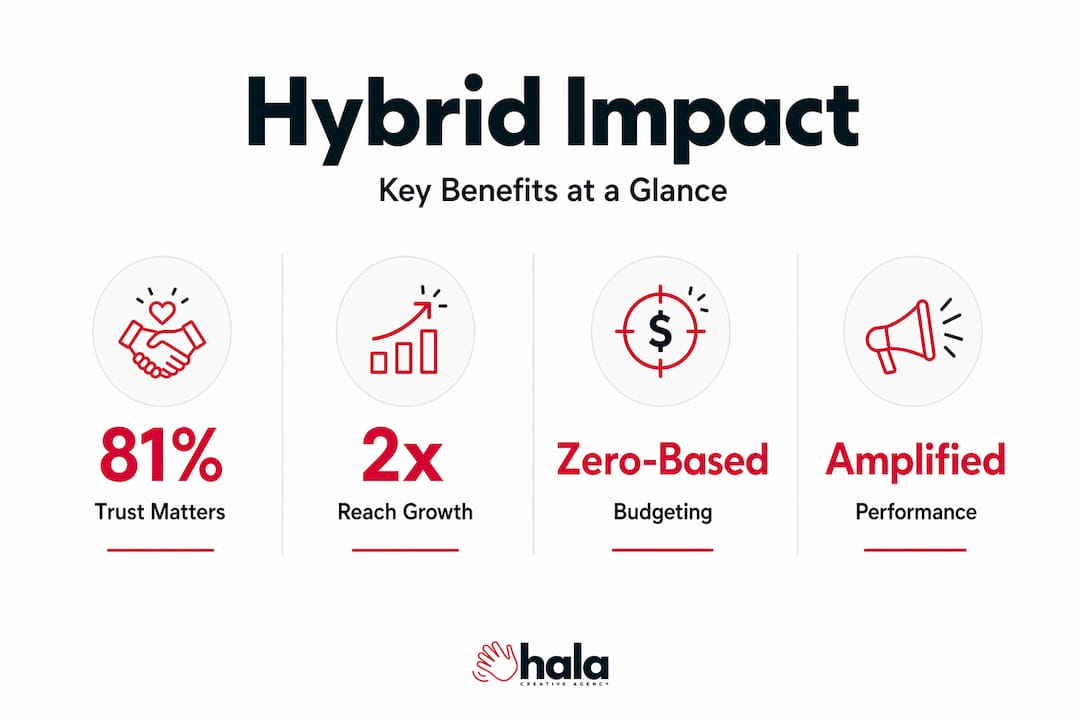
Greater reach with deeper resonance. Digital channels are excellent at targeting specific demographics, but they generate ad fatigue quickly. Traditional channels reach audiences digital cannot, particularly older demographics and environments where screens are not present. Unified messaging across digital and physical channels increases brand resonance and drives conversions at each touchpoint.
Trust built at scale. Trust is the variable most marketing strategies undervalue. 81% of consumers need to trust a brand through consistent omnichannel experiences before they consider a purchase. A brand that shows up on Instagram, sends a thoughtful email, and also has a visible physical presence in the community feels real in a way that purely digital brands often do not. For building trust online and offline simultaneously, hybrid is the only approach that works at both layers.
Budget flexibility. Hybrid marketing supports zero-based budgeting because you can shift investment fluidly between content formats and channels based on what is performing. If a live event generates 40% of your qualified leads in Q1, you double down on events. If digital retargeting outperforms in Q4, you reallocate. Neither pure-digital nor pure-traditional campaigns offer that kind of flexibility.
Compounding campaign performance. Each channel amplifies the others. An SEO article drives organic traffic to a landing page. That landing page promotes an in-person workshop. The workshop generates social media posts. Those posts run as paid ads. That loop does not exist in a single-channel strategy.
How to plan and execute a hybrid campaign
Getting hybrid marketing right requires more than good intentions. Here is a practical framework for planning and executing campaigns that actually work.
-
Define your audience across both worlds. Before choosing channels, map your customer’s full journey. Where do they discover brands? Where do they research? Where do they make decisions? For most Dubai-based SMEs, discovery happens on Instagram or Google, research happens on websites and through referrals, and decisions are made after a face-to-face or phone conversation. Your channel mix should reflect that exact path.
-
Align your message before you distribute it. Every channel must carry the same core promise, even when the format differs. Your billboard headline and your Google ad should feel like they come from the same conversation with the customer. Inconsistency here does not just confuse people. It signals that your brand is disorganized.
-
Build measurement across both channel types. Digital metrics are easy: click-through rates, cost per lead, conversion rates. Offline metrics require more intentional tracking. Use unique phone numbers for print campaigns, QR codes on physical collateral, and ask new clients directly how they heard about you. Explore digital engagement strategies that integrate both data types into a single reporting view.
-
Apply an agile execution framework. The Scrumban framework blends sprint planning with Kanban-style visual workflows, giving hybrid teams the structure to plan ahead while staying flexible enough to adapt mid-campaign. This is especially useful when managing multiple vendors contributing to a single campaign.
-
Review and rebalance on a fixed cadence. Set a monthly review to compare channel performance against goals. The advantage of hybrid campaigns is that you can rebalance budgets in real time. Do not wait until the end of the quarter to discover that one channel consumed 60% of the budget and delivered 20% of the results.
Pro Tip: Start small and intentional. Pick one offline channel and one digital channel, connect them with a single measurable action (a QR code, a unique URL, a promo code), and run the integrated pair for 60 days before expanding. This gives you real data on how your audience responds to connected touchpoints before you scale the full model.
For businesses new to this approach, reviewing digital marketing examples from the Middle East can provide concrete benchmarks for what integrated campaigns look like in your specific market.
My perspective on why most hybrid strategies fail
I have worked with businesses across the Gulf region that were convinced they were doing hybrid marketing. What they were actually doing was running parallel campaigns with no connection between them. A social media agency posted daily content. A separate PR firm handled media coverage. A third vendor managed Google ads. No one owned the customer journey from end to end.
The coordination tax is real. When your strategy is split across multiple vendors, you pay for every handoff in time, money, and message consistency. I have seen campaigns where the digital ads and the physical event collateral told completely different brand stories, not because anyone was incompetent, but because no one had visibility across both workstreams at once.
What actually works is having one integrated team, whether internal or agency-led, that owns strategy, creative, execution, and measurement together. Fragmented agency models create duplicated costs and slower time-to-market, which is the opposite of what hybrid marketing is supposed to deliver.
My honest advice: before you worry about which channels to use, decide who owns the whole thing. The channel mix is a tactic. Unified accountability is the strategy.
— Hisham
Ready to build your hybrid marketing strategy?
If you have read this far, you already understand that hybrid marketing is not about doing more. It is about doing connected work that compounds across channels. Halacreative helps businesses in Dubai and across the UAE design and execute integrated marketing campaigns that blend digital performance with brand credibility, from social media and SEO to events and content strategy, all managed under one accountable team.
Whether you are a growing SME ready to stop treating your channels as separate budgets, or an established business looking to unify a fragmented marketing setup, Halacreative builds the strategy and the team structure to make it work. Explore our Dubai SME marketing guide or reach out directly to discuss what a hybrid approach could look like for your business in 2026.
FAQ
What is the hybrid marketing definition?
Hybrid marketing is the strategic integration of traditional offline channels (events, print, direct mail) with digital channels (social media, SEO, paid advertising) under a unified brand message and shared campaign strategy.
What are the main advantages of a hybrid marketing approach?
The core advantages include higher conversion rates, stronger consumer trust through consistent omnichannel presence, flexible budget allocation, and compounding performance as each channel reinforces the others.
How does hybrid marketing improve customer engagement?
By delivering consistent, personalized experiences across both digital and physical touchpoints, hybrid marketing meets customers at every stage of their journey, which builds the trust that drives purchase decisions.
How do I start implementing hybrid marketing?
Begin by mapping your customer’s full journey across both online and offline channels, align your brand message across all formats, and connect one digital and one offline channel with a measurable action before scaling the full model.
Why do hybrid marketing strategies outperform single-channel campaigns?
Single-channel campaigns reach a limited slice of your audience and lack the reinforcement effect of multiple touchpoints. Hybrid strategies benefit from omnichannel customer experiences that build awareness, credibility, and conversion simultaneously across the full customer journey.