
TL;DR:
- Data-driven marketing involves making decisions based on measurable customer data to improve targeting, spending, and results. UAE SMEs can leverage unified customer profiles, structured testing, and real-time insights to increase customer acquisition and retention efficiently. Implementing this approach requires discipline, proper tools, and a focus on continuous, data-informed decision-making.
Data-driven marketing is the practice of making every marketing decision based on measurable customer data rather than gut instinct or broad assumptions. For small and medium-sized businesses in the UAE, this distinction matters enormously. Dubai’s digital economy is competitive, ad costs are rising, and customers expect personalization across every channel. Companies that understand why use data-driven marketing as a core discipline, not just a buzzword, consistently outperform those still relying on intuition. This article breaks down what data-driven marketing means in practice, why the evidence behind it is compelling, and how UAE SMEs can start applying it today.
Why use data-driven marketing instead of traditional approaches?
Data-driven marketing is defined as a strategy where behavioral, transactional, and demographic data guide every decision from audience targeting to budget allocation to message timing. Traditional marketing, by contrast, relies on broad demographic assumptions and periodic campaign reviews. The difference is not just philosophical. It changes how fast you can act, how precisely you can spend, and how well you can prove results.
Traditional marketing typically segments audiences by age, gender, or geography. Data-driven strategies go further by using:
- Behavioral data: pages visited, products viewed, time on site, email open patterns
- Transactional data: purchase history, average order value, repeat purchase frequency
- Demographic and psychographic data: location, income indicators, lifestyle signals from first-party sources
- Real-time campaign signals: click-through rates, cost per acquisition, conversion paths across channels
The shift from intuition to data also changes your testing culture. Booking.com is a well-known example of a company that runs 1,000+ concurrent experiments at any given time, using A/B and multivariate testing to continuously improve conversion rates. UAE SMEs do not need that scale to benefit from the same principle. Even running two or three structured tests per month builds a compounding knowledge base about what actually works for your specific audience.
One prerequisite that many businesses overlook is unified customer profiles. Fragmented data silos prevent effective segmentation because your email platform, CRM, and ad accounts each hold a partial picture of the same customer. A Customer Data Platform (CDP) or even a well-structured CRM integration resolves this by creating a single customer view, which is the foundation for any meaningful personalization.
What are the measurable benefits for UAE SMEs?
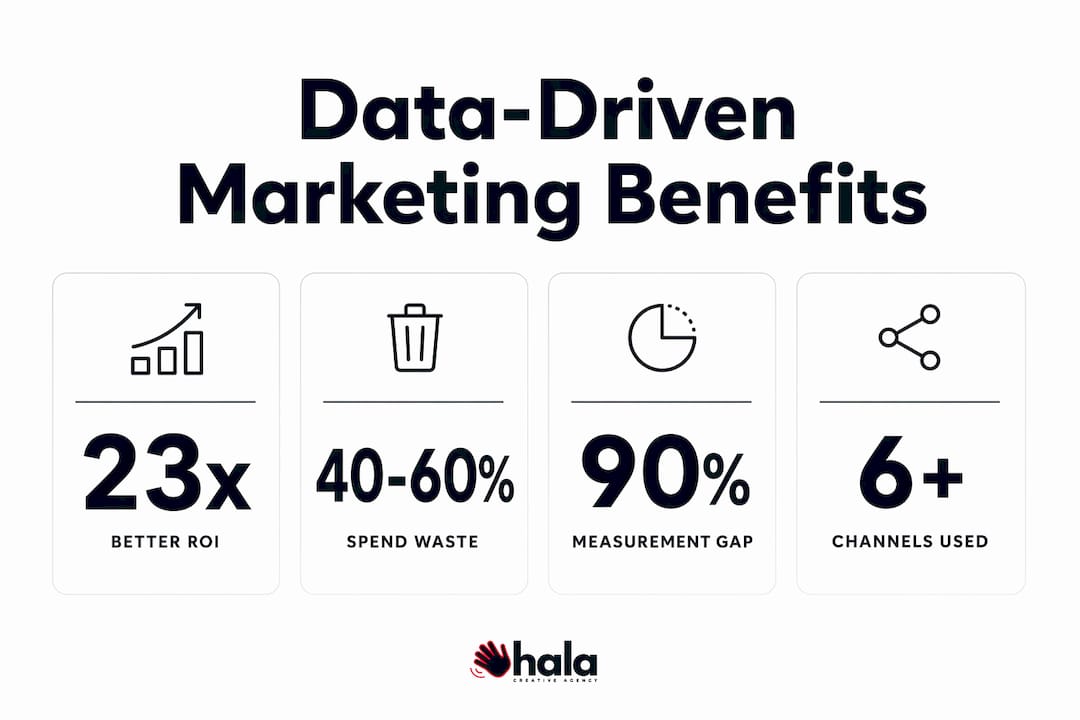
The financial case for data-driven marketing is not theoretical. Organizations using data-driven approaches are 23 times more likely to acquire customers and 6 times more likely to retain them, according to McKinsey research. For a UAE SME competing against larger regional players, that acquisition and retention advantage is the difference between sustainable growth and constant churn.

Budget efficiency is the second major benefit. Research from Formula shows that 40% to 60% of marketing spend is wasted or sub-optimized when businesses allocate budgets without data. That means a business spending AED 50,000 per month on digital advertising could be losing AED 20,000 to AED 30,000 on channels, audiences, or messages that simply do not convert. Data-driven reallocation recovers that waste and redirects it toward what works.
Speed of decision-making is a third advantage that SMEs often underestimate. Traditional marketing waits for quarterly reviews to assess campaign performance. Data-driven teams reallocate budgets faster based on live campaign signals, meaning a poorly performing Google Ads campaign gets adjusted in days, not months. This responsiveness compounds over time into a significant competitive edge.
There is also a measurement reliability issue that is growing more urgent. McKinsey warns that 90% of marketing spend can be financially blind when businesses rely solely on bottom-funnel click metrics. With iOS privacy changes and cookie deprecation affecting attribution across the UAE’s digital ecosystem, businesses that depend on last-click data alone are making expensive decisions with incomplete information.
Pro Tip: If you are currently measuring marketing performance only through Google Analytics last-click attribution, add a simple monthly revenue-per-channel analysis alongside it. This gives you a directional view of true contribution before you invest in more advanced measurement tools.
How can UAE SMEs implement data-driven marketing practically?
Implementation does not require a data science team. It requires discipline, the right tools, and a willingness to change how decisions get made. Here is a practical sequence for UAE SMEs starting this process:
- Audit your current data sources. List every platform collecting customer data: your website, CRM, email tool, ad accounts, and point-of-sale system. Identify where data is duplicated, inconsistent, or siloed.
- Build consent-driven first-party data collection. With privacy regulations tightening across the region, first-party data collected directly from customers with clear consent is your most durable asset. Use lead forms, loyalty programs, and email subscriptions to build this foundation.
- Resolve customer identities across channels. Connect data points from different platforms to the same individual using email addresses or phone numbers as identifiers. This is identity resolution, and it is what makes unified customer profiles possible.
- Adopt triangulated measurement. The IAB’s 2026 State of Data report recommends combining Marketing Mix Modeling with incrementality testing rather than relying on any single attribution method. MMM analyzes aggregate channel spending patterns without requiring individual-level tracking, making it privacy-safe. Incrementality testing uses holdout groups to prove whether a campaign actually caused a conversion or whether the customer would have converted anyway.
- Create a testing calendar. Commit to running at least two structured experiments per month. Test subject lines, landing page headlines, audience segments, or ad creatives. Document results and apply learnings to the next campaign.
- Shift from reporting to deciding. Dashboards are not data-driven marketing. Actual decision changes that follow the data are. Every weekly marketing review should end with at least one concrete change to targeting, budget, or messaging based on what the data shows.
Pro Tip: High-performing data-driven teams personalize across six or more channels, while low performers manage only three. You do not need to reach six channels immediately. Start with two channels where you already have strong data, master personalization there, then expand.
Data fragmentation is the most common barrier UAE SMEs face. Many businesses in Dubai run separate agencies for SEO, paid media, and social, each reporting in isolation. This creates a false picture of performance. Consolidating reporting into a single dashboard, even a simple one built in Google Looker Studio, gives you the cross-channel view needed to make genuinely informed decisions.
How does data-driven marketing improve ROI in the Middle East context?
The UAE market has specific characteristics that make data-driven approaches particularly valuable. Dubai’s consumer base is highly multicultural, with residents from over 200 nationalities. A single broad campaign message rarely resonates across this diversity. Data-driven segmentation allows you to tailor messaging by language preference, cultural context, and purchase behavior, which directly improves conversion rates.
CMO-CFO alignment is another factor that separates high-growth UAE businesses from stagnant ones. McKinsey research emphasizes that CMOs partnering with CFOs to align measurement frameworks consistently prove marketing’s incremental revenue impact. In practical terms, this means marketing teams presenting revenue contribution data in the same language finance teams use, not just impressions and clicks. This builds credibility and protects marketing budgets during economic uncertainty.
AI and automation are accelerating the speed at which data translates into decisions. Tools like Meta Advantage+ and Google’s Performance Max already use machine learning to optimize ad delivery in real time based on behavioral signals. For UAE SMEs, the practical benefit is that AI-driven marketing decisions can now be made at a speed and scale that was previously only accessible to enterprise brands with large analytics teams.
“The real advantage of data-driven marketing is not the data itself. It is the organizational discipline to translate that data into consistent decisions across targeting, messaging, and budget allocation.” — CDP.com
The regional digital maturity gap also creates opportunity. Many UAE SMEs are still in early stages of data adoption, which means businesses that build strong measurement infrastructure now will have a compounding advantage over competitors who delay. The cost of building this infrastructure is lower than most business owners assume, particularly with cloud-based tools like HubSpot, Klaviyo, and Google Analytics 4 available at SME-friendly price points.
Key takeaways
Data-driven marketing gives UAE SMEs a measurable, repeatable advantage by replacing guesswork with decisions grounded in customer behavior, budget performance, and channel attribution.
| Point | Details |
|---|---|
| Customer acquisition advantage | McKinsey data shows data-driven organizations are 23x more likely to acquire customers than intuition-led competitors. |
| Budget waste reduction | Between 40% and 60% of marketing spend is wasted without data-driven allocation, representing recoverable revenue for SMEs. |
| Measurement beyond last-click | Combining Marketing Mix Modeling with incrementality testing gives a more accurate, privacy-safe view of true marketing impact. |
| First-party data as foundation | Consent-driven first-party data collection is the most durable asset for UAE businesses facing increasing privacy restrictions. |
| CMO-CFO alignment drives credibility | Aligning marketing metrics with financial outcomes builds internal trust and protects marketing budgets during business reviews. |
What I have learned from watching UAE businesses adopt data-driven marketing
After working with SMEs across Dubai and the wider UAE, the pattern I see most often is this: businesses collect data but do not change decisions based on it. They install Google Analytics, set up a CRM, run monthly reports, and then continue making the same budget and targeting choices they made before. The data becomes decoration.
The businesses that actually grow are the ones that treat data as a forcing function. Every campaign review ends with a specific change. Every budget decision references a performance metric. This sounds obvious, but it requires a cultural shift that most teams resist because it makes accountability visible.
I have also seen a lot of data paralysis, particularly among business owners who are new to analytics. They wait for perfect data before acting. They want six months of clean historical data before testing a new channel. The reality is that imperfect data acted on quickly beats perfect data acted on slowly. Start with what you have, run a test, measure the result, and improve. That cycle, repeated consistently, is what data-driven marketing actually looks like in practice.
One more thing worth saying directly: do not invest in expensive measurement tools before you have fixed your data hygiene. I have seen UAE businesses spend significant budgets on attribution platforms while their CRM still has duplicate contacts and their ad accounts are tracking the wrong conversion events. Fix the foundation first. The tools are only as good as the data flowing into them.
For UAE SMEs specifically, I would recommend starting with smarter data decisions at the campaign level before attempting full-funnel attribution. Get one channel working with clean data and clear measurement, then expand. Sustainable growth comes from compounding small, well-measured wins.
— Hisham
How Hala Creative Agency helps UAE SMEs build data-driven marketing systems
If you recognize your business in any of the challenges described above, whether that is fragmented reporting, wasted ad spend, or campaigns that run without clear measurement, Hala Creative Agency builds the infrastructure to fix it.

Hala Creative Agency works with small and medium-sized businesses across Dubai and the UAE to design data-driven marketing strategies that connect campaign performance directly to revenue outcomes. Services include measurement setup, first-party data architecture, paid media management, and cross-channel reporting built for SME budgets. The agency’s hybrid AI-human approach means you get the speed of automation with the judgment of experienced marketers who understand the UAE market. Explore proven regional marketing examples or contact Hala Creative Agency directly to discuss your growth goals.
FAQ
What is data-driven marketing in simple terms?
Data-driven marketing means making every marketing decision based on measurable customer data rather than assumptions. This includes decisions about who to target, what message to use, which channels to invest in, and how to allocate budget.
Why is data-driven marketing better than traditional marketing?
Traditional marketing relies on broad demographics and periodic reviews. Data-driven approaches use real-time behavioral and transactional signals to optimize campaigns continuously, which reduces wasted spend and improves conversion rates at every stage of the funnel.
How much budget do UAE SMEs need to start data-driven marketing?
You do not need a large budget to start. Tools like Google Analytics 4, HubSpot’s free CRM tier, and Meta’s native analytics provide sufficient data for most SMEs to begin making better decisions. The investment is primarily in time and process discipline, not expensive software.
What is Marketing Mix Modeling and why does it matter?
Marketing Mix Modeling (MMM) is a statistical method that analyzes how different marketing channels contribute to overall revenue using aggregate data rather than individual tracking. The IAB recommends it as a privacy-safe complement to incrementality testing for more reliable attribution.
How does data-driven marketing help with customer retention?
McKinsey research shows that data-driven organizations are 6 times more likely to retain customers. This is because behavioral data enables personalized follow-up, timely re-engagement campaigns, and loyalty offers targeted to customers most at risk of churning.