
TL;DR:
- Effective marketing budget optimization requires ongoing data-driven analysis across channels to maximize ROI and avoid waste.
- Applying frameworks like 70/20/10, implementing proper tracking, and adjusting budgets incrementally help UAE SMBs build smarter, adaptable strategies.
Marketing budget optimization is the process of allocating and adjusting your spend across channels using precise data and systematic analysis to drive the highest return on investment. For small and medium businesses in Dubai and the UAE, this is not a one-time exercise. It is an ongoing discipline that separates brands that scale from those that stall. Frameworks like the 70/20/10 allocation rule, tools like Facebook CAPI and Marketing Mix Modeling, and methods like zero-based budgeting give you the structure to make every dirham count. The goal is not just to spend less. It is to spend smarter, measure what actually matters, and reallocate continuously based on what the data tells you.
How to optimize your marketing budget: tools and prerequisites
The foundation of any effective budget strategy is granular performance data. You need your CRM, ad platforms like Google Ads and Meta, and your sales pipeline feeding into a single view. Without that integration, you are making allocation decisions based on incomplete signals. Data-driven marketing for UAE businesses explains why this integration is particularly critical for regional SMBs where customer journeys often span offline and online touchpoints.

Server-side tracking mitigates data loss from ad blockers and privacy restrictions, feeding more accurate conversion data back to your ad platforms. In the UAE, where mobile-first behavior and privacy-conscious consumers are both growing trends, this matters more than most marketers realize. Facebook CAPI is the most widely adopted implementation for Meta campaigns, and Google’s Enhanced Conversions serves the same function for Search.
Zero-based budgeting requires justifying every channel spend from zero each cycle rather than carrying over last year’s numbers. This forces your team to ask whether each channel is still earning its place. Most UAE SMBs skip this step and end up funding legacy channels out of habit rather than performance.
The essential software stack for a UAE SMB running paid and organic channels typically includes:
- Google Analytics 4 or a comparable analytics platform for cross-channel attribution
- A CRM like HubSpot or Zoho CRM to connect marketing activity to revenue outcomes
- Meta Business Suite and Google Ads for campaign-level performance data
- A reporting layer like Looker Studio to consolidate metrics into one dashboard
- Server-side tracking implementation via Facebook CAPI or Google Tag Manager server-side
Internal alignment between your marketing and sales teams is non-negotiable. If your sales team is not sharing pipeline data with marketing, you cannot measure true channel contribution to revenue.
Pro Tip: Set up conversion tracking before you run a single dirham of paid spend. Tracking gaps discovered after the fact cannot be retroactively fixed, and the data you lose in the first weeks of a campaign is gone permanently.
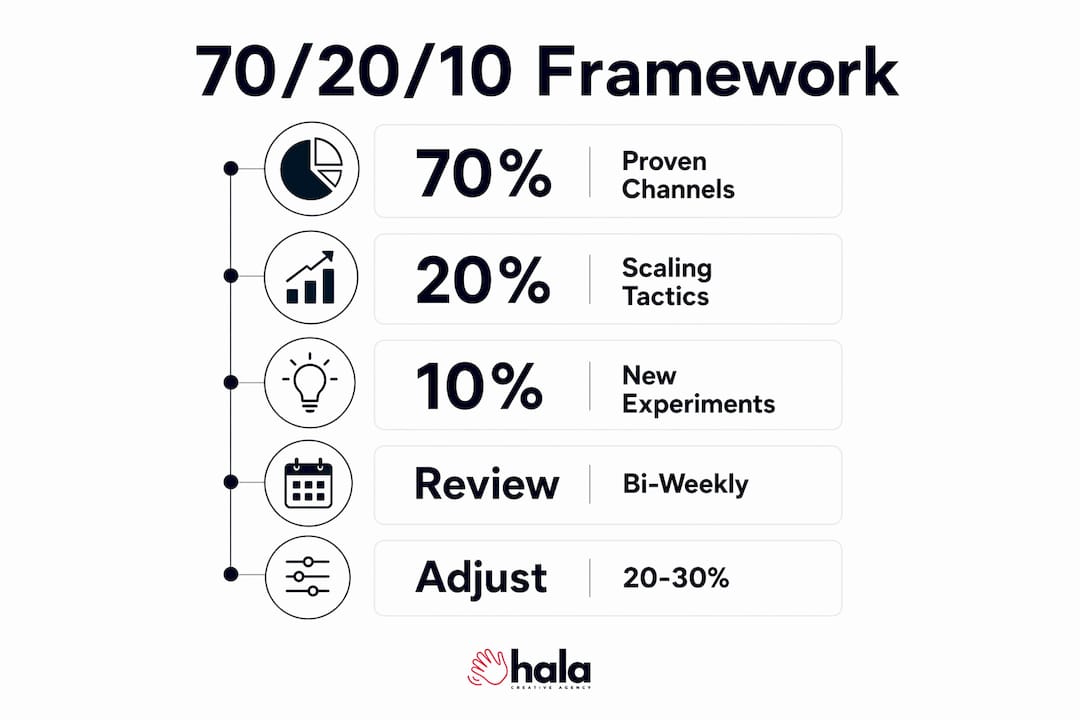
What is the 70/20/10 framework and how does it work?
The 70/20/10 allocation rule is the most practical starting framework for SMBs managing limited budgets across multiple channels. It divides your total marketing spend into three buckets based on risk and expected return. Applied consistently, it prevents both over-investment in unproven channels and under-investment in what is already working.
Here is how each slice functions in practice:
| Allocation | Channel type | Risk level | Expected outcome |
|---|---|---|---|
| 70% | Proven, high-ROAS channels | Low | Stable, predictable revenue contribution |
| 20% | Scaling channels with early positive signals | Medium | Growth potential with manageable downside |
| 10% | Experimental initiatives with defined learning goals | High | Insights and optionality for future scaling |
The 70% bucket is your anchor. For most Dubai SMBs, this means Google Search, high-performing Meta campaigns, or SEO content that is already converting. You protect this spend first. The 20% bucket is where you take calculated bets. If a TikTok campaign or influencer partnership is showing early traction, this is where you fund its growth. The 10% bucket is explicitly for learning. You are not expecting a return here. You are buying information about whether a new channel or format deserves a larger share in the next cycle.
The incremental adjustment rule is equally important. Budget changes should stay within 20 to 30% of current spend per adjustment. Larger shifts disrupt the algorithmic learning phases on Meta and Google, resetting the optimization process and temporarily degrading performance. This is a mistake that costs UAE SMBs real money every month.
Pro Tip: Schedule bi-weekly budget reviews rather than monthly ones during the first 90 days of a new campaign. Early data is noisier, and catching a misallocation at week two costs far less than discovering it at week eight.
How to conduct ongoing performance analysis and reallocation
Budget optimization is iterative portfolio design focused on incremental ROI, not the platform-reported metrics like clicks and impressions that most dashboards surface by default. Incremental ROI measures what revenue you would have lost if you had not run a specific channel or campaign. That distinction matters because some channels look productive in isolation but are actually capturing demand that would have converted anyway.
Follow this stepwise approach to reallocation:
- Establish a 30-day performance baseline for each active channel using CPA, ROAS, and pipeline contribution as your primary metrics.
- Reallocate 10 to 15% of budget from the lowest-performing channel to the highest-performing one and hold that change for two full weeks before evaluating.
- Use Marketing Mix Modeling to analyze channel effectiveness and identify saturation points where additional spend stops generating proportional returns.
- Apply multi-touch attribution to understand which channels are assisting conversions rather than just closing them. Google Analytics 4’s data-driven attribution model is the most accessible option for SMBs.
- Pause or cut placements that have spent more than three times your target CPA without converting. Redirect that budget to high-intent channels like branded search or retargeting.
- Reconcile your CRM revenue data against ad platform reported revenue monthly. Discrepancies of more than 15% signal a tracking issue that is distorting your allocation decisions.
One trap that catches UAE marketers repeatedly is expanding audiences before accumulating sufficient conversion volume. Premature audience expansion can increase CPA by 20 to 50% because the platform loses the conversion signal density it needs to optimize targeting. Build conversion volume first, then broaden.
Pro Tip: Reconcile your CRM and ad platform data every two weeks. Revenue leakage from misattributed conversions is one of the most common and most invisible budget drains for SMBs running multi-channel campaigns.
What mistakes should you avoid in budget optimization?
The most expensive errors in marketing budget management are not about choosing the wrong channel. They are about process failures that compound over time. Recognizing them early saves significant spend.
- Budget theatre: Spending because budget exists rather than because performance justifies it. Monthly or bi-weekly reviews based on measurable drivers are the antidote. If a channel cannot justify its spend against pipeline metrics, it loses its allocation in the next cycle.
- Ignoring attribution nuances: Last-click attribution systematically undervalues top-of-funnel channels like SEO and awareness campaigns. UAE SMBs that rely on last-click data routinely cut channels that are actually driving pipeline. Use a digital advertising strategy that accounts for assisted conversions.
- Over-investing before algorithm readiness: Scaling budget on a campaign that has not yet exited the learning phase on Meta or Google resets the optimization cycle. Wait for at least 50 conversions per ad set before scaling.
- Tracking data discrepancies: Gaps between CRM and platform data are almost always caused by missing server-side tracking. Facebook CAPI and Google Enhanced Conversions close the majority of these gaps for UAE businesses operating in a mobile-heavy environment.
- Budget ownership conflicts: When marketing and finance teams disagree on how to measure channel value, allocation decisions slow down and become political rather than data-driven. Structured review cadences with shared dashboards remove the ambiguity.
Aligning budget reviews with pipeline and revenue metrics rather than just spend figures is the single most effective governance change most UAE SMBs can make. When leadership sees spend tied directly to pipeline contribution, benefits-based budget framing makes approval conversations faster and more rational.
Key takeaways
Businesses that apply granular, data-driven budget management can recover 10 to 20% of existing marketing spend by cutting underperforming channels and reinvesting those savings to generate 5 to 10% revenue growth.
| Point | Details |
|---|---|
| Start with data integration | Connect your CRM, ad platforms, and sales pipeline before making any allocation decisions. |
| Apply the 70/20/10 rule | Protect proven channels with 70%, scale promising ones with 20%, and test new ideas with 10%. |
| Adjust budgets incrementally | Keep changes within 20 to 30% per cycle to avoid disrupting algorithmic learning on Meta and Google. |
| Measure incremental ROI | Platform-reported clicks and impressions do not reflect true channel value. Use Marketing Mix Modeling and multi-touch attribution. |
| Review on a regular cadence | Monthly budget reviews outperform annual fixed budgets because market and competitor dynamics shift faster than annual cycles allow. |
What I have learned optimizing budgets for UAE SMBs
The most persistent mistake I see among Dubai SMBs is treating the annual marketing budget as a fixed contract rather than a working hypothesis. Markets in the UAE move fast. Platform costs on Meta and Google shift seasonally around Ramadan, Dubai Shopping Festival, and Expo-adjacent events. A budget set in January based on Q4 data is already partially wrong by February.
What actually works is building a driver-based model that ties every dirham of spend to a measurable pipeline metric. When you can show leadership that AED 50,000 in Google Search spend is generating 120 qualified leads at a specific cost per lead, the conversation about reallocation becomes straightforward. When you cannot show that, every budget decision becomes a negotiation based on opinion.
I have also seen UAE businesses consistently underestimate the impact of local platform behavior. Snapchat, for example, carries disproportionate reach among younger UAE demographics compared to its performance in Western markets. TikTok’s cost-per-click in the Gulf is still materially lower than Meta in many verticals. These are not global best-practice insights. They come from running campaigns in this specific market and watching the data.
The social media workflow for Dubai SMBs matters as much as the budget split. A well-structured workflow prevents the kind of reactive spending that burns through experimental budget without generating any learning. Discipline in process is what separates teams that get smarter each month from those that repeat the same allocation mistakes on a new budget cycle.
— Hisham
How Hala Creative Agency helps UAE businesses spend smarter
Hala Creative Agency works with Dubai and UAE SMBs to build marketing budget strategies grounded in real performance data, not guesswork. The team handles data integration setups, server-side tracking implementation, and continuous campaign optimization across paid and organic channels.
If your current budget is producing inconsistent returns or you are not sure which channels are actually driving revenue, Hala Creative Agency can audit your spend and build a reallocation plan tailored to your market. The agency’s branding and growth approach for Dubai businesses connects budget strategy directly to brand performance, so every dirham you spend builds both short-term pipeline and long-term equity. Reach out for a consultation and get a budget framework built specifically for your business.
FAQ
What is the 70/20/10 marketing budget rule?
The 70/20/10 rule allocates 70% of your budget to proven, high-return channels, 20% to scaling promising tactics, and 10% to experimental initiatives. It balances stability with growth and prevents over-investment in unproven channels.
How much of my marketing budget should I reallocate at once?
Reallocation changes should stay within 20 to 30% of current spend per adjustment cycle. Larger shifts disrupt the algorithmic learning phases on platforms like Meta and Google, which temporarily increases costs and reduces performance.
Why do my ad platform metrics not match my CRM revenue data?
Discrepancies between ad platform data and CRM data are typically caused by missing or incomplete conversion tracking. Implementing server-side tracking tools like Facebook CAPI or Google Enhanced Conversions closes most of these gaps by recovering data lost to ad blockers and browser privacy restrictions.
How often should I review my marketing budget allocation?
Monthly reviews outperform annual fixed budgets because market conditions, competitor activity, and platform costs shift continuously. For new campaigns, bi-weekly reviews during the first 90 days catch misallocations before they compound.
What is incremental ROI and why does it matter?
Incremental ROI measures the revenue you would have lost without a specific channel or campaign, rather than total attributed revenue. It prevents the common mistake of funding channels that appear productive but are actually capturing demand that would have converted through other means anyway.