
TL;DR:
- Brand voice is the consistent personality conveyed through a brand’s words across all communication channels. It remains fixed while tone adapts to context, helping build trust and drive revenue. Maintaining clear, actionable guidelines ensures voice consistency and prevents content drift across teams and platforms.
Brand voice is defined as the consistent personality a brand expresses through its words, covering vocabulary, sentence structure, and perspective across every piece of communication. It is not a campaign mood or a seasonal refresh. It is the fixed verbal identity that makes your brand recognizable whether someone reads your Instagram caption, your email newsletter, or your website homepage. For marketing professionals and business owners in Dubai and across the Middle East, getting brand voice explained clearly is the first step toward building a brand that earns trust and drives real revenue.
What is brand voice and why does it matter for your business?
Brand voice is a verbal architecture system: a set of fixed traits including vocabulary choices, sentence structure, and point of view that keeps your content coherent across multiple writers, agencies, and AI drafts. Think of it as the written equivalent of a person’s speaking style. You recognize a close friend’s voice in a text message before you see their name. Your brand should work the same way.
The most common confusion in understanding brand voice is mixing it up with tone. Voice is fixed. Tone shifts by context but voice always stays the same personality. A brand can be warm and direct in a customer service reply and still be warm and direct in a product launch announcement. The words and energy adapt; the underlying character does not.
The business case for consistency is concrete. Consistent brand presentation is linked to an average revenue lift of 23%, with the most consistent brands seeing up to 33% uplift. Brands that lack consistency spend roughly 1.75 times more on media to achieve the same results. That gap represents real budget waste that a clear voice guide can prevent.
Brand voice consistency is the primary driver of trust in written content. Each consistent interaction reinforces recognition and reduces the perceived risk a buyer feels before making a purchase. Each inconsistent interaction does the opposite.
“Brand voice matters because it keeps messaging intentional, trustworthy, and cohesive across every touchpoint, reducing off-brand content risk.” — Hootsuite
About 95% of organizations have brand guidelines, but only 25–30% enforce them. That enforcement gap is where most of the ROI opportunity sits.
The core difference between voice and tone:
- Voice: Fixed. The same across all channels. Defined by vocabulary, sentence length, and perspective.
- Tone: Flexible. Adapts to context, audience, and platform without changing the underlying personality.
- Example: Liquid Death uses irreverent, punk-influenced language everywhere, from product labels to customer service replies. The tone shifts slightly by channel, but the voice never softens into something corporate.
How to define and document your brand voice effectively
Defining your brand voice starts with two inputs: your audience and your mission. Your voice should reflect how your audience actually speaks and what your company genuinely stands for. A forced tone that does not connect to either will feel hollow and will not hold up across writers or over time.
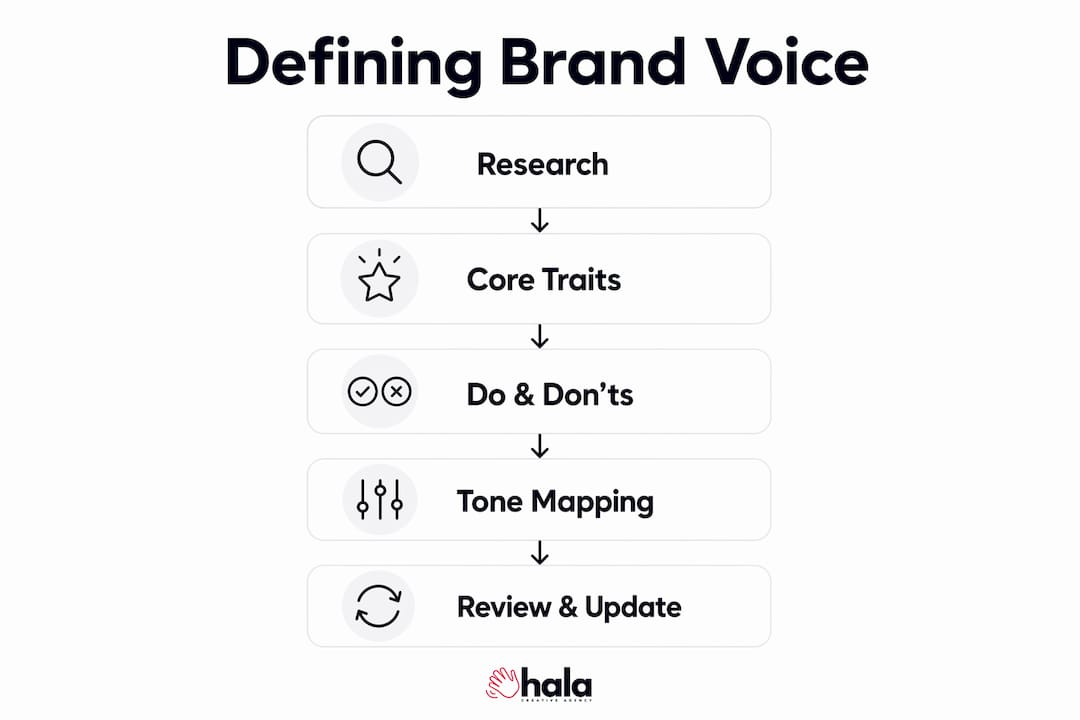
Follow these steps to build a voice that works in practice:
- Audit your existing content. Pull 10–15 pieces of content across channels. Identify words and phrases that appear repeatedly. Note what feels right and what feels off. This gives you a baseline.
- Define 3–5 core voice traits. Keep the list short. Effective brand voice guides use 3–5 traits that are specific and actionable, not vague adjectives like “friendly” or “professional.” Each trait should include a brief definition and a trade-off. For example: “Direct, not blunt. We get to the point without being dismissive.”
- Write a voice statement. One or two sentences that capture the personality. Pair it with a tone map that shows how the voice adapts across situations like social media, email, and customer complaints.
- Build a do/don’t list. For each trait, write three examples of on-brand language and three examples of off-brand language. Include a banned words list. Words like “synergy,” “leverage,” and “solutions” are common culprits that drain personality from copy.
- Add before/after rewrites. Take real content from your brand and rewrite it to show the difference. Before/after examples demonstrate on-brand versus off-brand language more clearly than any description can.
Pro Tip: Write your voice guide for a new freelancer who has never worked with your brand. If they can pick it up and write on-brand copy in 30 minutes, the guide is working. If they need a meeting to understand it, it is too conceptual.
The table below shows the difference between a weak voice descriptor and a usable one:
| Weak descriptor | Usable voice trait |
|---|---|
| Friendly | Warm but never casual. Use first names. Avoid exclamation points. |
| Professional | Clear and direct. Short sentences. No jargon. |
| Bold | Takes a clear position. Never hedges with “it could be argued.” |
| Innovative | Explains new ideas simply. No buzzwords. |
For Dubai businesses building their identity from the ground up, Hala Creative Agency has published a step-by-step voice process that covers audience research through final documentation.

How to maintain brand voice consistency across channels and teams
Consistency breaks down at scale. When three writers, two agencies, and an AI tool are all producing content for the same brand, the voice drifts unless the guide gives them concrete rules to follow. Documenting voice alone is not enough. Explicit constraints on word use and channel-specific guidance prevent generic, inconsistent drafts.
The most practical tool for multi-author teams is a voice chart. A voice chart maps each principle to concrete examples of vocabulary, sentence structure, and perspective. Reviewers use it to check content systematically rather than relying on gut feel. This removes subjectivity from the approval process and speeds up review cycles.
Tone maps work alongside the voice chart. A tone map shows how the emotional register shifts by channel without changing the core voice. A real estate brand in Dubai might use a confident, reassuring tone in property listings and a lighter, more conversational tone in social media posts. The vocabulary stays consistent. The energy adjusts.
Common pitfalls that break consistency:
- Rewriting all content to match a campaign mood, which fragments brand identity and creates a different “voice” for every launch.
- Creating a voice guide that is too long or too conceptual for daily use. Practitioners favor short, scannable guides with clear constraints over detailed philosophy documents.
- Assigning no one to own voice decisions. Without a named owner, enforcement defaults to whoever reviewed the last piece of content.
- Treating AI-generated drafts as final. AI tools produce content at volume, but without explicit voice rules fed into the prompt, the output defaults to generic.
Pro Tip: Treat your brand voice guide as a living document. Schedule a quarterly review to update banned words, add new before/after examples, and reflect any shifts in your audience or market position.
For regional context on how branding strategies connect voice to broader identity work, the frameworks apply directly to SMBs operating across the UAE and wider Middle East.
Brand voice examples and common misconceptions
The clearest way to understand brand voice is to see it in action. Two brands selling water can sound completely different. Liquid Death uses aggressive, irreverent language. La Croix uses light, playful language. Neither voice is better. Both are consistent, and that consistency is what makes each brand recognizable without a logo in sight.
The table below shows how the same message sounds in three distinct brand voices:
| Message | Formal voice | Conversational voice | Bold voice |
|---|---|---|---|
| Product launch | “We are pleased to introduce our latest offering.” | “We just launched something we think you’ll love.” | “It’s here. And it changes everything.” |
| Customer complaint | “We apologize for any inconvenience caused.” | “That’s on us. Let’s fix it right now.” | “Not good enough. Here’s what we’re doing about it.” |
| Call to action | “Please contact our team for further information.” | “Drop us a message. We’ll get back to you today.” | “Talk to us. No forms. No waiting.” |
The most common misconception about brand voice is that it should change with each campaign. Campaigns change. Voice does not. A brand running a Ramadan campaign in Dubai and a product launch campaign in the same quarter should sound like the same company in both. The creative concept adapts. The personality stays put.
The second misconception is that a list of adjectives counts as a voice guide. A list of adjectives alone is insufficient. Operationalizing voice requires structural rules, banned words, and examples. “Confident” means nothing to a writer without a sentence showing what confident looks like on the page.
Reducing voice to operational writing rules with examples and banned word lists is the single most effective way to minimize inconsistency across teams and content types.
Key Takeaways
A well-documented brand voice with concrete rules and examples is the most reliable way to build recognition, earn trust, and reduce wasted media spend.
| Point | Details |
|---|---|
| Voice is fixed, tone is flexible | Voice stays constant across all channels; tone adapts to context without changing the core personality. |
| Consistency drives revenue | Consistent brand presentation links to up to 33% revenue uplift and significantly lower media spend. |
| Keep the guide short and usable | Use 3–5 traits with do/don’t examples and a banned words list. Long conceptual guides go unused. |
| Assign clear ownership | Name one person responsible for voice decisions to prevent enforcement gaps and content drift. |
| Update the guide regularly | Quarterly reviews keep the voice relevant as your audience, market, and channels evolve. |
Why most brand voice projects fail before they start
The brands I see struggle most with voice are not the ones that skipped the process. They are the ones that completed it and then filed the document. They ran a workshop, wrote five adjectives on a slide, and called it a voice guide. Six months later, their Instagram sounds nothing like their email newsletter, and their AI-generated blog posts read like a different company entirely.
The real failure is treating brand voice as a creative exercise instead of an operational system. Voice is infrastructure. It needs the same rigor as a style guide or a content approval workflow. The brands that get this right, whether they are hospitality groups in Dubai or e-commerce startups across the Gulf, share one habit: they assign a named owner to voice decisions and they give that person actual authority to reject off-brand content.
The second thing I have learned is that the guide format matters as much as the content. A two-page voice chart with examples beats a 20-page brand bible every time. Writers open the two-pager. The bible sits in a shared drive. If you are working with AI tools or multiple freelancers, concrete rules and banned word lists are not optional. They are the only thing standing between your brand and generic output.
Audit your voice guide today. If a new writer cannot apply it in 30 minutes without asking questions, it needs a rewrite. For Dubai businesses looking at branding tips for the Middle East market specifically, the principles are the same but the cultural and linguistic context adds another layer worth addressing directly in your documentation.
— Hisham
How Hala Creative Agency helps you build a voice that holds
Building a brand voice that actually holds across channels, teams, and AI tools takes more than a workshop and a word list. Hala Creative Agency works with SMBs across Dubai and the wider Middle East to develop voice guides that are built for daily use, not shelf storage.
The process covers audience research, core trait definition, do/don’t documentation, and channel-specific tone maps. The result is a guide your writers, agencies, and AI tools can apply without a briefing call every time. For businesses ready to turn voice into a measurable marketing asset, the marketing services at Hala Creative Agency are built around exactly that outcome. Brand consistency is not a creative luxury. It is a growth driver, and the right documentation makes it repeatable.
FAQ
What is brand voice in simple terms?
Brand voice is the consistent personality a brand uses in all its written and spoken communications, defined by vocabulary, sentence structure, and perspective. It stays the same across every channel and every campaign.
What is the difference between brand voice and tone?
Voice is fixed and reflects the brand’s core personality. Tone is flexible and shifts based on context, such as a social media post versus a customer service reply, without changing the underlying voice.
How many traits should a brand voice guide include?
Effective brand voice guides define 3–5 core traits. Each trait should be specific, include a trade-off statement, and come with do/don’t examples and a banned words list.
Why does brand voice matter for revenue?
Consistent brand presentation is linked to an average revenue lift of 23%, with the most consistent brands reaching up to 33%. Inconsistent brands spend roughly 1.75 times more on media to achieve the same results.
How often should you update your brand voice guide?
A quarterly review is the standard practice. Updates should reflect changes in your audience, new channels, and any shifts in market position or company values.