
TL;DR:
- Most startup founders underestimate branding’s role in building customer trust, recognition, and emotional connection. Strong branding enhances marketing efficiency and physical availability, essential for growth, especially in competitive markets like the UAE. Integrating brand strategy with channel access and ongoing iteration creates sustainable long-term business success.
Most startup founders think branding means a logo, a color palette, and a tagline. That framing costs them customers. The real role of branding for startups is building the mental and emotional infrastructure that makes buyers think of you, trust you, and choose you over everyone else. It shapes perception before a salesperson ever makes contact. In markets like Dubai and the wider UAE, where new businesses compete against established names and well-funded rivals, effective branding is not a luxury. It is the foundation every other growth activity depends on.
Table of Contents
- Key Takeaways
- The role of branding for startups, defined
- Mental availability, physical availability, and buying triggers
- Branding strategies that build mental and physical presence
- Applying brand strategy as a startup founder
- Why strong branding pays off long-term
- My honest take on where startup founders get this wrong
- How Hala Creative Agency helps startups build brands that grow
- FAQ
Key Takeaways
| Point | Details |
|---|---|
| Branding is not marketing | Branding builds identity and trust; marketing promotes it. Both serve distinct, complementary roles. |
| Mental availability drives purchase | Buyers choose brands they think of in buying moments, not just brands they have heard of. |
| Category entry points matter | Aligning your brand with specific buying triggers makes it more likely you get considered at all. |
| Physical availability closes the loop | Great branding without easy purchase access still loses sales. Channel strategy must match brand strategy. |
| Measure the right things | Track how often buyers think of you in purchase situations, not just general awareness scores. |
The role of branding for startups, defined
Branding is often confused with its most visible outputs. The logo. The fonts. The Instagram aesthetic. Those are brand assets. They are not the brand itself.
Brand identity is the full set of values, associations, emotions, and experiences a customer connects to your company. It answers the question: what does this business stand for, and why should I trust it? Branding builds identity and emotional connection, while marketing creates visibility and customer acquisition. Both matter. Neither replaces the other.
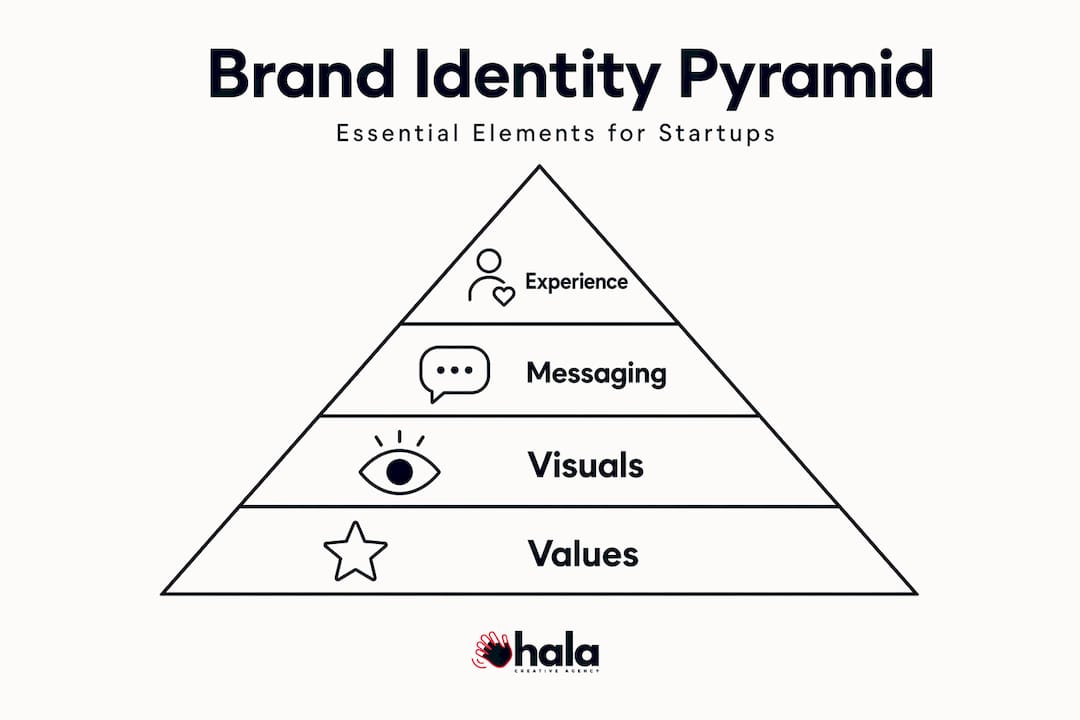
Here is why this distinction matters so much for founders. You can run ads, do outreach, and attend every trade show in the Gulf, but if buyers do not have a clear, positive picture of what your company represents, your marketing spend works much harder for much smaller returns. Branding is what makes marketing efficient.
For startups specifically, early-stage brand building does several things at once:
- Builds credibility before you have years of reviews or a long client roster to prove it
- Reduces perceived risk for buyers who have never heard of you and need a reason to trust you
- Creates a consistent story your entire team can tell across every channel and customer touchpoint
- Establishes emotional connection so customers feel something about your business, not just an opinion
Think of branding as the answer to a question buyers ask silently: “Is this company real, and do they get me?” Your brand either answers that question convincingly or leaves the buyer looking elsewhere.
Mental availability, physical availability, and buying triggers

This is where most startup branding guides go wrong. They talk about brand awareness as if it is a number you chase. “We need more awareness.” But mental availability is not awareness in the traditional sense. It is something more specific and more valuable.
Mental availability is whether your brand comes to mind when a buyer enters a purchase situation. Not whether they vaguely recognize your name. Whether they think of you when they are ready to buy. Those are two completely different things.
What category entry points actually are
Category Entry Points, or CEPs, are the specific triggers, needs, and contexts that put a buyer into purchase mode. A startup selling project management software does not just want to be “known.” It wants to be the brand that comes to mind when a team lead thinks, “We keep missing deadlines” or “Our remote team is totally out of sync.”
CEP coverage determines whether a brand can effectively get bought. Without connecting your brand to the specific triggers buyers experience, even a beautiful identity will not drive consideration.
The physical side buyers often ignore
Mental availability gets your brand considered. Physical availability gets the deal done. B2B brand growth requires both: being thought of in buying situations and being easy to find and purchase through relevant channels.
A startup with strong mental availability but weak physical availability is like a restaurant people love the idea of but can never find a reservation for. The enthusiasm exists. The conversion does not.
Common physical availability failures include:
- No presence on the procurement platforms or marketplaces your buyers actually use
- Sales team coverage that does not match where your buyers research and decide
- A website that ranks poorly or creates friction during the evaluation stage
- Missing from industry events or directories where buyers build shortlists
Pro Tip: Run a simple exercise: walk through your own purchase journey as if you are a new buyer who has never heard of your company. Count every obstacle. Fix the worst three before spending another dirham on brand awareness campaigns.
Branding strategies that build mental and physical presence
Not every branding tactic serves the same goal. Some build mental availability. Others improve physical availability. Smart founders know which one they need more of at any given stage.
| Tactic | Primary goal | Notes for startups |
|---|---|---|
| Distinctive visual identity | Mental availability | Consistent assets help memory structures form faster |
| Owned media (blog, podcast, social) | Mental availability | Builds association with CEPs over time at low cost |
| SEO and content marketing | Physical availability | Gets you found during active research and buying |
| Trade shows and events | Both | High cost but builds trust and physical presence together |
| Paid placement (ads, promoted listings) | Physical availability | Rented prominence delivers short-term lift but stops when spend stops |
| Partnerships and integrations | Physical availability | Puts you in channels where buyers already operate |
| PR and thought leadership | Mental availability | Associates your brand with category-relevant topics and problems |
The balance matters. Owned prominence through distinctive assets reduces long-term dependence on paid placements. Paid placements deliver quick wins but stop the moment you stop spending. For startups with limited budgets, building owned brand presence early is the more sustainable play.
Pro Tip: Before investing in paid visibility, build at least three to five distinctive brand assets that consistently signal your company across all channels. A recognizable visual mark, a consistent voice, and a unique brand phrase work better than interchangeable corporate stock-photo aesthetics.
For founders operating in the UAE, branding for Middle East SMBs carries additional considerations around cultural resonance, language, and the pace of relationship-based purchasing in regional B2B markets.
Applying brand strategy as a startup founder
Understanding the theory is one thing. Putting it to work inside a startup with limited time and a small team is another. Here is how to approach it practically.
-
Identify your Category Entry Points first. Run elicitation surveys or structured interviews with existing customers and prospects. Ask what triggered them to start looking for a solution. Ask what words or problems they associate with your category. The patterns that emerge are your CEPs. Prioritize the top three to five.
-
Audit your brand against those CEPs. Does your website copy, your LinkedIn presence, your pitch deck, and your sales materials reflect those specific triggers? Most startup brands talk about their product features. Buyers are thinking about their problems. Close that gap.
-
Map your physical availability gaps. List every channel where your buyers research, compare, and purchase. Where are you absent? Where is a competitor better positioned? This is not just about digital channels. It includes distribution partners, sales coverage territories, and channel programs.
-
Build KPIs around mental availability. Mental availability metrics measure how often buyers think of your brand across multiple entry points, not just whether they recognize your name in a survey. Track consideration rates, brand recall in specific buying situations, and share of voice within your category.
-
Iterate based on what the market tells you. Your first brand positioning will not be perfect. That is fine. The founders who build great brands treat it as an ongoing refinement process rather than a one-time deliverable. Read the data, talk to customers, and adjust.
For a structured view of how to apply this step by step, the branding workflow for Dubai SMBs walks through the practical sequencing in detail.
Pro Tip: Do not wait until you have funding to take branding seriously. The founders who build strong brands early spend less on customer acquisition later. Brand equity compounds over time, and starting the clock earlier gives you a real advantage over competitors who delay.
Why strong branding pays off long-term
The long-term benefits of branding for startups go well beyond getting recognized. The compounding effect of a consistent, well-positioned brand shows up in ways that directly affect your growth rate and business health.
- Known brands reduce rejection risk: in B2B buying, hidden buyers are 31% more likely to reject unknown brands and 70% more likely to reject brands that are poorly known within buying groups. A strong brand neutralizes that resistance before it starts.
- Higher customer retention follows strong emotional connection. Buyers who feel aligned with a brand’s identity come back and refer others without prompting.
- Premium pricing becomes defensible. A well-recognized brand justifies price differences in ways that pure product specs cannot.
- Investor confidence grows when a startup demonstrates deliberate, consistent brand building. Investors read brand quality as a signal of founder maturity and market judgment.
- Sustainable marketing efficiency improves over time. Strong mental availability means your paid campaigns convert at higher rates because the brand is already trusted by the time an ad appears.
For a deeper look at how advertising supports brand building for UAE businesses specifically, the research-backed connections between spend and mental availability are worth understanding before planning your next campaign.
My honest take on where startup founders get this wrong
I have worked with a lot of founders who genuinely believe they have a branding problem when they actually have a physical availability problem. They have built a recognizable identity. Their content is good. Their visual work is sharp. But they cannot figure out why sales are flat. Nine times out of ten, buyers simply cannot easily find them, evaluate them, or buy from them through the channels they actually use.
The reverse is just as common. A startup invests in distribution and channel coverage but has no consistent brand story behind it. Sales reps go into meetings with different pitches. The website says one thing. The LinkedIn page says another. Buyers who encounter the brand in multiple places get confused, and confusion kills consideration.
What I have learned is that the most common branding mistake is treating mental and physical availability as sequential. “First we build the brand, then we sort out distribution.” That logic sounds clean but does not hold up in practice. Both need to develop together. Your brand recognition efforts and your channel strategy should be planned in the same conversation, not handed off to different teams operating in isolation.
Patience is the other lesson. Brand building is a slow burn. The founders who expect brand investment to pay off in 30 days end up abandoning it right before it would have started working.
— Hisham
How Hala Creative Agency helps startups build brands that grow
At Hala Creative Agency, we work with startups and emerging businesses across the UAE to build brands grounded in marketing science, not just aesthetic instinct.
Our process starts with research. We identify the Category Entry Points your buyers actually use, map your physical availability gaps, and build a brand identity that connects your positioning to the channels where your buyers make decisions. Whether you are entering a competitive Dubai market for the first time or scaling a regional business that needs a sharper identity, our startup branding and marketing services are built to deliver measurable results. We also have a clear view of why a branding agency accelerates growth in ways that in-house teams working alone rarely match. If you are ready to build a brand that actually converts, let’s talk.
FAQ
What is branding for startups, exactly?
Branding for startups is the process of creating a distinct identity, including values, visual assets, and messaging, that shapes how customers perceive and remember your business. It goes well beyond a logo to include every experience a buyer has with your company.
How does branding differ from marketing?
Branding defines who you are and builds trust; marketing promotes your offer and drives acquisition. Both are necessary, but branding is the foundation that makes marketing more effective over time.
What are category entry points and why do they matter?
Category Entry Points are the specific triggers and contexts that put a buyer into purchase mode. Brands that link their identity to CEPs are far more likely to be considered when buyers are ready to decide.
Why is physical availability important for startup branding?
Physical availability means being easy to find and purchase in the channels buyers actually use. Without accessible purchase options, strong brand awareness does not convert into sales, especially in B2B markets.
How should startups measure branding effectiveness?
Rather than tracking general awareness, startups should use mental availability metrics that measure how often buyers recall the brand in specific buying situations across multiple category entry points.