

TL;DR:
- Digital transformation for Dubai SMBs is a comprehensive rethink of how businesses operate, deliver value, and engage customers using digital capabilities.
- It emphasizes reimagining processes, culture, and customer experience to create meaningful growth, not just technological upgrades.
Many Dubai business owners assume digital transformation means upgrading their software or building a new website. It doesn’t. What is digital transformation, really? It’s a complete rethinking of how your business operates, delivers value, and engages customers using digital capabilities. For small and medium businesses in Dubai competing in one of the world’s most fast-moving markets, getting this distinction right is the difference between incremental improvement and actual growth.
Table of Contents
- What is digital transformation and why it matters for Dubai SMBs
- Distinguishing digital transformation from digitization and digitalization
- Key components of a successful digital transformation
- Common pitfalls and how Dubai SMBs can avoid them
- How digital transformation boosts marketing and growth for Dubai businesses
- Why many Dubai SMBs still misunderstand digital transformation and how to think about it differently
- How Hala Creative Agency can support your digital transformation journey in Dubai
- Frequently asked questions
Key Takeaways
| Point | Details |
|---|---|
| True transformation | Digital transformation is a fundamental rethink of your business strategy and customer engagement, not just technology adoption. |
| Components to align | Success requires aligning technology, process changes, and a culture open to innovation and experimentation. |
| Avoid pitfalls | Don’t mistake digital tools for transformation; redesign processes for real impact to prevent fragmentation. |
| Marketing growth | Transformation empowers personalized marketing and seamless customer experiences that drive sustainable growth. |
| Start strategically | Begin with a holistic customer journey analysis to identify where digital capabilities can create new value. |
What is digital transformation and why it matters for Dubai SMBs
Digital transformation is, at its core, about reimagining your business from the customer’s perspective outward. According to Salesforce, it is “the process of using digital technologies” to create new or modify existing business processes, culture, and customer experiences to meet changing business and market requirements. Coursera adds that it is “the process of integrating digital technologies” into all parts of an organization to deliver value to customers.
Notice what both definitions share: the word value. Not efficiency. Not speed. Value. That framing matters because it shifts your question from “what tools should I buy?” to “what does my customer actually need from me?”
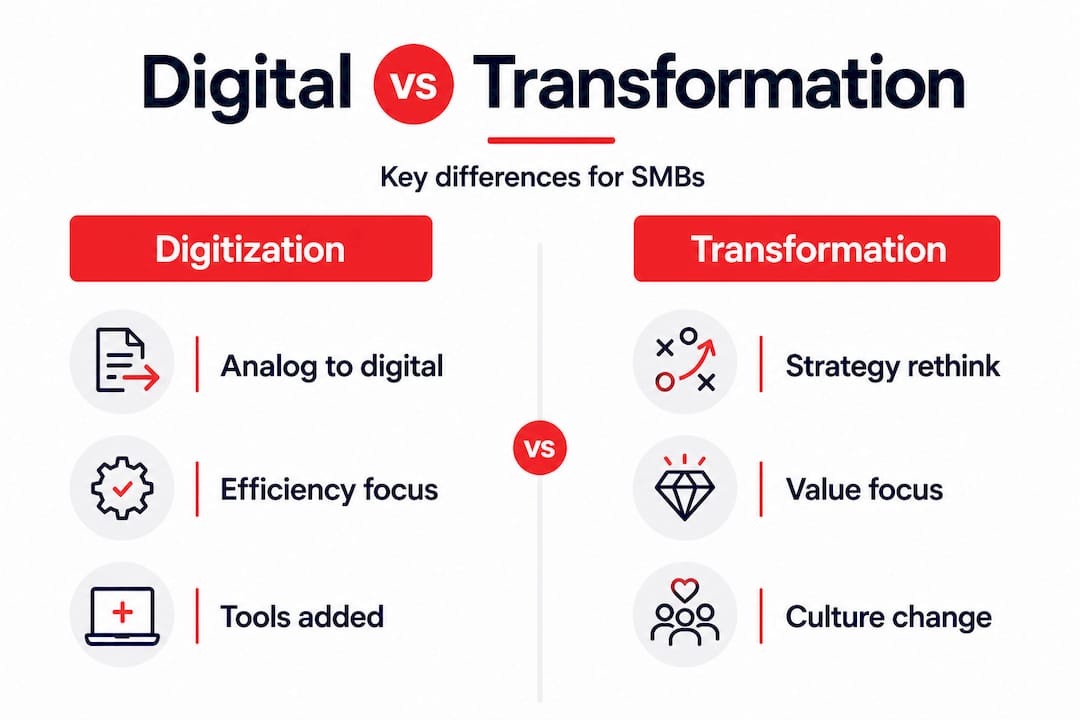
For Dubai SMBs, this is especially urgent. Customers in the UAE expect fast, personalized, and consistent experiences across every touchpoint. Whether they find you on Instagram, visit your website, or walk into your shop, the experience should feel coherent. That coherence comes from transformation, not technology selection.
Here is what digital transformation actually touches in your business:
- Business processes: How work gets done, from sales to fulfillment to customer service
- Company culture: Whether your team experiments, adapts, and makes decisions using data
- Customer experience: How buyers interact with your brand across every channel
- Business model: Whether you create and deliver value the same way you did five years ago
Exploring digital tools for customer journeys can help you understand where these touchpoints currently fall short and where transformation can have the most impact.
Distinguishing digital transformation from digitization and digitalization
This is where most SMB owners get confused, and the confusion is costly. These three terms are not interchangeable, and treating them as equivalent is one of the most common strategic mistakes in business today.
Here’s how they differ:
| Term | What it means | Example |
|---|---|---|
| Digitization | Converting analog content to digital format | Scanning paper invoices to PDFs |
| Digitalization | Using digital tools to improve existing processes | Using accounting software to manage the same old billing process |
| Digital transformation | Rethinking strategy, operations, and customer engagement using digital capabilities | Redesigning billing as a self-service customer portal that reduces friction and increases retention |
The distinction is not academic. When a Dubai restaurant builds a website and calls it “going digital,” they have digitized their menu. When they add an online reservation system, they have digitalized a process. But when they use customer data from that reservation system to personalize follow-up messages, adjust menu offerings by demand, and route staff scheduling automatically, that’s transformation.
Many SMBs launch a website and feel they have completed something meaningful. They have, but it’s a first step, not a finish line. Reviewing a digital marketing checklist can reveal exactly where you currently sit on this maturity curve and what gaps remain.
The goal is to avoid spending money on tools that layer over broken processes. That never produces transformation. It only produces expensive broken processes.
Key components of a successful digital transformation
With the differences clear, let’s explore the pillars that support a successful digital transformation. Successful transformation is built on three connected dimensions, and weakness in any one of them limits the others.
-
Technology modernization: Replacing or updating the platforms your business runs on so they can communicate with each other, scale with demand, and give you real-time data. Outdated systems that cannot share data are a ceiling on growth.
-
Process redesign: Not just digitizing how you currently work, but questioning whether the process itself makes sense. A checkout flow that takes eight steps might need to become three. A client onboarding that relies on email chains might need a structured portal.
-
Culture shift: This is where most transformations fail. Technology modernization, process change, and culture are connected dimensions essential to transformation success. Culture means your team treats data as a decision-making tool, not a reporting chore. It means leadership welcomes experimentation and does not punish honest failure.
As Coursera notes, a culture open to change and experimentation is not a nice-to-have. It is a prerequisite. Two businesses using identical tools will get radically different results based solely on whether their teams are empowered to act on what the data tells them.
Pro Tip: Before investing in any new technology, map your top three customer-facing processes on paper. If you cannot explain how each step creates value for the customer, the process is a candidate for redesign, not just digitization.
Understanding how to structure a digital marketing workflow for SMEs is a practical way to apply this framework immediately.
Common pitfalls and how Dubai SMBs can avoid them
Understanding the essentials helps, but knowing what to avoid is equally important for your success. The following mistakes appear repeatedly among Dubai SMBs attempting transformation, and each one is preventable.
-
Treating tool adoption as transformation: True change requires process redesign and measurable value outcomes. Buying a CRM does not transform your sales process unless you redesign how your team qualifies leads and follows up.
-
Fragmented digital efforts: Running your social media, website, email marketing, and customer service on disconnected platforms creates inconsistent experiences. Customers feel it immediately, even if you don’t notice it internally.
-
Misaligned data ownership: When no one person or team owns the customer journey data, decisions get made in silos. Marketing doesn’t know what customer service hears. Sales doesn’t know what marketing is promising. Without aligned people and processes, tech investments cause fragmentation and impede durable capabilities.
-
Layering technology over old workflows: This is the most expensive mistake. If your approval process requires three managers to sign off on a social media post, adding a new scheduling tool doesn’t fix that. The workflow is the problem.
-
Skipping the customer journey audit: Your digital maturity gaps are most visible in your customer’s experience, not your internal dashboards. Map the journey from first awareness to post-purchase and look for friction.
Pro Tip: Assign one person in your business to own the customer journey end to end. Not a department. One person. Their job is to spot friction and escalate it for resolution. This single change prevents most fragmentation issues before they compound.
Understanding why digital agencies drive real growth for UAE businesses helps frame when external expertise prevents these costly errors.
How digital transformation boosts marketing and growth for Dubai businesses
Having covered pitfalls, let’s see how digital transformation directly fuels your marketing success and growth. When transformation is done right, it changes the quality of every marketing decision you make.

Salesforce puts it clearly: transformation begins and ends with how you think about and engage customers. It drives business model innovation, not just operational efficiency. In marketing terms, this plays out in very specific ways.
What transformation enables in your marketing:
- Personalized campaigns based on real purchase and behavior data, not assumptions
- Unified customer profiles that combine your website, social, and CRM data
- Automated workflows that trigger the right message at the right moment in the buyer journey
- Measurable attribution that shows which channels actually drive revenue
- Faster iteration because your team isn’t buried in manual reporting
A practical step-by-step approach for Dubai SMBs:
- Audit your current customer data sources and identify gaps or disconnects
- Pick one high-impact customer journey (acquisition or retention) and redesign it using digital capabilities
- Set measurable outcomes before you build anything (conversion rate, response time, retention rate)
- Integrate channels so customer data flows between your website, email, and social platforms
- Review results monthly and adjust based on actual data, not gut feel
Digital marketing strategies for UAE SMBs confirm that transformation reshapes marketing strategy and approach, enabling better engagement and measurable growth. For Dubai businesses specifically, where competition across retail, F&B, real estate, and professional services is intense, this capability is a real competitive edge.
Pairing transformation with focused digital engagement strategies gives you both the foundation and the execution playbook.
Why many Dubai SMBs still misunderstand digital transformation and how to think about it differently
Here’s the uncomfortable reality: most Dubai SMBs are not behind on technology. They are behind on thinking.
Walk into almost any growing small business in Dubai and you will find WhatsApp Business, Instagram, a website, maybe a booking system. The tools are there. But the customer experience is still fragmented. The data is still siloed. Decisions are still made on instinct. That’s not transformation. That’s digitization dressed up as strategy.
The reason this persists is a mindset problem, not a budget problem. Business owners invest in tools because tools feel tangible. You can point to them, demo them, and put them in a proposal. Culture change and process redesign are harder to sell internally because the results are less immediate and the effort is higher.
As Coursera notes, two businesses with similar tools can get very different results based entirely on people and culture alignment. The difference isn’t the software. It’s whether the team is empowered to act on what the software tells them.
What we see consistently when working with Dubai SMBs is that the businesses achieving real transformation share one trait: they have someone with clear ownership of the customer experience and the authority to change it. Not a committee. Not a shared responsibility. One person who obsesses over the gap between what the customer expects and what the business delivers.
The other shift worth making: stop evaluating digital transformation as a project with an end date. It’s a capability you build. Dubai’s market evolves quickly. Your customers’ expectations evolve with it. The businesses that treat transformation as an ongoing practice outperform those that treat it as a one-time implementation.
If you’re unsure where to start or whether your current approach is coherent, understanding why a branding agency drives growth in Dubai reveals how aligned strategy, brand, and digital execution compound over time in ways that no single tool purchase can replicate.
How Hala Creative Agency can support your digital transformation journey in Dubai
With a clear understanding of digital transformation, the next question is execution. Strategy without execution is just a document.

Hala Creative Agency works with Dubai SMBs to build coherent, measurable digital presences that go beyond aesthetics. From brand identity and website development to full-scale digital marketing campaigns, every service is designed around your customer journey and business goals. We bring together data-driven insights and human creativity in a way that fits your budget without sacrificing results. Whether you’re starting from scratch or untangling a fragmented digital presence, our team helps you build a marketing foundation that compounds. Explore our digital marketing strategies for UAE SMBs or follow our step-by-step digital marketing guide for Dubai SMEs to see how the journey works in practice.
Frequently asked questions
What is the main difference between digital transformation and digitalization?
Digital transformation involves fundamentally rethinking business strategy and operations using digital capabilities, while digitalization refers to improving existing processes with digital tools without changing the core strategy. As Syracuse iSchool explains, digitization, digitalization, and transformation have distinct meanings, with transformation being the broadest and most strategic of the three.
How important is company culture in digital transformation success?
Culture is critical. A team open to change and experimentation is what separates businesses that extract real value from technology from those that simply collect unused tools.
Can small businesses achieve digital transformation without large budgets?
Yes. Transformation aligns people, process, and technology to create measurable impact, meaning strategy and culture changes often deliver more return than expensive technology purchases alone.
What practical first step should Dubai SMBs take toward digital transformation?
Map your customer journey end to end before buying anything. Benchmarking your customer journey reveals where real transformation opportunities exist, rather than where the newest software vendor wants you to look.
How does digital transformation benefit marketing for Dubai businesses?
It enables personalized, data-driven campaigns, unified customer experiences across channels, and measurable workflows. Digital transformation reshapes marketing strategies in ways that drive sustainable growth rather than short-term traffic spikes.