
TL;DR:
- Online reputation management involves continuously monitoring and influencing how your business appears across online channels. It is essential because most consumers read online reviews before choosing a business, making your digital reputation your first sales conversation.
Online reputation management (ORM) is the continuous practice of monitoring, influencing, and shaping how your business is perceived across search engines, social media platforms, and review sites. For business owners and executives in Dubai and across the Middle East, what is online reputation management comes down to one practical reality: 98% of consumers read online reviews before choosing a local business. That single statistic means your digital reputation is often the first sales conversation you have with a potential customer, before they ever contact you. ORM is not a one-time fix. It is an ongoing discipline that spans proactive engagement, real-time monitoring, and deliberate response cycles across every channel where your brand appears.
What is online reputation management and how does it work?
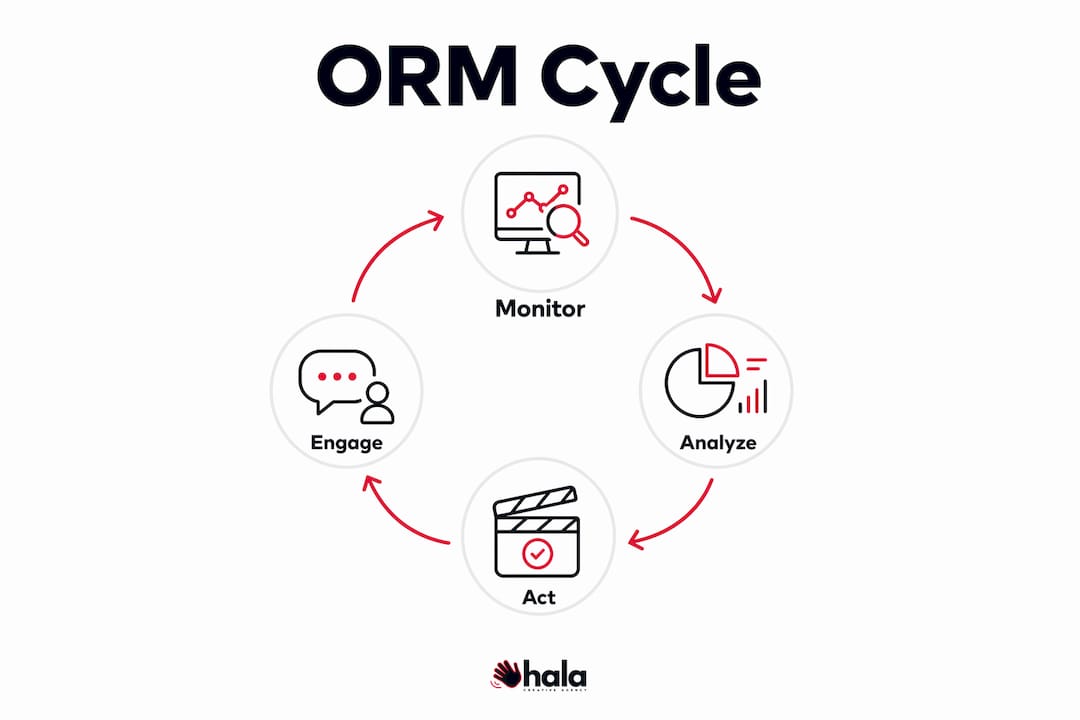
ORM is defined as a four-stage continuous cycle: monitoring, sentiment analysis, action, and consistent engagement. Each stage feeds the next. You cannot respond to what you have not heard, and you cannot improve what you have not measured.
The four stages work like this:
- Monitoring — Track every mention of your brand across search results, review platforms like Google Business Profile and Tripadvisor, social media, news sites, and industry forums.
- Sentiment analysis — Classify mentions as positive, neutral, or negative. Identify patterns, not just individual comments.
- Action — Amplify positive content through sharing and responses. Address negative feedback directly, promptly, and with empathy.
- Consistent engagement — Maintain an active, authentic presence so your brand voice stays visible and credible over time.
Modern ORM platforms track brand mentions across over 100 million online sources in real time. That scale makes manual monitoring impossible for any business managing more than a handful of locations or product lines.
Pro Tip: Set up alerts not just for your brand name, but for your key products, your executives’ names, and your top competitors’ category terms. Reputation crises rarely announce themselves with your exact business name.

The channels you must cover include Google search results pages, Google Business Profile reviews, social media platforms (Instagram, LinkedIn, X), industry-specific review sites, local news coverage, and AI-generated answer summaries. That last channel is new and growing fast. When a potential client asks an AI assistant about the best marketing agency in Dubai, the answer it generates pulls from your online reputation, not your advertising budget.
| ORM Stage | Primary Channel | Key Action |
|---|---|---|
| Monitoring | Search, reviews, social media | Set up real-time alerts and tracking |
| Sentiment analysis | All channels | Score mentions and identify trends |
| Action | Reviews, social media, press | Respond, amplify, or correct |
| Consistent engagement | All channels | Publish content, reply, and build presence |
What is the difference between brand and reputation?
Brand and reputation are not the same thing, and confusing them is one of the most expensive mistakes a business leader can make. Gartner defines brand as the organization’s intentional messaging, while reputation is the earned perception formed by stakeholders based on actual experiences. Your brand is what you say about yourself. Your reputation is what others say about you when you are not in the room.
This distinction matters because ORM must align what your company promises with what it actually delivers. A luxury hotel in Dubai can invest heavily in brand photography and social media content. But if guests consistently report slow check-in times on Google Reviews, the gap between brand and reputation widens. That gap destroys trust faster than any competitor ever could.
“Reputation management is an organization-wide effort, not limited to PR, requiring alignment of all business practices.” — Gartner
Authentic brand-reputation alignment starts internally. Your employees’ behavior, your customer service processes, and your product quality all feed your public reputation directly. ORM is not a marketing department problem. It is a leadership problem.
The risks of a disconnect are concrete:
- A mismatch between brand messaging and customer experience accelerates negative reviews.
- Employees who feel misaligned with company values share that frustration publicly on platforms like Glassdoor, which affects both talent acquisition and customer trust.
- Search engines surface review content prominently. A three-star average rating on Google can suppress your visibility even when your SEO is strong.
Building a strong digital brand identity is the foundation. ORM is the ongoing maintenance of that foundation against real-world friction.
Which strategies and tools effectively manage online reputation?
The most effective ORM approach shifts from reactive damage control to proactive listening and engagement. Businesses that wait for a crisis to act are always playing catch-up. The ones that build ORM into their daily operations create a compounding advantage over time.
Practical strategies that work:
- Centralize your review management. Use a single dashboard that aggregates reviews from Google, Tripadvisor, Facebook, and industry platforms. Responding from one place reduces response time and keeps your tone consistent.
- Respond to every review, positive and negative. A thoughtful response to a negative review signals to future customers that you take feedback seriously. It also gives you a chance to correct the record publicly.
- Expand your social listening scope. Tracking only direct brand mentions misses the bulk of conversations that influence your reputation. Monitor industry keywords, competitor category terms, and customer frustration phrases relevant to your sector.
- Create content that controls your search narrative. Blog posts, case studies, and press releases that rank well push negative or irrelevant content further down search results pages.
- Integrate ORM with your customer experience process. When a customer complaint triggers both a service recovery action and a public response, you close the loop in a way that builds loyalty.
AI-assisted tools now help draft personalized, brand-consistent responses at scale, while human team members approve final communications. This hybrid approach is exactly what Hala Creative Agency advocates: AI handles volume and speed, humans handle judgment and empathy. For a business managing 10 locations across the UAE, that combination is the only way to maintain response quality without burning out your team.
Pro Tip: Never copy-paste the same response to multiple reviews. Review platforms and customers both notice template replies. Even small personalizations, like referencing the specific service mentioned, signal genuine attention.
Social media strategies are inseparable from ORM. Every post, comment, and story contributes to the public perception your reputation is built on. Treat your social channels as reputation assets, not just marketing channels.
Automated response tools can handle initial acknowledgment at scale, but the follow-through must be human. Speed matters for acknowledgment. Accuracy and empathy matter for resolution.
How can businesses measure ORM effectiveness?
Measurement separates ORM from guesswork. The metrics that matter most are the ones tied directly to business outcomes, not just online activity.
| Metric | What it measures | Business outcome |
|---|---|---|
| Average star rating | Overall customer sentiment | Revenue correlation, search visibility |
| Review volume and velocity | Engagement and recency of feedback | Trust signals for new customers |
| Sentiment score trend | Positive vs. negative shift over time | Early warning for reputation issues |
| Search ranking for brand terms | Visibility of owned vs. third-party content | Control over first impressions |
| Social mention volume | Brand awareness and conversation share | Market presence and reach |
A one-star improvement in Yelp rating correlates with a 5%–9% revenue increase, according to Harvard Business School research. That is not a soft metric. It is a direct financial return on reputation investment.
Analytics dashboards that consolidate multi-channel feedback give executives a single view of reputation health. Analytics in branding work the same way: the value is in seeing patterns across channels, not reading individual data points in isolation.
The pitfall to avoid is over-relying on surface numbers. A rising star rating means little if the volume of reviews is too low to be statistically meaningful. A spike in social mentions could be positive buzz or a viral complaint. Always read the qualitative context behind the numbers.
Reputation management also extends beyond digital channels. Offline behavior, such as how your team handles in-person complaints or how your business appears in local news, feeds directly into your online scores. The two environments are not separate.
Key Takeaways
Effective online reputation management requires continuous monitoring, authentic brand-reputation alignment, and a hybrid AI-human response process to protect and grow business credibility.
| Point | Details |
|---|---|
| ORM is a four-stage cycle | Monitor, analyze sentiment, act, and engage consistently across all digital channels. |
| Brand and reputation are different | Brand is what you say; reputation is what customers experience and report publicly. |
| Proactive ORM outperforms reactive | Businesses that listen and engage daily avoid crises rather than recovering from them. |
| Measure outcomes, not just activity | Tie star ratings, sentiment trends, and search rankings to revenue and trust metrics. |
| AI assists, humans decide | AI tools scale response volume; human oversight keeps communications accurate and empathetic. |
ORM is a culture, not a campaign
I have worked with business owners who treat reputation management as something you do after a bad review appears. That mindset is the single most common and most costly mistake I see. By the time a crisis is visible online, it has usually been building for weeks in customer conversations, employee frustrations, and unresolved service gaps.
The businesses I have seen build genuinely strong reputations treat ORM as an organizational habit. Every department, from operations to customer service to marketing, understands that their daily decisions show up in public perception. That is not a marketing philosophy. It is a leadership one.
I am also skeptical of businesses that hand ORM entirely to AI tools and walk away. AI is genuinely useful for monitoring at scale and drafting first-pass responses. But I have seen AI-generated replies that technically answered a complaint while completely missing the emotional tone of the customer. That kind of response does more damage than silence. Human judgment is not optional in this process.
The other thing I tell every executive I work with: your reputation is being shaped right now, whether you are managing it or not. The only question is whether you are in the conversation.
— Hisham
How Hala Creative Agency builds and protects your digital reputation
Hala Creative Agency works with businesses across Dubai and the wider Middle East to build digital reputations that hold up under scrutiny. The agency combines AI-assisted monitoring and response tools with hands-on brand strategy to give business owners both speed and quality in their ORM programs. Whether you are managing reviews across multiple locations, rebuilding after a reputation setback, or building your online presence from the ground up, the team brings a data-driven process to every stage. Explore Hala Creative Agency’s full range of digital marketing services to see how reputation management fits into a broader growth strategy for your brand.
FAQ
What is online reputation management in simple terms?
Online reputation management is the ongoing process of monitoring and influencing what people find when they search for your business online. It covers search results, reviews, social media, and AI-generated answers.
How does a bad online reputation affect revenue?
A one-star improvement in ratings correlates with a 5%–9% revenue increase, according to Harvard Business School research. Negative reviews left unaddressed directly reduce customer conversion rates.
What tools are used for online reputation monitoring?
Effective ORM uses platforms that track brand mentions across millions of online sources in real time, combined with centralized review management dashboards that consolidate feedback from Google, social media, and industry review sites.
How often should businesses monitor their online reputation?
Reputation monitoring should run continuously, not weekly or monthly. Real-time alerts catch emerging issues before they escalate into public crises that require full online reputation repair.
Is online reputation management only for large businesses?
ORM is critical for businesses of any size. Small and medium businesses in competitive markets like Dubai are often more vulnerable to reputation damage because a single negative review represents a larger share of their total review volume.