
TL;DR:
- Paid advertising involves paying platforms to quickly target specific audiences with your message.
- It relies on real-time auctions, where factors like Quality Score influence ad placement and cost.
Paid advertising is defined as paying a platform to display your marketing message to a specific, targeted audience. Unlike organic methods that earn visibility over time, paid ads buy it immediately. Social media ad spending in the U.S. alone reached $117.7 billion in 2025, a 32.6% year-over-year increase. That number reflects how central paid advertising has become to digital growth. For small and medium-sized businesses in Dubai and across the UAE, understanding paid advertising is no longer optional. It is the fastest path to measurable visibility in a crowded market.
What is paid advertising and how does it actually work?
Paid advertising operates through real-time auctions. Every time a user opens a webpage or types a search query, platforms like Google Ads run an automated auction in milliseconds to decide which ad appears and where. Your bid is one factor, but it is not the only one.

Ad rank depends on Quality Score, which measures three things: the relevance of your ad copy, your expected click-through rate (CTR), and the quality of your landing page experience. Quality Scores range from 1 to 10. A score above 7 lowers your cost per click and improves your placement. This means a well-crafted ad from a smaller business can outrank a bigger competitor who simply bids more.
Your budget sets a daily or campaign-level spending cap. You choose a bidding strategy, such as manual cost-per-click (CPC), target return on ad spend (ROAS), or target cost per acquisition (CPA). The platform then enters your ad into relevant auctions within that budget.
Key performance indicators every business owner should track include:
- CTR (Click-Through Rate): The percentage of people who see your ad and click it. A low CTR signals weak ad copy or poor targeting.
- CPC (Cost Per Click): What you pay each time someone clicks. Lower CPC with high Quality Score means more traffic for less money.
- Conversion rate: The percentage of clicks that result in a desired action, such as a purchase or form submission.
- ROAS (Return on Ad Spend): Revenue generated for every dollar spent on ads. This is your clearest measure of campaign profitability.
Pro Tip: Set up conversion tracking before you launch any campaign. Without it, you are spending money without knowing what it produces.
What are the main types of paid advertising?
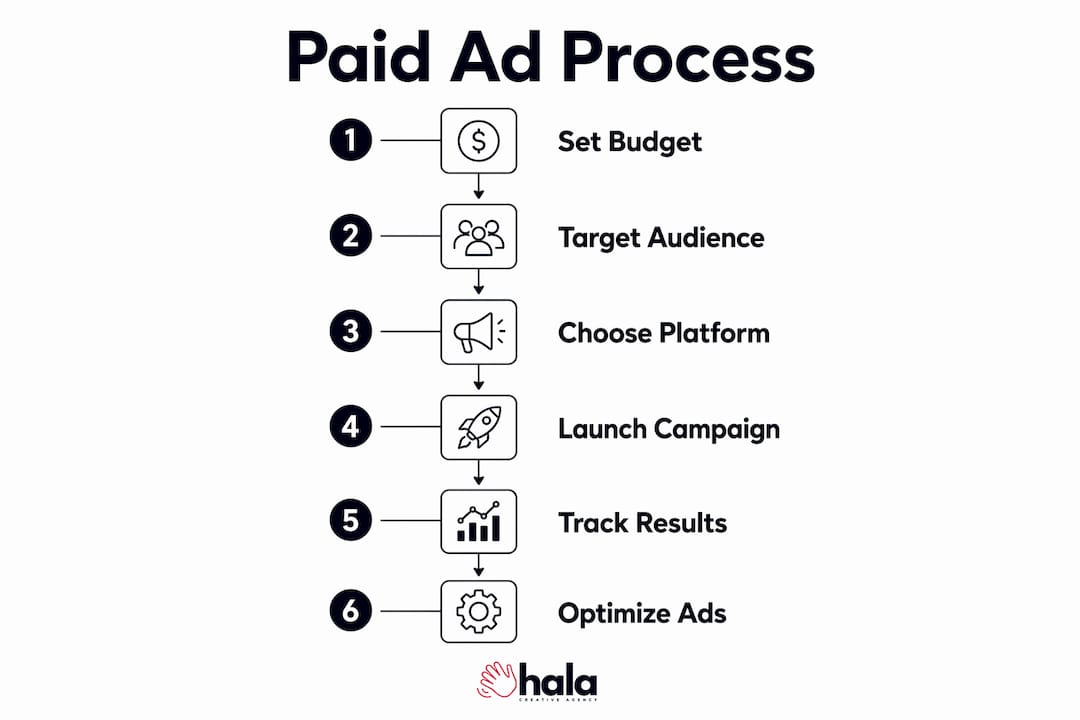
Paid advertising covers several distinct formats. Each serves a different purpose and fits different stages of the customer journey. Choosing the right type depends on your business goal, not just your budget.
Paid search (PPC)
Paid search targets high-intent users who are actively searching for a solution. When someone types “interior design company Dubai” into Google, they are ready to act. Pay-per-click (PPC) ads appear at the top of those results and capture that intent at the exact right moment. This makes PPC the strongest format for bottom-of-funnel conversions.
Paid social advertising
What is paid social advertising? It is the practice of paying social platforms to distribute your content to audiences defined by demographics, interests, and behaviors. Paid social guarantees visibility by buying distribution, while organic social earns it through engagement. Platforms like Instagram, TikTok, LinkedIn, and Snapchat all offer paid social formats. This format excels at building awareness and nurturing leads who are not yet searching for your product.
Display and programmatic advertising
Display ads are visual banners placed across websites, apps, and news platforms. Programmatic buying automates the placement process using audience data. These ads work well for brand awareness and retargeting users who have already visited your site.
Video advertising
Video ads run on platforms like YouTube and within social feeds. They communicate more context than static images and work well for product demonstrations, testimonials, and brand storytelling.
Retargeting
Retargeting shows ads specifically to users who have already interacted with your website or social profiles. Because these users already know your brand, retargeting campaigns typically convert at higher rates than cold-audience campaigns.
| Ad Type | Format | Primary Goal | Cost Model |
|---|---|---|---|
| Paid search (PPC) | Text ads in search results | Conversions, leads | CPC |
| Paid social | Image, video, carousel in feeds | Awareness, engagement | CPM or CPC |
| Display | Banner images on websites | Brand awareness, retargeting | CPM |
| Video | In-stream or in-feed video | Awareness, consideration | CPV or CPM |
| Retargeting | Any format, warm audiences | Conversions | CPC or CPA |
For a full breakdown of online advertising types tailored to SMBs, that resource covers each format in greater depth.
What benefits does paid advertising offer small businesses?
Paid advertising lets SMBs set budgets that fit smaller spend levels and test campaigns with minimal financial risk. Modern platforms have removed the barrier that once made advertising exclusive to large enterprises. A restaurant in Jumeirah can now reach the same precision targeting tools as a multinational hotel chain.
The core benefits for small and medium-sized businesses are:
- Speed: Paid ads generate traffic the same day a campaign goes live. Organic SEO takes months to build momentum. When you need results now, paid advertising delivers.
- Precise targeting: You define your audience by location, age, income, interests, job title, and even past purchase behavior. You are not broadcasting to everyone. You are speaking directly to the people most likely to buy.
- Real-time testing: You can run two versions of an ad simultaneously, compare results within days, and double down on what works. No other channel offers this speed of feedback.
- Measurable ROI: PPC campaigns charge only when users click, making every dirham traceable. You know exactly what each lead or sale cost you.
- Synergy with organic efforts: Paid ads and SEO are not competing strategies. Paid ads drive immediate traffic while your organic presence builds. Together, they cover both short-term and long-term growth.
Pro Tip: Run paid ads to your best-performing organic content. If a blog post already converts well, putting budget behind it amplifies results without starting from scratch.
How can SMBs optimize paid advertising campaigns?
55% of U.S. small businesses use online advertising, but many struggle because they launch campaigns without clear goals or proper structure. Optimization is not a one-time task. It is an ongoing process that separates profitable campaigns from wasted budgets.
Follow these steps to build campaigns that perform:
- Define your goal first. Are you driving website visits, phone calls, form submissions, or product purchases? Every campaign setting, from bidding strategy to ad format, flows from this answer.
- Research keywords with intent in mind. For paid search, focus on keywords that signal buying intent. “Best accounting software Dubai” converts better than “what is accounting software.” Use tools like Google Keyword Planner to estimate search volume and cost.
- Choose the right match types. Exact match and phrase match give you control over which searches trigger your ads. Broad match misuse is one of the most common reasons beginners waste budget on irrelevant clicks.
- Build a negative keyword list. Negative keywords block your ads from showing on searches that will never convert. If you sell premium furniture, you do not want your ad appearing for “cheap furniture Dubai.”
- Match your landing page to your ad. If your ad promises a free consultation, your landing page must deliver that offer immediately. A mismatch between ad and landing page destroys Quality Score and conversion rates.
- Review performance weekly. Check CTR, CPC, conversion rate, and ROAS every week. Pause underperforming ad sets. Increase budget on what is working.
- Test one variable at a time. Change one element per test, whether that is the headline, image, or call to action. Testing multiple variables simultaneously makes it impossible to know what caused a change in results.
For businesses in the UAE, running social media ads requires additional consideration of platform preferences and cultural context. What works in a Western market does not always translate directly to Dubai audiences.
Pro Tip: Start with a small daily budget on one campaign. Prove the concept before scaling spend. Scaling a broken campaign only loses money faster.
The paid vs. organic strategy question is worth examining before you commit your full budget to either channel.
Key Takeaways
Paid advertising delivers the fastest, most measurable path to audience reach for small and medium-sized businesses, but only when campaigns are built on clear goals, precise targeting, and continuous performance review.
| Point | Details |
|---|---|
| Auctions determine placement | Quality Score, not just bid amount, controls where your ad appears and what it costs. |
| Match ad type to goal | Use paid search for conversions, paid social for awareness, and retargeting for warm audiences. |
| Budget control is built in | SMBs can start small, test campaigns, and scale only what proves profitable. |
| Negative keywords protect spend | Excluding irrelevant searches prevents wasted clicks and keeps cost per acquisition low. |
| Paid and organic work together | Paid ads drive immediate traffic while SEO builds long-term visibility. Use both. |
Why I think most SMBs are using paid ads the wrong way
Most business owners I talk to treat paid advertising like a vending machine. Put money in, get customers out. When it does not work immediately, they conclude that paid ads “do not work for their industry.” That conclusion is almost always wrong.
The real issue is intent. Targeting based on user intent for search ads and audience characteristics for social ads is what separates profitable campaigns from money pits. A real estate developer in Dubai running broad search ads for “property” is competing against every developer in the country. The same developer running ads for “off-plan apartments in Dubai Marina under AED 1.5 million” is talking to a buyer who is already halfway to a decision.
The second mistake I see constantly is treating paid and organic as separate budgets with separate goals. Paid social buys attention that organic content earns. The smartest approach is to use paid ads to amplify content that already resonates organically. This is not a theory. It is the pattern I see in campaigns that consistently outperform their benchmarks.
Paid advertising in 2026 rewards specificity. The businesses that win are the ones willing to narrow their audience, test their messaging, and read their data honestly. The ones that lose are the ones chasing reach without a clear reason for it.
— Hisham
How Hala Creative Agency helps SMBs run paid campaigns that deliver
Running paid campaigns that actually return results requires more than a budget and a platform account. It requires the right structure from day one.
Hala Creative Agency builds and manages paid advertising campaigns for small and medium-sized businesses across Dubai and the wider UAE. The team handles everything from audience research and creative development to bid management and performance reporting. Every campaign is built around your specific business goal, not a generic template. If you are ready to stop guessing and start seeing measurable returns from your ad spend, the team at Hala Creative Agency is ready to build that with you. Reach out for a strategy session at halacreative.agency.
FAQ
What is paid advertising in simple terms?
Paid advertising is when a business pays a platform to show its ads to a specific audience. You set a budget, define your audience, and the platform displays your message to the people most likely to act.
What is the difference between paid advertising and organic marketing?
Paid advertising buys immediate visibility through ad placements, while organic marketing earns visibility over time through content, SEO, and engagement. Paid delivers faster results; organic builds compounding long-term value.
How much does paid advertising cost for a small business?
There is no fixed minimum. Platforms like Google Ads and Meta allow businesses to start with small daily budgets and scale based on results. The actual cost depends on your industry, targeting, and competition for the audience you want to reach.
What is the best platform for paid advertising?
The best platform depends on your goal. Google Ads works best for capturing high-intent buyers actively searching for your product. Social platforms work best for building awareness among audiences who are not yet searching. Many businesses in the UAE run both simultaneously for full-funnel coverage.
What is a Quality Score and why does it matter?
Quality Score is a rating from 1 to 10 that Google assigns to your ads based on relevance, expected CTR, and landing page experience. A higher score lowers your cost per click and improves your ad placement, meaning better results for less spend.