
TL;DR:
- Performance marketing charges advertisers only when measurable actions like sales or leads occur.
- It relies on accurate tracking, predefined KPIs, and integration with broader branding for success.
Performance marketing is a digital advertising model where advertisers pay only for results, such as a click, a lead, or a completed sale. Unlike traditional advertising, where you pay upfront for exposure with no guarantee of return, performance marketing ties every dollar spent to a measurable outcome. Common payment models include cost per click (CPC), cost per lead (CPL), and cost per acquisition (CPA). Platforms like Google Ads and Meta Ads are the most widely used channels for running these campaigns. For business owners in Dubai and across the UAE, this model is particularly attractive because it reduces financial risk and makes ROI visible from day one.
What is performance marketing and how does it work?
Performance marketing operates through three core players: the advertiser, the publisher or affiliate, and a tracking network. The advertiser sets the campaign goal and defines what a successful action looks like. The publisher, which could be a website, an influencer, or an affiliate network, drives traffic toward that goal. The tracking network records what happens and confirms whether the defined action occurred.

The technical backbone of this system is digital tracking infrastructure, specifically pixels, cookies, and UTM parameters. A pixel fires when a user lands on a confirmation page after a purchase. A UTM tag tells you which ad, campaign, or channel drove that visit. Without these tools working correctly, you cannot confirm attribution, and you risk paying for actions that were not actually caused by your campaign.
Payment triggers are set before the campaign launches. You define what counts as a conversion, whether that is a form submission, a phone call, an app install, or a product purchase. This pre-definition is critical. Unclear success metrics make it impossible to manage partners or measure ROI accurately.
Real-time monitoring is not optional in performance marketing. Campaigns require continuous review of KPIs to catch underperforming ad sets before they drain budget. The model shifts financial risk from the advertiser to the publisher, since publishers only earn when the defined action is delivered.
Pro Tip: Set up your tracking infrastructure before launching any campaign. A misconfigured pixel or broken UTM link means you could be paying for conversions that never actually happened, and you will have no data to prove otherwise.
What channels and tactics does performance marketing use?
Performance marketing uses four primary channels: search engine marketing (SEM), social media advertising, affiliate networks, and native advertising. Each channel serves a different purpose, and the right choice depends on your campaign goal.
SEM, primarily through Google Ads, captures demand that already exists. A user searches for “hotel in Dubai Marina,” and your ad appears at the top of the results. You pay only when they click. Social media advertising on platforms like Meta and TikTok creates demand by placing ads in front of users who match a defined audience profile. Affiliate networks connect advertisers with publishers who promote products in exchange for a commission on each sale or lead.
Performance marketing channels focus on measurable results rather than impressions or general brand awareness. That distinction matters when you are managing a fixed budget and need to justify every spend.
Here is a quick comparison of the main channels:
| Channel | Best for | Payment model | Trade-off |
|---|---|---|---|
| SEM (Google Ads) | High-intent buyers | CPC | Competitive keywords cost more |
| Social media ads | Audience building, retargeting | CPM, CPC, CPL | Requires strong creative |
| Affiliate networks | E-commerce, lead generation | CPA, CPS | Harder to control brand messaging |
| Native advertising | Content-driven acquisition | CPC, CPM | Lower intent than search |
The key difference between performance marketing and brand awareness campaigns is accountability. Brand campaigns measure reach and recall. Performance campaigns measure actions and revenue. For businesses running digital advertising in Dubai, combining both approaches produces the strongest long-term results.
What are performance marketing metrics and KPIs?
The four metrics that define campaign health in performance marketing are CPA, ROAS, conversion rate, and click-through rate (CTR). Each one tells you something different, and reading them together gives you the full picture.
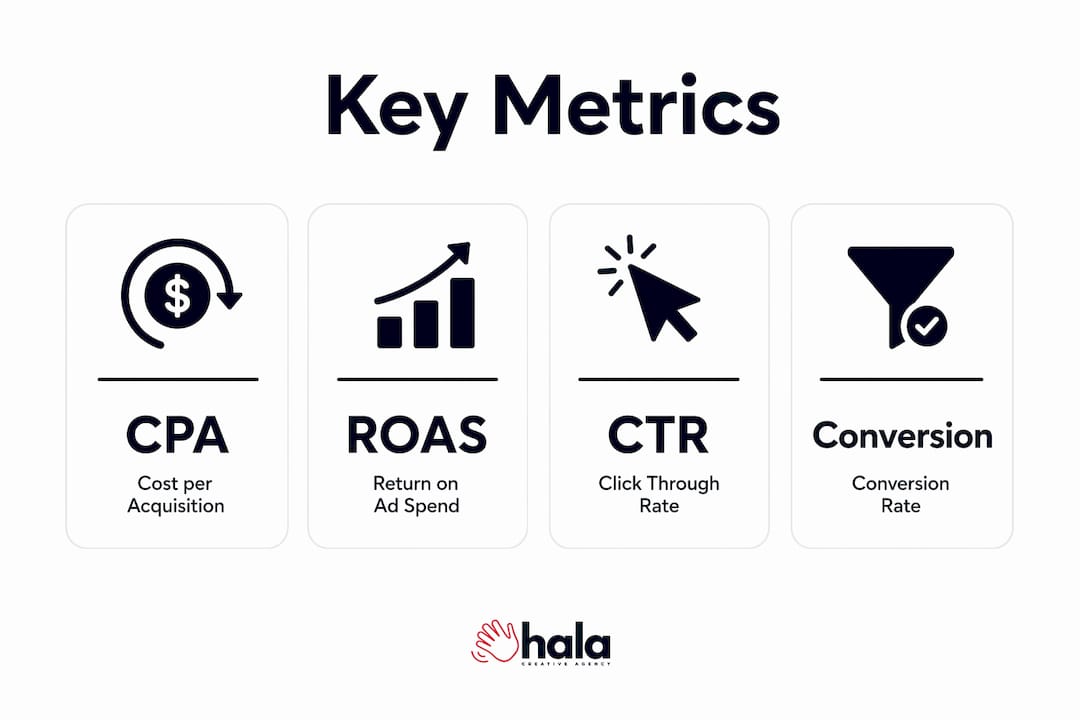
CPA (cost per acquisition) tells you how much you paid to acquire one customer or lead. A lower CPA means your campaign is efficient. ROAS (return on ad spend) measures revenue generated for every dollar spent on ads. A ROAS of 4.0 means you earned $4 for every $1 spent. Conversion rate shows what percentage of clicks turned into the desired action. CTR measures how often people clicked your ad after seeing it.
Continuous optimization against these KPIs is what separates profitable campaigns from wasteful ones. Identifying an underperforming channel early and reallocating budget can dramatically change campaign outcomes.
Here is a reference table for typical performance benchmarks across common channels:
| Metric | SEM benchmark | Social ads benchmark | Affiliate benchmark |
|---|---|---|---|
| CTR | 2%–5% | 0.5%–1.5% | Varies by niche |
| Conversion rate | 3%–5% | 1%–3% | 1%–4% |
| ROAS | 3x–5x | 2x–4x | 3x–6x |
These benchmarks vary by industry, and the UAE market often sees different baselines due to higher competition in sectors like real estate and hospitality. For a deeper breakdown of how ROAS is calculated and applied, the methodology is worth reviewing before setting campaign targets.
Pro Tip: Never optimize solely for clicks. High CTR with low conversion rate means your ad attracts the wrong audience. Align your primary KPI with the business outcome that actually matters, whether that is a signed contract, a booked appointment, or a completed purchase.
What are the common pitfalls in performance marketing?
The most common mistake in performance marketing is scaling a campaign before the data is stable. Scaling too early wastes budget because the algorithm has not yet identified the best-performing audience segments. Most platforms require several weeks of data before performance stabilizes enough to make scaling decisions.
A second major pitfall is poor tracking setup. Incorrect pixel or UTM configuration means you pay for actions that cannot be attributed to your campaign. This is not just a reporting problem. It is a financial one.
Other common errors include:
- Optimizing for the wrong KPI. Chasing clicks instead of qualified leads inflates traffic numbers without improving revenue.
- Ignoring the learning phase. Changing bids or creatives too frequently resets the algorithm’s learning, which delays performance improvements.
- Running performance marketing in isolation. Relying solely on paid performance raises acquisition costs the moment spending stops. Organic and brand efforts must run alongside paid campaigns.
- Skipping creative testing. Ad fatigue is real. Rotating creatives and testing new formats keeps performance from declining over time.
The businesses that get the most from performance marketing treat it as part of a broader system, not a standalone growth lever. Integrating it with SEO, content, and brand-building efforts is what sustains results. For context on how different digital marketing strategies compare and complement each other, the decision often comes down to business stage and budget structure.
Key Takeaways
Performance marketing delivers measurable ROI only when tracking is accurate, KPIs are predefined, and campaigns are integrated with broader brand-building efforts.
| Point | Details |
|---|---|
| Pay for results, not exposure | Performance marketing charges only for defined actions like clicks, leads, or sales. |
| Tracking accuracy is non-negotiable | Pixels and UTM parameters must be configured correctly before any campaign launches. |
| Choose KPIs that match business goals | Optimizing for clicks instead of qualified conversions wastes budget and skews data. |
| Respect the learning phase | Scaling too early disrupts algorithm optimization and inflates cost per acquisition. |
| Integrate with brand marketing | Paid performance alone raises long-term acquisition costs once ad spend stops. |
Performance marketing is not a shortcut. Here is what I have learned.
After working with businesses across Dubai and the wider Middle East, the pattern I see most often is this: a business launches a Google Ads or Meta campaign, gets early results, scales aggressively, and then watches performance collapse within 60 days. The problem is almost never the channel. It is the setup.
The attribution question is the one most businesses underestimate. Knowing that a sale happened is not the same as knowing why it happened. I have seen campaigns where the last-click model credited a retargeting ad for a sale that was actually driven by an organic search three weeks earlier. That kind of misattribution leads to bad budget decisions at scale.
The other thing I push back on is the idea that performance marketing is a replacement for brand investment. It is not. A business with no brand recognition pays more per click, converts at a lower rate, and loses customers faster to competitors who have built trust. Performance marketing amplifies what is already there. It does not create it from scratch.
My honest advice: start with a clear definition of what a successful action looks like for your business, build your tracking before you build your ads, and give the campaign at least four to six weeks before drawing conclusions. The businesses that treat performance marketing as a long-term system, rather than a quick fix, are the ones that compound results over time.
— Hisham
How Hala Creative Agency approaches performance marketing
Hala Creative Agency works with businesses across Dubai and the UAE to build performance marketing campaigns that are grounded in accurate tracking, clear KPIs, and integration with broader brand strategy. The team handles everything from pixel setup and UTM architecture to campaign management across Google Ads, Meta, and affiliate channels. If your current campaigns are generating traffic but not qualified leads, or if you are scaling without stable data, that is exactly the kind of problem Hala Creative Agency is built to solve. Explore the full range of marketing services or review real campaign examples from businesses in the region.
FAQ
What is the performance marketing definition?
Performance marketing is a digital advertising model where advertisers pay only when a specific, measurable action occurs, such as a click, lead, or sale. Common payment structures include CPC, CPL, and CPA.
How does performance marketing differ from traditional advertising?
Traditional advertising charges for exposure, such as impressions or airtime, regardless of results. Performance marketing charges only when a predefined action is completed, which ties spend directly to outcomes.
What are the main types of performance marketing?
The primary types are search engine marketing (SEM), social media advertising, affiliate marketing, and native advertising. Each targets different stages of the buyer journey and uses different payment models.
What are the most important performance marketing metrics?
The four core metrics are CPA (cost per acquisition), ROAS (return on ad spend), conversion rate, and click-through rate. These metrics together show whether a campaign is profitable and where to improve it.
Is performance marketing right for small businesses in Dubai?
Performance marketing works well for small businesses because it limits wasted spend by paying only for results. However, it requires accurate tracking setup and should be paired with brand-building efforts to sustain long-term growth.