
TL;DR:
- Programmatic advertising automates digital ad buying through real-time auctions, making it the dominant method in the industry. It involves a four-platform ecosystem that manages ad placements, targets audiences precisely, and spans various formats like display, video, and native ads. To succeed, businesses must actively manage campaigns, set clear goals, and develop strategic creative work rather than relying solely on automation.
Programmatic advertising is the automated buying and selling of digital ad space through software that completes real-time auctions in under 100 milliseconds. Unlike traditional media buying, which requires manual negotiations and insertion orders, programmatic uses algorithms to match ads to audiences at the moment a webpage loads. The ecosystem runs on four core technologies: Demand-Side Platforms (DSPs), Supply-Side Platforms (SSPs), ad exchanges, and Data Management Platforms (DMPs). Over 91% of US digital display ad spend is now bought programmatically. That number tells you this is not a niche tactic. It is the default method for digital advertising at scale.
What is programmatic advertising and how does it work step by step?
The process starts the moment a user visits a webpage. That single page visit triggers an auction that most marketers never see but always benefit from.
- User visits a site. The publisher’s SSP sends an ad request to an ad exchange, including data about the user, the page, and the available ad slot.
- Ad exchange opens the auction. DSPs representing multiple advertisers receive the bid request simultaneously. Each DSP evaluates the impression against its targeting criteria and budget.
- Bidding happens in milliseconds. Auctions complete in 10–100 milliseconds while the page is still loading. Users never experience a delay.
- Highest bid wins. The winning advertiser’s ad is served into the slot. The entire process finishes before the page fully renders.
- Data feeds back into the system. Impression, click, and conversion data flows back to the DSP, improving future bidding decisions automatically.
This process repeats billions of times each day across the open web, mobile apps, streaming platforms, and digital screens.
Pro Tip: Set frequency caps inside your DSP from day one. Without them, the same user can see your ad dozens of times in a single session, which burns budget and damages brand perception.

Traditional media buying focuses on securing fixed placements on specific websites. Programmatic shifts that logic entirely. You buy access to audiences, not pages. A luxury real estate brand in Dubai can target high-net-worth users wherever they browse, rather than paying a premium to appear on one publication.
What are the main components of the programmatic ecosystem?
Four platforms power every programmatic transaction. Understanding each one helps you ask better questions when working with media partners.
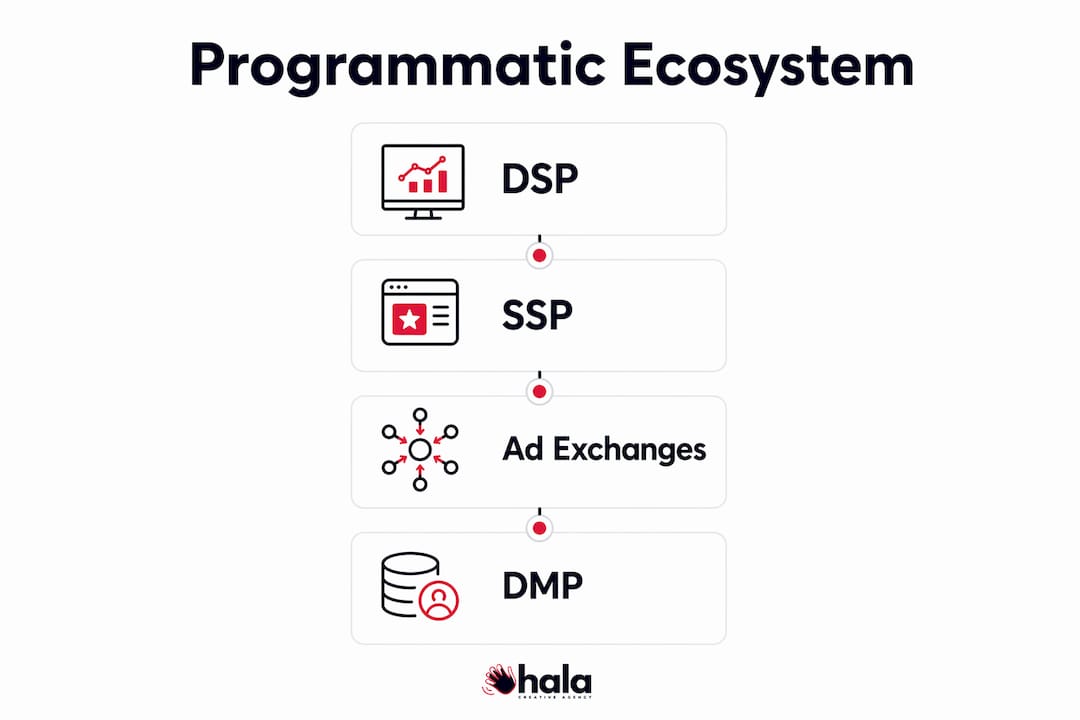
Demand-Side Platforms (DSPs)
A DSP is the advertiser’s control center. It connects to multiple ad exchanges, manages bidding logic, and applies audience targeting. Marketers set budgets, creative assets, and targeting parameters inside the DSP. The platform then bids automatically on every eligible impression.
Supply-Side Platforms (SSPs)
An SSP serves the publisher’s interests. It connects available ad inventory to multiple exchanges and DSPs, maximizing the price a publisher earns for each impression. SSPs also enforce floor prices, meaning publishers never sell below a minimum rate.
Ad exchanges
Ad exchanges are the marketplace where DSPs and SSPs meet. They run the auction, enforce rules, and settle transactions. Think of an ad exchange as the stock exchange of digital advertising. It operates continuously, at massive scale, with no human intervention required per transaction.
Data Management Platforms (DMPs)
DMPs collect, organize, and activate audience data. They pull from first-party sources (your CRM, website analytics) and third-party data providers to build audience segments. Those segments feed into DSPs, telling the bidding algorithm which users to prioritize. The full programmatic ecosystem of DSPs, SSPs, exchanges, and DMPs works together to make automated media buying possible at any scale.
| Component | Primary role | Who benefits most |
|---|---|---|
| DSP | Buys ad inventory automatically | Advertisers and agencies |
| SSP | Sells publisher inventory at best price | Publishers and media owners |
| Ad exchange | Hosts the real-time auction | Both sides of the transaction |
| DMP | Supplies audience targeting data | Advertisers and data teams |
What types and formats does programmatic advertising include?
Programmatic is a buying method, not an ad format. That distinction matters because it changes how you plan campaigns.
Programmatic spans display, video, native, audio, connected TV, and digital out-of-home (DOOH). A single DSP can serve a banner ad on a news site, a pre-roll video on a streaming app, and a billboard in a Dubai mall, all within the same campaign. The format changes. The underlying auction logic does not.
Programmatic inventory falls into three main buying types:
- Open auctions. Any advertiser can bid. Prices are competitive and inventory is broad. Best for reach and prospecting campaigns.
- Private marketplaces (PMPs). Publishers invite specific advertisers to bid on premium inventory. Prices are higher, but placement quality and brand safety improve significantly.
- Programmatic guaranteed. Advertiser and publisher agree on price and volume in advance. The transaction executes automatically. This combines the control of direct buying with the efficiency of programmatic delivery.
Private marketplaces and guaranteed deals reduce brand safety risk compared to open auctions. Open auctions can place your ad next to low-quality or inappropriate content if brand safety tools are not configured properly. For businesses in the UAE where brand reputation carries significant weight, PMPs are worth the premium.
Pro Tip: If you are running video campaigns programmatically, separate your connected TV (CTV) inventory from mobile and desktop video. CTV audiences are more engaged, but the CPMs are higher. Mixing them in one line item skews your performance data.
For a broader view of online advertising formats and how programmatic fits within each, the landscape is wider than most marketers initially expect.
What are the key benefits of programmatic advertising for businesses?
The business case for programmatic advertising rests on four concrete advantages that manual buying cannot match.
Speed. A programmatic campaign can go live within hours of creative approval. Traditional buying cycles involve proposals, negotiations, and contracts that can take weeks. For businesses responding to market events or seasonal demand in Dubai, that speed is a real competitive edge.
Audience precision. Programmatic lets marketers target audiences with precision using behavioral, demographic, geographic, and contextual signals simultaneously. A hotel group can target users who have searched for flights to Dubai, visited competitor booking pages, and fall within a specific income bracket, all at once.
Real-time optimization. Real-time reporting lets you adjust bids, pause underperforming creatives, and shift budget toward top-performing audience segments within minutes. Traditional campaigns lock in placements for weeks regardless of performance.
Scale. A single DSP connection gives you access to billions of ad impressions across thousands of publishers. No sales team can replicate that reach manually.
The trade-off is worth naming directly. Programmatic gives you less control over exact placement than a direct buy. Your ad may appear on sites you did not specifically choose. Brand safety tools, inclusion lists, and private marketplaces address this, but they require active management. Businesses working with partners like Nils Digital who specialize in advanced ad buying systems can reduce that risk through proper campaign architecture from the start.
How to integrate programmatic advertising into your marketing strategy
Understanding programmatic advertising is one thing. Running it profitably is another. These steps give you a practical starting point.
- Define your goal before touching a DSP. Brand awareness, lead generation, and retargeting each require different bidding strategies, creative formats, and measurement frameworks. Mixing objectives in one campaign produces confusing data.
- Set realistic budgets with clear CPM or CPA targets. Programmatic auctions are competitive. Entering with an unrealistically low budget means losing most auctions in your target audience segment. Research benchmark CPMs for your industry and region before launching.
- Invest in creative quality. Campaign performance depends heavily on creative quality regardless of how sophisticated the bidding algorithm is. A weak ad served to the perfect audience still underperforms. Allocate budget to multiple creative variants so the system can identify what resonates.
- Start with private marketplaces for premium inventory. Open auctions work for scale, but PMPs give you better placement quality and brand safety from the start. Negotiate access to PMP deals with publishers in your target markets before scaling to open exchange.
- Review performance weekly, not monthly. Programmatic generates data fast. Weekly reviews let you catch budget waste, creative fatigue, and audience overlap before they compound. Monthly reviews are too slow for a channel that changes daily.
- Use first-party data as your targeting foundation. Third-party cookies are disappearing. Marketers who build CRM-based audience segments and upload them to their DSP will maintain targeting precision as the industry shifts. Start building that data infrastructure now.
For a practical framework on building effective ad campaigns suited to the UAE market, the principles above apply directly to local market conditions.
Agencies that combine programmatic technology with strong creative capabilities, like the approach used at Valiz, demonstrate that automation and creative strategy work best when they are built together rather than treated as separate workstreams.
Key Takeaways
Programmatic advertising is the most efficient method for digital media buying available to marketers in 2026, but it requires active management, quality creative, and clear goals to deliver results.
| Point | Details |
|---|---|
| Automated auction process | Real-time bidding completes in 10–100 milliseconds, invisible to users and requiring no manual intervention per impression. |
| Four-platform ecosystem | DSPs, SSPs, ad exchanges, and DMPs each play a distinct role; understanding all four improves campaign decisions. |
| Buying method, not a format | Programmatic spans display, video, native, audio, CTV, and DOOH; the format changes but the auction logic stays the same. |
| Creative quality still drives results | Automation handles placement, but ad creative determines whether the audience responds. Budget both equally. |
| Brand safety requires active management | Open auctions carry placement risk; private marketplaces and inclusion lists protect brand reputation in premium markets like Dubai. |
Why programmatic still needs a human hand
I have worked with businesses across the Middle East that approached programmatic advertising as a “set it and forget it” channel. They connected to a DSP, uploaded creative, set a budget, and expected the algorithm to do the rest. Every single one of them wasted significant spend in the first 90 days.
The technology is genuinely impressive. The auction speed, the targeting depth, the cross-channel reach. None of that is marketing hype. But the assumption that automation replaces judgment is where most campaigns fail. The algorithm optimizes toward the goal you set. If you set the wrong goal, or measure the wrong metric, the algorithm will pursue that mistake at scale and do it efficiently.
What I have found actually works is treating programmatic as a precision instrument that still requires a skilled operator. The DSP handles the bidding. You handle the strategy: which audiences matter, which creative messages match which funnel stages, which inventory environments protect your brand. That division of labor is what separates campaigns that scale profitably from ones that burn through budget with nothing to show.
The future of programmatic is clearly moving toward deeper AI integration and new inventory types like CTV and DOOH. But the marketers who will benefit most are not the ones who understand the technology best. They are the ones who understand their audience best and use the technology to reach them with the right message at the right moment.
— Hisham
How Hala Creative Agency helps businesses run programmatic advertising
Running programmatic advertising well requires more than access to a DSP. It requires audience strategy, creative development, and ongoing performance management working together.
Hala Creative Agency works with businesses across Dubai and the wider UAE to build digital advertising strategies that combine programmatic media buying with brand-consistent creative. The team manages campaign setup, audience segmentation, and real-time reporting so clients see exactly where their budget goes and what it produces. For businesses ready to move beyond boosted posts and manual placements, the branding and advertising process at Hala Creative Agency provides a structured path from strategy to live campaigns that perform.
FAQ
What is programmatic advertising in simple terms?
Programmatic advertising is software that automatically buys and sells digital ad space through real-time auctions. It matches your ad to the right user at the right moment without manual negotiation.
How does programmatic advertising differ from Google Ads?
Google Ads uses programmatic auction principles within its own ecosystem, but programmatic advertising extends across thousands of publishers and platforms beyond Google’s network.
Is programmatic advertising effective for small businesses?
Programmatic advertising is effective for businesses of any size when campaigns are set up with clear goals, proper audience targeting, and quality creative. Small budgets can still reach precise audiences, though private marketplace access typically requires higher minimum spends.
What is the difference between programmatic and display advertising?
Display advertising is an ad format (banner images on websites). Programmatic is the buying method used to purchase display ads, as well as video, audio, native, and connected TV inventory.
How do private marketplaces improve brand safety in programmatic?
Private marketplaces provide premium, brand-safe inventory through pre-negotiated access with specific publishers, reducing the risk of ads appearing next to low-quality or inappropriate content found in open auctions.