
TL;DR:
- Brand storytelling fosters emotional connections that increase customer loyalty and ensure memorable brand experiences.
- To succeed, SMBs must integrate storytelling across all organizational functions, authentically sharing real challenges and outcomes.
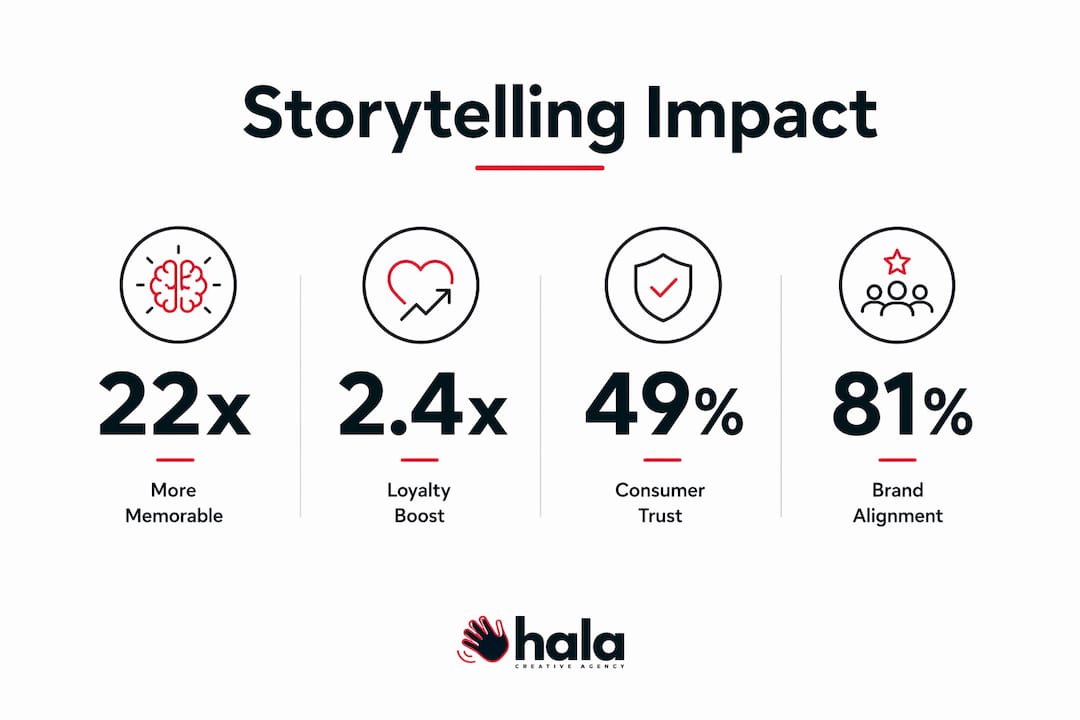
Brand storytelling is the strategic use of narrative to emotionally connect your brand with customers and build lasting loyalty. For small and medium-sized businesses in Dubai and across the UAE, this distinction matters more than ever. Consumers are 55% more likely to purchase from a brand they relate to emotionally, and emotionally engaged customers are 2.4 times more loyal. Patagonia built a billion-dollar outdoor brand on environmental conviction. Airbnb turned a simple apartment-rental concept into a global movement by telling stories of belonging. The question for your business is not whether storytelling works. The question is whether you are using it deliberately.
Why brand storytelling works differently than traditional marketing
Traditional marketing speaks to the rational mind. Brand storytelling speaks to the part of the brain that actually makes decisions.

95% of purchasing decisions occur subconsciously, driven by emotional resonance rather than logic. This means that a feature list, a price comparison, or a product specification sheet rarely closes the deal on its own. What moves people is a narrative they can see themselves inside.
The neuroscience behind this is specific and well-documented. When you read a data point, only the language-processing areas of your brain activate. When you hear a story, multiple regions fire simultaneously:
- Sensory cortex activates, making the story feel physically real
- Motor cortex engages, as if the listener is performing the actions described
- Emotional centers respond, generating feelings of empathy and connection
- Memory consolidation accelerates, which is why stories are 22 times more memorable than facts alone
That last point deserves emphasis. Twenty-two times more memorable. For a small business competing against larger brands with bigger ad budgets, that multiplier is a structural advantage.
Storytelling also triggers oxytocin release in the listener’s brain. Oxytocin is the neurochemical associated with trust and empathy. When your brand narrative activates oxytocin, you are not just communicating a message. You are building a biological foundation for trust. Contrast that with feature-focused marketing, which triggers no such response and leaves no emotional residue.
Consumers encounter up to 10,000 ads daily. Feature-based messages dissolve into that noise within seconds. A story with a real protagonist, a real conflict, and a real resolution stays.
Why consistent storytelling across your whole business matters
Most SMBs treat storytelling as a marketing function. They craft a compelling brand narrative, publish it on their website, run it through social media, and consider the job done. This is where the strategy breaks down.
Storytelling must move beyond marketing to include product, sales, support, and leadership for narrative alignment. When a customer reads a brand story about warmth and personal service, then calls your support line and gets a cold, scripted response, the contradiction destroys credibility faster than any competitor could. This is what practitioners call the “brand gap.” The gap between what you say and what customers actually experience.
Closing that gap requires treating storytelling as an organizational discipline. Here is how to embed it across your business:
- Define your core narrative in writing. One page. Who is your customer, what problem do they face, and how does your brand help them win?
- Brief every team on that narrative. Sales, support, operations, and leadership all need to understand the story they are living and telling.
- Audit customer touchpoints quarterly. Review emails, chat transcripts, invoices, and onboarding flows for narrative consistency.
- Give leadership a storytelling role. Founders and managers who share personal stories about the business build trust that no ad campaign can replicate.
- Build a feedback loop. Collect customer language from reviews, surveys, and social comments. The words customers use to describe your brand are the raw material of your best stories.
- Govern the narrative. Regular audits and governance of the brand story maintain coherence as your business evolves.
Pro Tip: The fastest way to find your brand gap is to ask three customers to describe your business in their own words, then compare their language to your marketing copy. The distance between those two descriptions is exactly where your storytelling work needs to happen.
Only 49% of consumers trust businesses to do the right thing, while 81% are more likely to buy from brands aligned with their personal values. Narrative coherence across every function is how you earn that alignment.
What are the key elements of an effective brand story?
The most common storytelling mistake SMBs make is positioning the brand as the hero of the story. Your brand is not the hero. Your customer is.
Effective brand narratives include a non-brand protagonist (the customer), a conflict the customer faces, the brand as a guide, and clear outcomes backed by evidence. Donald Miller’s StoryBrand framework formalizes this structure and has been used by thousands of businesses to clarify their messaging. The logic is simple: people are drawn to stories where they see themselves succeeding, not stories about how great someone else is.
The table below shows how this shift changes every element of your communication:
| Storytelling element | Traditional marketing approach | Narrative-driven approach |
|---|---|---|
| Central character | The brand | The customer |
| Core message | “We are the best” | “Here is how you win” |
| Conflict | Ignored or minimized | Named and validated |
| Brand role | Hero | Guide or mentor |
| Evidence | Awards and credentials | Customer outcomes and transformation |
| Emotional tone | Promotional | Empathetic and authentic |
Beyond structure, authenticity is the variable that separates stories that build loyalty from stories that feel like advertising. Brands that share authentic hardships and behind-the-scenes realities build deeper trust than polished campaigns alone. A Dubai-based restaurant sharing the story of how it nearly closed during a difficult year, and what it learned, will generate more genuine connection than a hundred posts about its award-winning menu.
Specificity is also non-negotiable. Vague claims (“we care about our customers”) carry no weight. Specific evidence (“we called every client personally during the 2020 lockdown to check in, not to sell”) carries enormous weight. The more specific your story, the more believable it becomes.
Pro Tip: Avoid the temptation to make your story too polished. Vulnerability and imperfection are what make narratives feel human. Share the challenge before you share the resolution.
For UAE-based SMBs looking to build a strong digital identity, the storytelling framework above applies directly to how you present your brand across every digital channel.
How can SMBs practically implement brand storytelling?
Knowing why storytelling works is one thing. Building the habit of doing it consistently is another.
The first step is discovery. Every business has more stories than it realizes. Your founding moment, a customer whose life changed because of your product, a supplier relationship built over a decade, a failure that reshaped how you operate. These are not marketing assets sitting in a drawer. They are living inside your team, your customer base, and your operations. You just need a process to surface them.
Once you have raw material, the formats matter. The most effective storytelling formats for SMBs include:
- Origin stories that explain why the business exists and what the founder was trying to solve
- Customer transformation stories that show the before and after of working with you, with specific details and outcomes
- Behind-the-scenes content that shows how decisions are made, products are built, or services are delivered
- Leadership narratives where founders or managers share personal perspectives on the industry, the business, or a challenge they faced
- Community stories that connect the brand to the local context, particularly powerful for businesses in Dubai and the wider UAE market
Distribution matters as much as format. Instagram and LinkedIn work differently for storytelling. Instagram rewards visual, emotionally immediate content. LinkedIn rewards longer, more reflective narratives, particularly from founders. Email newsletters allow for deeper, more personal storytelling that builds loyalty over time.
Consistent brand storytelling boosts recall, sentiment, and organic word-of-mouth more than feature-focused campaigns. Measure storytelling success through engagement rate, comment sentiment, direct message volume, and qualitative feedback. These metrics tell you whether your narrative is landing, not just whether people saw it.
The most important principle is continuity. Storytelling is not a campaign. It is an ongoing practice. One powerful story published once does not build a brand. A steady rhythm of authentic narratives, told across multiple channels over months and years, does. For practical guidance on branding for Middle East SMBs, the principles of consistency and authenticity apply regardless of industry or budget.
You can also explore how storytelling boosts brand engagement through specific content formats and distribution strategies that work in 2026.
Key takeaways
Brand storytelling works because it accesses the subconscious, builds oxytocin-driven trust, and creates narrative coherence that no feature-focused campaign can replicate.
| Point | Details |
|---|---|
| Storytelling beats features | Stories are 22x more memorable than facts and activate emotional decision-making centers. |
| Customer is the hero | Effective narratives position the customer as protagonist, with the brand as guide. |
| Organizational alignment is required | Storytelling must span product, sales, support, and leadership to close the brand gap. |
| Authenticity outperforms polish | Sharing real hardships and specific outcomes builds more trust than curated campaigns. |
| Consistency is the strategy | Sustained narrative rhythm across channels drives recall, loyalty, and word-of-mouth. |
Why I think most SMBs are treating storytelling as a tactic when it is actually infrastructure
After working with businesses across Dubai and the wider region, the pattern I see most often is this: a business invests in a brand story, publishes it beautifully, and then moves on. Six months later, the story has drifted. The website says one thing, the sales team says another, and the customer experience delivers something else entirely.
Storytelling fatigue is real in 2026. Audiences have become exceptionally good at detecting inauthenticity. A polished narrative that does not match the lived experience of dealing with your business does more damage than no story at all. The brands that win long-term are the ones where the story is not a marketing document. It is an operating principle.
The SMBs I have seen differentiate most effectively are the ones where the founder personally lives the narrative. They post about real decisions, real setbacks, and real customer relationships. They do not wait for a campaign. They tell the story as it happens.
My honest advice: before you invest in storytelling content, audit whether your business actually lives the story you want to tell. If there is a gap, close the gap first. Then tell the story. The sequence matters more than the production quality.
Authenticity in branding is not a trend. It is the baseline expectation your customers bring to every interaction with your brand.
— Hisham
How Hala Creative Agency helps SMBs build stories that grow businesses
Hala Creative Agency works with small and medium-sized businesses across Dubai and the UAE to build brand narratives that hold together across every channel and customer touchpoint. The work goes beyond a logo or a tagline. It covers brand strategy, digital identity, campaign storytelling, and the organizational alignment that makes a story credible over time. If you are ready to build a brand that customers remember and return to, see how expert branding drives measurable business growth in Dubai. For businesses at an earlier stage, the advertising and branding guide for UAE SMBs is a practical starting point.
FAQ
What is brand storytelling, exactly?
Brand storytelling is the practice of using narrative structure to communicate your brand’s values, purpose, and customer relationships. It differs from traditional marketing by prioritizing emotional resonance over product features.
Why does storytelling increase customer loyalty?
Emotionally engaged customers are 2.4 times more loyal than those who are not, because storytelling triggers oxytocin release, which builds trust and empathy at a neurological level.
How is brand storytelling different from advertising?
Advertising promotes a product or offer. Brand storytelling builds a relationship by placing the customer as the protagonist in a narrative where the brand helps them solve a real problem or achieve a meaningful outcome.
How often should an SMB publish brand stories?
Consistency matters more than frequency. A realistic rhythm of two to four story-driven pieces per month across your chosen channels builds more brand equity than sporadic high-production campaigns.
What is the biggest mistake SMBs make with brand storytelling?
The most common mistake is positioning the brand as the hero rather than the customer. The second most common is treating storytelling as a one-time campaign rather than an ongoing organizational practice.