
TL;DR:
- Analytics transforms consumer data into strategic decisions that enhance brand equity for SMBs. Combining multiple measurement tools provides a comprehensive view of brand health, improving targeting and timing. Building a strong first-party data foundation and integrating AI tools enable nimble, evidence-based branding in competitive markets.
The role of analytics in branding is to convert raw consumer data into decisions that build measurable brand equity. Marketing intelligence, the formal industry term for this practice, gives brand managers the ability to act on what consumers actually do rather than what they say they prefer. AI-driven analytics alone can produce 6–10% revenue growth within 12 months for nearly half of adopters. For SMBs in Dubai and across the UAE, that gap between guessing and knowing is where competitive advantage lives. Tools like Google Analytics, Brandmaven, and BCG’s First-Fast Response (FFR) metric are redefining how brand health gets measured and acted upon.
What core analytics tools support effective branding?
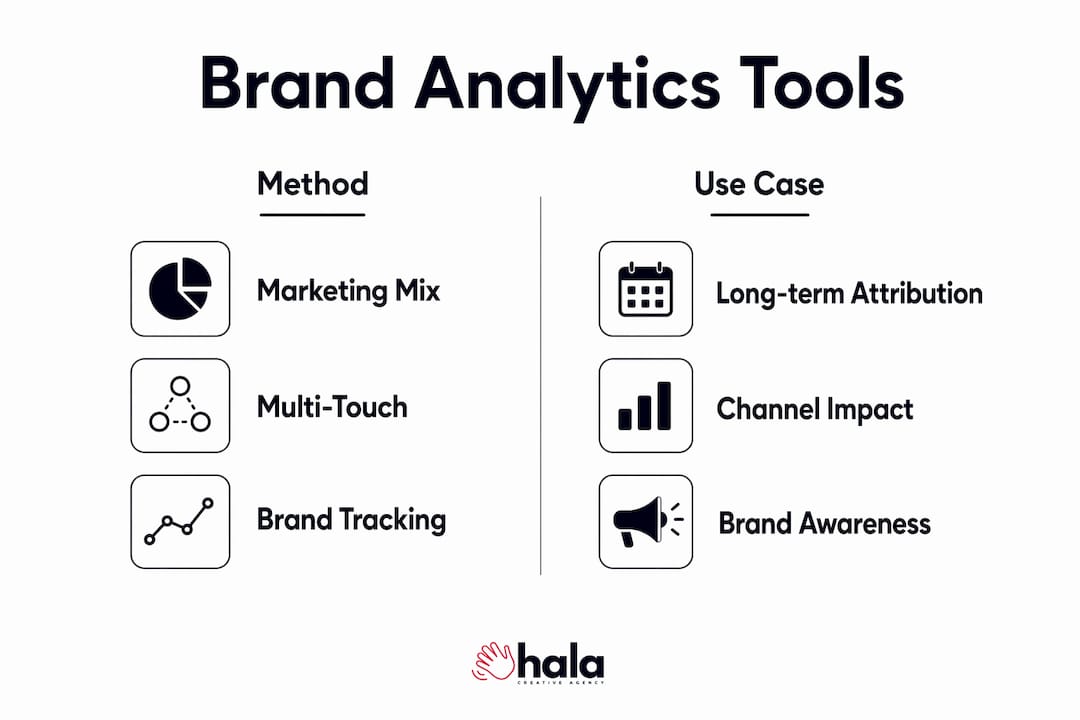
Three methodologies form the foundation of any serious brand analytics program: marketing mix modeling, multi-touch attribution, and predictive analytics platforms. Each answers a different question. Marketing mix modeling tells you which channels drove brand growth over time. Multi-touch attribution shows which touchpoints moved a specific buyer. Predictive analytics tells you where to invest next.

The case for triangulated measurement
Relying on one method produces blind spots. 70% of high-maturity marketers integrate three or more distinct measurement methodologies to evaluate brand impact. That number signals something important: the brands winning on brand equity are not picking one tool and calling it done. They combine brand KPIs, behavioral data, and financial models into a single picture.
The BCG-developed First-Fast Response metric illustrates this well. FFR is 2.6 times more responsive and 4 times more predictive of future sales than unaided awareness metrics. Traditional brand tracking surveys ask consumers what they remember. FFR measures how quickly and confidently they respond to brand stimuli. That speed of response is a far stronger signal of purchase intent.
Here is a quick comparison of the three core tool categories:
| Tool Type | Best For | Limitation |
|---|---|---|
| Marketing Mix Modeling | Long-term channel attribution | Slow to update; retrospective |
| Multi-Touch Attribution | Digital journey mapping | Misses offline and upper-funnel |
| Predictive Analytics Platforms | Forward-looking budget decisions | Requires clean, integrated data |
Pro Tip: Start with marketing mix modeling if you have 12+ months of spend data. Layer in multi-touch attribution once your digital tracking is consistent. Add predictive tools only after your data sources are unified.
Popular platforms accessible to SMBs include Google Looker Studio for dashboard visualization, Semrush for branded search tracking, and Brandmaven for AI-powered brand sentiment monitoring beyond web traffic.
Analytics vs. traditional branding: what actually changes?
Traditional branding relied on stated preferences: focus groups, surveys, and brand recall studies. Analytics replaces that with revealed behavior, what consumers actually click, buy, search, and share. The difference is structural.
Brands that use behavioral data consistently outperform those relying on stated preferences for positioning and messaging decisions. Netflix and Spotify are the clearest examples. Netflix does not ask subscribers what genres they want. It observes what they watch at 11 PM on a Tuesday and builds content strategy from that signal. Spotify’s Discover Weekly playlist is built entirely on listening behavior, not listener surveys.
For SMBs, this shift matters in three specific ways:
-
Messaging precision. Behavioral data reveals which value propositions actually drive clicks versus which ones sound good in a boardroom. A Dubai-based hospitality brand, for example, might assume “luxury” is its core message. Analytics might show that “proximity to business districts” drives 3x more conversions.
-
Media timing. Analytics identifies when your audience is most receptive. Posting on Instagram at 9 AM because a generic guide said so is guesswork. Analyzing your own audience’s engagement patterns is strategy.
-
Pricing signals. Search volume spikes around price-related queries tell you when consumers are in comparison mode. That is the moment to reinforce brand value, not discount.
“The role of analytics has evolved from retrospective scorecards to essential strategic capabilities that shape long-term brand equity.” — Markhub24 Research
Analytics also changes the speed of brand decisions. Traditional brand strategy operated on quarterly or annual review cycles. Data-driven branding allows weekly or even daily adjustments to messaging, spend, and channel mix. That agility is a real advantage for SMBs competing against larger brands with slower internal processes.
Pro Tip: Run an A/B test on two different brand messages using paid social ads before committing to a full campaign. Spend AED 500–1,000 to get behavioral signal. That is cheaper than a focus group and faster than a survey.
What challenges do marketers face with brand analytics?
The most common mistake is treating Google Analytics as a complete brand measurement solution. Google Analytics misses off-site brand momentum entirely, including AI-powered consumer sentiment, competitor brand shifts, and social perception. Web traffic tells you what happened on your site. It does not tell you what consumers think about your brand when they are not on it.
The second challenge is siloed data. Most SMBs have brand data scattered across Google Ads, Meta Business Suite, a CRM, and maybe a third-party email platform. Each tool reports in isolation. Integrating marketing mix modeling with multi-touch attribution through frameworks like AIMx prevents fragmented measurement and allows agile budget reallocation. Without integration, you are making brand decisions based on partial evidence.
Here is a breakdown of the most common analytics gaps and their fixes:
| Challenge | Root Cause | Practical Fix |
|---|---|---|
| Incomplete brand tracking | Over-reliance on Google Analytics | Add Brandmaven or a social listening tool |
| Siloed channel data | No unified data layer | Use a platform like Looker Studio to consolidate |
| No brand ROI proof for finance | Soft metrics only | Track branded search volume as a proxy metric |
| Ethical data concerns | Third-party cookie reliance | Build first-party data through owned channels |
Branded search volume deserves special attention. Branded search data correlates tightly with brand health changes and gives CFOs a quantifiable metric they can trust. When Expedia Group shifted its measurement approach to include branded search volume, it gained the ability to make faster budget decisions with finance team buy-in. SMBs can replicate this by tracking branded keyword trends in Google Search Console every week.
Data governance is the third challenge. As privacy regulations tighten across the UAE and globally, collecting consumer data without clear consent frameworks creates legal and reputational risk. Build your analytics infrastructure around first-party data: email lists, loyalty programs, and owned website behavior.
How can smbs implement analytics for stronger brand strategy?
Most SMBs do not have a dedicated data science team. That is not a barrier. A practical analytics program for brand strategy can be built in four steps.
-
Establish your first-party data foundation. Set up Google Tag Manager to track all meaningful website interactions. Connect your CRM to your ad platforms. Every consumer action on your owned channels should feed a single source of truth.
-
Define brand KPIs before you measure anything. Brand awareness, consideration, and preference are the three core brand metrics. Map each one to a measurable proxy. Awareness maps to branded search volume and social reach. Consideration maps to return visit rate and email open rate. Preference maps to direct traffic and branded click-through rate.
-
Build a weekly measurement rhythm. Review brand KPIs every Monday. Look for anomalies, spikes in branded search, drops in direct traffic, changes in social sentiment. Anomalies are where the insight lives. Successful brands embed data into strategic decision-making rather than treat analytics as a quarterly report.
-
Add AI-powered tools as your data matures. 92% of business leaders now use AI-driven personalization in advertising analytics to balance short-term optimization with long-term brand goals. Tools like Meta Advantage+ and Google Performance Max use machine learning to optimize ad delivery in real time. For SMBs, these tools make sophisticated analytics accessible without a large team. You can explore how AI marketing benefits Dubai SMBs in practice to see how this plays out at the regional level.
Pro Tip: Use Google Search Console’s “Performance” report filtered to branded queries as your weekly brand health check. A 10% week-over-week drop in branded impressions is an early warning signal worth investigating before it shows up in sales data.
Balancing short-term performance metrics with long-term brand equity is the hardest part of this work. Performance metrics like cost per click and conversion rate are easy to measure and easy to optimize. Brand equity metrics are slower to move and harder to quantify. The solution is to track both in parallel and never sacrifice one for the other. Analytics for brand strategy works best when it serves both the quarterly target and the five-year brand vision simultaneously.
Key takeaways
Data-driven branding works because it replaces guesswork with behavioral evidence, giving SMBs the same strategic precision that large brands have used for years.
| Point | Details |
|---|---|
| Triangulate your measurement | Combine brand KPIs, behavioral data, and financial models for a complete brand picture. |
| Behavioral data beats surveys | Observed consumer actions are a structurally stronger signal than stated preferences. |
| Branded search is your ROI proxy | Track branded keyword volume weekly to show finance teams real-time brand health. |
| Google Analytics is not enough | Add social listening and AI sentiment tools to capture off-site brand perception. |
| Build first-party data first | Own your consumer data through email, CRM, and website tracking before scaling analytics. |
Why most smbs are measuring the wrong things
I have worked with brand managers across Dubai and the wider UAE who are drowning in dashboards but starving for direction. The problem is almost never a lack of data. It is a lack of clarity about what the data is supposed to answer.
The most common mistake I see is treating engagement metrics as brand metrics. Likes, shares, and impressions tell you that content reached people. They do not tell you whether your brand means something to those people. A post can go viral and do nothing for brand consideration. I have seen it happen repeatedly in the hospitality sector, where a clever campaign generates massive reach but zero lift in direct bookings or branded search.
The shift that actually moves the needle is connecting analytics to brand positioning decisions, not just campaign reporting. When you use data to answer questions like “what does our brand stand for in the consumer’s mind?” and “how does our positioning compare to competitors in search behavior?”, analytics becomes a strategic asset. That is a different use of the same tools.
I am also skeptical of brands that adopt AI analytics tools without first cleaning up their data foundations. AI amplifies whatever signal you feed it. If your CRM data is incomplete and your tracking is inconsistent, an AI tool will produce confident-sounding nonsense. Get the basics right first. Then add the sophisticated tools.
The brands I have seen grow fastest in this region are not the ones with the most tools. They are the ones with the clearest questions. Define what brand success looks like in measurable terms, then build your analytics stack around answering that specific question. Everything else is noise.
— Hisham
How hala creative agency builds analytics into your brand strategy
If you recognize your business in any of the challenges above, you are not alone. Most SMBs in Dubai and the UAE are sitting on underused data that could be reshaping their brand strategy right now.
Hala Creative Agency works with SMBs to build analytics programs that connect directly to brand positioning and business growth. From setting up first-party data infrastructure to interpreting branded search trends and running AI-powered campaign analytics, the team brings both the technical and creative sides together. If you want to understand what a branding agency drives for growth in the Dubai market, start with a conversation about your current measurement gaps. You can also explore branding tips for Middle East SMBs to see how analytics fits into a broader brand-building approach.
FAQ
What is the role of analytics in branding?
Analytics in branding converts consumer behavior data into decisions that improve brand positioning, messaging, and equity. It replaces intuition-driven strategy with evidence from actual consumer actions.
How does data-driven branding differ from traditional branding?
Traditional branding relies on surveys and focus groups. Data-driven branding uses behavioral signals like branded search volume, click patterns, and purchase data, which are more predictive of real consumer intent.
What analytics tools should smbs use for brand strategy?
SMBs should start with Google Search Console for branded search tracking, Google Looker Studio for dashboard consolidation, and a social listening tool like Brandmaven for off-site brand sentiment.
How do you measure brand ROI with analytics?
Branded search volume is the most practical real-time proxy for brand health. Tracking week-over-week changes in branded keyword impressions gives finance teams a quantifiable metric tied to brand awareness.
Why is google analytics not enough for brand measurement?
Google Analytics misses off-site brand signals including social sentiment, competitor brand activity, and AI-driven consumer perception. Full brand measurement requires additional platforms that capture multi-dimensional brand health.