
TL;DR:
- Content strategy is a repeatable system that guides content from planning to performance measurement, aligning with business goals. It includes goal setting, audience research, audits, content calendars, creation, promotion, and analytics, ensuring content delivers measurable results. Businesses need it to build trust, improve SEO, guide buyer journeys, and prevent resource waste.
Content strategy is defined as a repeatable system for planning, creating, managing, and distributing content that aligns with specific business goals and audience needs. Unlike a one-off campaign or a social media post, a content strategy governs the full lifecycle of your content, from the first idea to long-term performance tracking. Frameworks from HubSpot and Harvard Business School both treat it as a structured discipline, not a creative free-for-all. Tools like Grammarly support content quality within that system, but the strategy itself is what gives every piece of content a clear purpose. Without it, even well-written content fails to build the brand authority or digital engagement your business needs.
What is content strategy, and what does it include?
Content strategy is the intentional planning and governance of content throughout its lifecycle to meet measurable business objectives. The industry term most professionals use is “content strategy,” and it sits above tactics like blog writing or social posting. A repeatable system built around six to seven core steps is what separates brands that grow through content from those that publish without direction.
A complete content strategy covers these core components:
- Define SMART goals. Every piece of content must connect to a specific, measurable business objective, such as increasing organic traffic by a set percentage or generating qualified leads each month.
- Research your audience. Build detailed personas that capture your buyers’ pain points, preferred formats, and decision triggers. For a Dubai-based real estate brand, that persona looks very different from a hospitality brand targeting GCC tourists.
- Conduct a content audit. Review existing content to identify what performs, what needs updating, and what should be removed. Audits prevent duplication and reveal gaps.
- Plan with a content calendar. A calendar maps topics, formats, channels, and publication dates. Planning content calendars keeps teams aligned and prevents last-minute, low-quality publishing.
- Create and optimize content. Write, design, or produce content with SEO, readability, and brand voice in mind. Use tools like Grammarly or Hemingway Editor to maintain quality at scale.
- Distribute and promote. Publish across the right channels, whether that is organic search, email, LinkedIn, or Instagram, based on where your audience actually spends time.
- Measure and analyze. Track metrics split into two categories: engagement metrics (time on page, shares, comments) and business impact metrics (leads, conversions, revenue influenced).
Pro Tip: Build governance into your strategy from day one. Assign clear roles for who creates, reviews, approves, and publishes content. Governance prevents content rot and keeps your brand voice consistent as your team grows.
How does content strategy differ from content marketing and content design?

These three terms get used interchangeably, but they describe distinct practices. Confusing them leads to misaligned teams and wasted budgets.
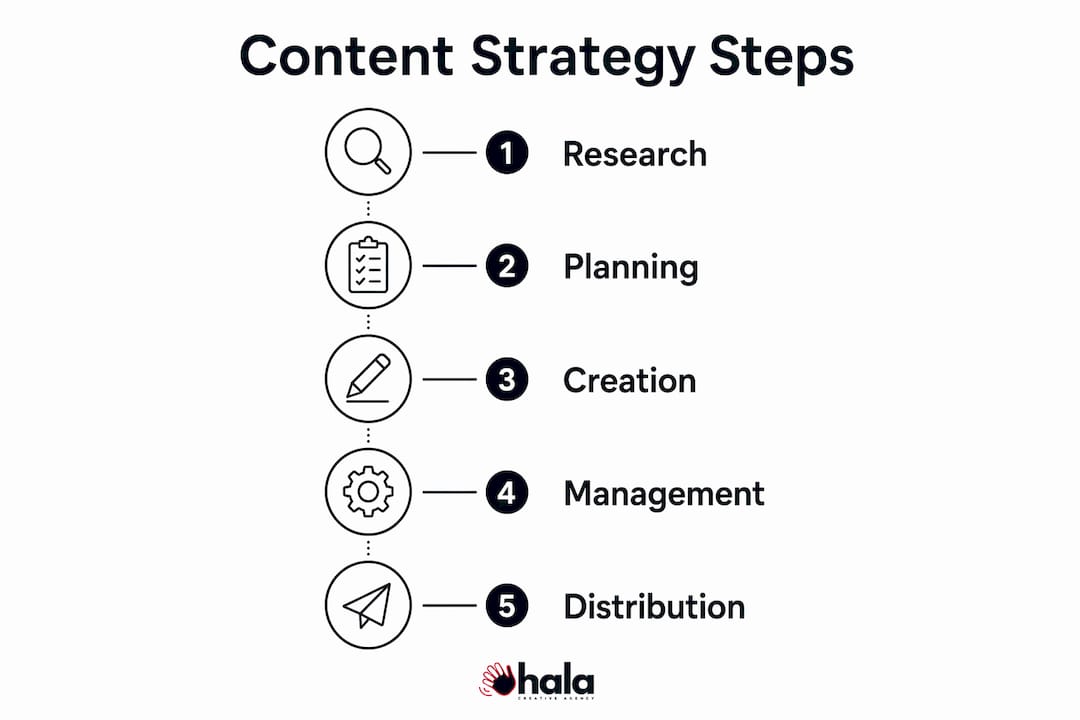
Content strategy and content design are distinct but complementary practices. Content strategy answers why and how at a planning level. Content marketing is the tactical execution of attracting and retaining an audience through content. Content design focuses on the structure, clarity, and accessibility of individual content pieces.
| Discipline | Focus | Key Deliverables |
|---|---|---|
| Content strategy | Why and how content serves business goals | Strategy documents, governance frameworks, content audits |
| Content marketing | Attracting and engaging audiences through content | Blog posts, videos, email campaigns, social content |
| Content design | Structure, clarity, and accessibility of content | Content models, style guides, UX writing, microcopy |
A business needs all three working together. Content strategy sets the direction. Content marketing executes the plan in the market. Content design makes each piece clear and usable. Skipping the strategy layer means your marketing team produces content without a shared purpose, and your designers optimize pieces that should not exist in the first place.
Why is content strategy critical for business success?
A documented content strategy prevents the single most common content failure: publishing without a plan and measuring nothing. Brands that treat content as a series of disconnected posts burn budget and build no lasting authority.
“More content does not equal better results. Strategy focuses on creating relevant, user-centered content that achieves measurable business goals.” — Interaction Design Foundation
The business case for a content strategy is concrete:
- Builds brand trust. Consistent, high-quality content signals expertise. For SMBs in Dubai and the UAE, where competition is intense across real estate, hospitality, and retail, trust is a direct conversion driver.
- Improves SEO performance. Content clusters build topical authority and prevent wasted resources on topics that never rank. A cluster around “commercial real estate Dubai” performs far better than isolated, unrelated blog posts.
- Guides the buyer journey. Content mapped to awareness, consideration, and decision stages moves prospects through the funnel without requiring a sales call at every touchpoint.
- Prevents wasted resources. Ad-hoc content creation is expensive. A strategy tells your team exactly what to produce and why, cutting revision cycles and rejected drafts.
- Supports growth. As your brand scales, a governance framework keeps quality and voice consistent across multiple writers, agencies, or markets.
Content strategy must be integrated from the start of any project, not added after a website is built or a campaign is already running. Retrofitting strategy onto existing content is always more expensive than building it in from the beginning.
How can business owners create an effective content strategy?
Building a content strategy does not require a large team or a big budget. It requires a clear process and the discipline to follow it. Here are the steps that consistently produce results for business owners and marketers.
- Set clear, measurable goals. Decide what success looks like before you write a single word. Goals like “increase website traffic from organic search by 30% in six months” give your content a target to hit.
- Map content to customer awareness levels. Content mapped to awareness levels guides prospects through the marketing funnel. A prospect who has never heard of your brand needs different content than one comparing your pricing to a competitor’s.
- Audit what you already have. Most businesses have more content than they realize, spread across websites, social profiles, and email archives. Catalog it, score it, and decide what to keep, update, or cut.
- Build topic clusters. Group related content around a central pillar page. A Dubai hospitality brand might build a cluster around “luxury staycations in Dubai,” with supporting articles on specific hotels, neighborhoods, and seasonal offers.
- Prioritize quality and SEO together. Use tools like Ahrefs or Google Search Console to identify keyword opportunities. Then write content that genuinely answers the question better than anything currently ranking.
- Assign governance roles. Decide who owns each stage of the content process. A structured digital marketing workflow prevents bottlenecks and keeps publishing on schedule.
- Track, analyze, and update. A living, evolving roadmap with continuous performance tracking is what separates effective strategies from documents that collect dust. Review performance monthly and update your content calendar based on what the data shows.
Pro Tip: Avoid orphan pages. Every piece of content should link to and from related pages within your site. Orphan pages hurt both user experience and search engine rankings, and they are one of the most common and easily fixed content strategy mistakes.
For marketers in the UAE, applying content marketing best practices specific to the Dubai market adds another layer of relevance to this process.
Key Takeaways
A content strategy is only as effective as the governance and measurement systems built into it from the start.
| Point | Details |
|---|---|
| Content strategy is a system | It is a repeatable, structured process, not a one-time document or a single campaign. |
| Governance prevents content rot | Assign roles for creation, review, and publishing to maintain quality as your team grows. |
| Strategy, marketing, and design are distinct | Each discipline serves a different function; all three must work together for results. |
| Map content to the buyer journey | Content aligned to awareness, consideration, and decision stages drives conversions more efficiently. |
| Measure and evolve continuously | Monthly performance reviews and data-driven updates keep your strategy relevant and effective. |
The mistake I see most often with content strategy
Most business owners I work with come to Hala Creative Agency after spending months publishing content that generates no results. The pattern is almost always the same: they started with tactics instead of strategy. They hired a writer, picked some topics, and started posting. Six months later, they have 40 blog posts and no measurable growth.
The real problem is almost never the content quality. It is the absence of a governance layer. Nobody decided who owns the editorial process. Nobody mapped the content to business goals. Nobody checked whether the topics connected to anything the audience was actually searching for. Ignoring governance leads to content rot and inconsistency, and it makes accountability impossible once a team grows beyond one person.
The second mistake is treating strategy as a one-time setup. Business owners often mistake content strategy as a one-time setup, whereas it requires ongoing analysis and evolution to remain effective. Markets shift. Algorithms change. Audience behavior evolves. A strategy document written in january and never revisited is not a strategy. It is a wish list.
My honest advice: before you produce one more piece of content, spend a week building the framework. Define your goals, map your audience, audit what you have, and assign clear ownership. That week of planning will save you six months of wasted effort.
— Hisham
How Hala Creative Agency can build your content strategy
A well-built content strategy is the foundation that makes every other marketing investment work harder.
Hala Creative Agency works with SMBs across Dubai and the wider Middle East to build content strategies grounded in data, audience research, and clear business goals. From SEO and social media management to full content planning and brand governance, the team combines AI-assisted research with human editorial judgment to produce strategies that scale. If you are ready to stop publishing without direction, a branding agency drives growth by aligning every content decision with your brand’s long-term objectives. Explore digital marketing examples from the Middle East market to see what a structured approach delivers in practice.
FAQ
What is the content strategy definition in simple terms?
Content strategy is a structured plan for creating, managing, and distributing content that serves specific business goals and audience needs. It governs the full content lifecycle, from planning to performance measurement.
How does content strategy differ from content marketing?
Content strategy is the overarching plan that defines why and how content is created. Content marketing is the tactical execution of that plan, focused on attracting and engaging audiences through specific content pieces.
What does a content strategy include?
A content strategy includes SMART goal setting, audience research, content audits, a content calendar, creation and SEO guidelines, distribution plans, governance roles, and performance measurement frameworks.
Why do businesses need a content strategy?
Without a content strategy, businesses publish content without clear goals, wasting resources and building no lasting authority. A strategy aligns every content decision with measurable business outcomes and audience needs.
How often should a content strategy be updated?
A content strategy should be reviewed and updated at least monthly based on performance data. Markets, algorithms, and audience behavior change, so treating strategy as a living document is what keeps it effective.