
TL;DR:
- Omnichannel marketing unifies all customer touchpoints into a seamless, personalized experience across platforms. It relies on integrated data systems and shared customer profiles to improve engagement and retention. Most failures stem from organizational issues rather than technology, making leadership ownership and team alignment critical.
Omnichannel marketing is defined as the practice of unifying every customer touchpoint, from social media and email to physical stores and mobile apps, into a single, continuous experience. Unlike approaches that treat each channel separately, an omnichannel strategy ensures that a customer who browses your Instagram, visits your website, and walks into your store encounters one consistent brand narrative. For marketing professionals and business owners in Dubai and across the UAE, understanding what is omni channel marketing is no longer optional. It is the foundation of any customer experience worth building.
What is omni channel marketing and how does it work?
Omnichannel marketing integrates all customer touchpoints to provide a continuous, personalized experience regardless of platform. The word “omni” means “all,” and that is exactly the point: every channel feeds into a shared understanding of who the customer is and where they are in their buying journey.

The mechanism is straightforward. A customer data platform (CDP) or CRM collects behavioral signals from every channel. Those signals update a central customer profile in real time. When the customer switches from a mobile app to a physical store, the brand already knows their preferences, cart history, and last interaction. No repetition. No friction.
Salesforce defines the ultimate test for omnichannel marketing as whether a customer can begin an interaction on one device and complete it in-store without repeating any information. That test is simple and brutal. Most businesses fail it because their channels do not share data.
The result of passing that test is real. Omnichannel marketing improves brand affinity and customer engagement by placing customers at the center and tailoring messaging to their journey across all touchpoints. Customers who feel recognized spend more and return more often.
How does omnichannel differ from multichannel marketing?
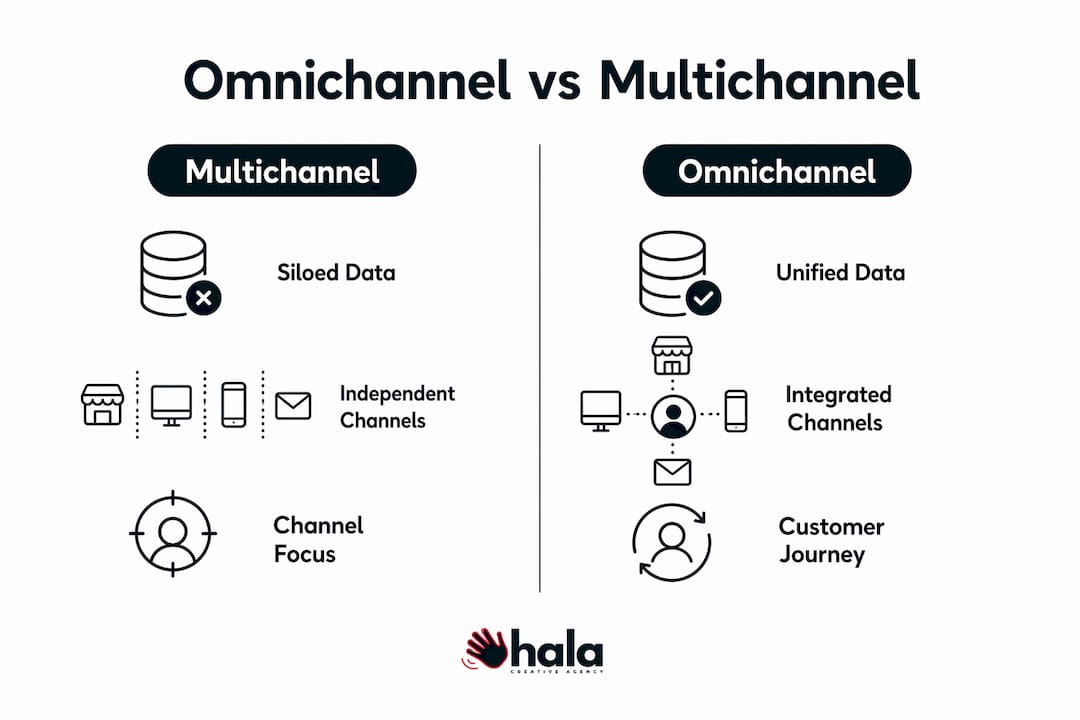
This is the most common point of confusion, and it matters. Multichannel marketing means your brand is present on multiple platforms: email, Instagram, a website, maybe a physical store. Omnichannel marketing means all those platforms share data and work together. The distinction is not cosmetic. It changes how customers experience your brand.
Multichannel marketing focuses on channel proliferation operating independently, while omnichannel marketing focuses on integration to eliminate data silos between marketing and sales touchpoints. A multichannel approach might send a promotional email the same day a customer just purchased in-store, because the email system does not know about the store transaction. An omnichannel system suppresses that email automatically.
| Dimension | Multichannel marketing | Omnichannel marketing |
|---|---|---|
| Data architecture | Siloed per channel | Centralized, shared in real time |
| Message personalization | Channel-specific, often generic | Context-aware, based on full customer history |
| Customer focus | Channel performance | Customer journey continuity |
| Team alignment | Channel-specific KPIs | Shared customer lifetime value (CLV) goals |
| Experience continuity | Restarts at each channel | Picks up where the customer left off |
The practical impact is significant. A customer who adds items to a cart on their phone, then visits your store, should see a sales associate who can pull up that cart. Multichannel cannot do that. Omnichannel can, because the data flows freely between systems.
Key differences that matter most to business owners:
- Data integration: Omnichannel requires a single source of truth for customer data.
- Personalization depth: Omnichannel adapts messaging to channel context and customer history, not just demographics.
- Efficiency: Adding more channels without integration decreases efficiency and confuses customers. More channels without a data backbone is not progress.
What are the core components of an effective omnichannel strategy?
An omnichannel strategy is only as strong as its data infrastructure. Without the right components in place, personalization fails and the customer experience breaks down at channel handoffs.
Centralized data architecture
The foundation is a unified customer data platform that connects your CRM, point-of-sale (POS) system, email platform, social media tools, and website analytics. Implementing omnichannel marketing requires integrating CRM, POS, and digital marketing to maintain consistent brand voice and real-time inventory. Each system must write to and read from the same customer record.
Real-time data integration
Batch data updates are not enough. If a customer makes a purchase at 2:00 PM and your system updates overnight, you will send irrelevant messages for hours. Real-time integration means every action triggers an immediate update to the customer profile, enabling instant personalization.
Context-aware personalization
True omnichannel adapts brand messaging to the channel context and customer history rather than broadcasting identical content everywhere. A push notification should be shorter and more urgent than an email. A retargeting ad should reference what the customer actually viewed, not a generic product category. This requires both data and creative discipline.
Cross-device continuity
Customers switch devices constantly. A session that starts on a desktop at work continues on a phone during a commute. Persistent login, device fingerprinting, and loyalty ID matching are the technical tools that make cross-device continuity possible.
Measurement focused on CLV
Success is measured by CLV and retention rather than individual channel conversions. A channel that drives low first-purchase revenue but high repeat purchase rates is more valuable than a channel that drives one-time buyers. Measuring at the customer level, not the channel level, reveals that truth.
Pro Tip: Before investing in new channels, audit your existing data connections. A broken CRM-to-email integration will undermine every personalization effort you make downstream.
How to implement omnichannel marketing in your business
Implementation fails most often because businesses try to do everything at once. The correct approach is phased, starting with the highest-impact connections and expanding from there.
-
Identify your two highest-traffic channels. Start by integrating the two channels with the highest customer activity and track customer-journey KPIs. For most Dubai businesses, this means your website and either WhatsApp or Instagram, depending on your audience.
-
Establish consistent customer identifiers. Without consistent customer identifiers like email addresses or loyalty IDs across all databases, automated personalization fails. Every system must use the same identifier to recognize the same person. This is data hygiene, and it is non-negotiable.
-
Align your team on journey KPIs. Internal teams often optimize for their own channel metrics: email open rates, social engagement, store foot traffic. Omnichannel requires a shared KPI, typically CLV or customer retention rate, that every team contributes to. This is a cultural shift, not just a technical one.
-
Use a maturity model to expand. Adobe recommends approaching omnichannel as a maturity model, prioritizing integration of the most critical customer data points first and expanding gradually. Start with two channels, prove the integration works, then add a third. Rushing to six channels before the first two are connected creates chaos.
-
Audit for channel presence versus real integration. The most common pitfall is confusing being present on multiple channels with actually integrating them. Having a Facebook page, a website, and a store is not omnichannel. Those three must share customer data to qualify. You can use a digital marketing checklist to verify your integration points before scaling.
-
Build feedback loops. Every campaign should generate data that refines the next one. Set up automated reports that track customer behavior across channels, not just within them.
Pro Tip: Map your customer journey on paper before touching any technology. Draw every touchpoint a customer encounters from first awareness to repeat purchase. The gaps you find on paper are the integrations you need to build first.
How do you measure omnichannel marketing success?
Measurement is where most omnichannel programs stall. Teams default to channel-specific metrics because those are easy to pull. The metrics that actually reflect omnichannel performance are harder to calculate but far more meaningful.
Key metrics for omnichannel success include CLV, customer retention, and engagement rather than isolated channel KPIs. This drives a complete view of performance across the entire customer relationship.
The metrics that matter most:
- Customer lifetime value (CLV): The total revenue a customer generates over their relationship with your brand. This is the north star metric for omnichannel programs.
- Customer retention rate: The percentage of customers who return within a defined period. Omnichannel programs should increase this number by making each experience more relevant.
- Cross-channel conversion rate: The percentage of customers who interact with more than one channel before converting. A rising number here proves your channels are working together.
- Time to resolution: How quickly a customer issue gets resolved when they switch channels. A customer who starts a complaint on Instagram and finishes it by phone should not have to repeat themselves.
- Cart abandonment recovery rate: How effectively your system identifies and re-engages customers who abandoned a cart on one channel through another channel.
| Metric | What it measures | Why it matters for omnichannel |
|---|---|---|
| Customer lifetime value | Total revenue per customer | Reflects the compounding effect of better experiences |
| Retention rate | Repeat purchase behavior | Shows whether integration is building loyalty |
| Cross-channel conversion | Multi-touchpoint purchase paths | Proves channels are collaborating, not competing |
| Cart recovery rate | Re-engagement across channels | Tests real-time data sharing between systems |
Integrated data informs and refines campaigns by connecting CRM and marketing tools to align sales and marketing for measurable growth. Without that connection, you are measuring channels in isolation and missing the full picture. For UAE businesses building data-driven marketing programs, these metrics should replace channel-specific dashboards as the primary reporting layer.
Key Takeaways
Omnichannel marketing succeeds when centralized data, consistent customer identifiers, and shared KPIs replace siloed channel operations.
| Point | Details |
|---|---|
| Definition is precise | Omnichannel marketing unifies all touchpoints into one continuous, personalized customer experience. |
| Data is the foundation | Without a centralized CDP and consistent identifiers, personalization breaks down at every channel handoff. |
| Start small, then scale | Integrate your two highest-traffic channels first before expanding to avoid confusion and inefficiency. |
| Measure CLV, not clicks | Customer lifetime value and retention rate reveal omnichannel performance better than any channel-specific metric. |
| Culture must shift | Teams must align on customer-journey KPIs rather than defending individual channel performance numbers. |
Why most omnichannel programs fail before they start
I have worked with enough marketing teams to know that the technology is rarely the problem. The problem is almost always organizational. Teams are structured around channels: the email team, the social team, the in-store team. Each team measures its own success. Each team defends its own budget. Omnichannel asks all of them to share credit for a customer’s purchase, and that is uncomfortable.
The businesses that get omnichannel right do one thing differently. They appoint someone, whether a CMO, a head of growth, or a dedicated customer experience lead, to own the customer journey across all channels. That person has the authority to override channel-specific decisions when they conflict with the overall customer experience. Without that authority, integration stalls at the first internal disagreement.
The other mistake I see constantly is treating omnichannel as a technology project. Brands invest in a CDP, connect a few APIs, and declare victory. But if the creative team is still producing channel-specific campaigns without referencing customer history, the technology is wasted. The digital marketing workflow has to change, not just the tech stack.
My honest recommendation: start with the customer journey, not the tools. Draw the path your best customer takes from first contact to fifth purchase. Find every moment where your brand drops the ball because channels do not talk to each other. Fix those moments first. The technology choices will become obvious once you know exactly what you need the data to do.
— Hisham
How Hala Creative Agency builds connected marketing programs
Hala Creative Agency works with businesses across Dubai and the UAE to build integrated marketing strategies that connect data, channels, and creative execution into one coherent customer experience. The agency’s hybrid AI-human approach means campaigns are informed by real customer data while preserving the brand voice that makes each business distinct.

Whether you are starting from scratch or trying to connect existing channels that are not talking to each other, Hala Creative Agency’s team maps the customer journey first, then builds the integrations that make personalization possible at scale. For businesses ready to move beyond scattered channel activity and into a genuinely connected marketing program, the step-by-step digital marketing guide is a practical starting point. Reach out to discuss what an integrated approach looks like for your specific business and market.
FAQ
What is omnichannel marketing in simple terms?
Omnichannel marketing means every channel your business uses, from social media to your physical store, shares customer data and delivers one consistent experience. A customer who starts on your app and finishes in-store should never have to repeat themselves.
How is omnichannel different from multichannel?
Multichannel means being present on many platforms. Omnichannel means those platforms share data and work together. The difference is integration: multichannel keeps channels siloed, while omnichannel connects them around a single customer profile.
What are the biggest benefits of omnichannel marketing?
The primary benefits are higher customer retention, improved brand affinity, and greater marketing efficiency. Customers who receive consistent, personalized experiences across channels are more likely to return and spend more over time.
Where should a business start with omnichannel marketing?
Start by integrating your two highest-traffic channels and establishing consistent customer identifiers like email or loyalty IDs across all systems. Data hygiene is the first step; personalization follows once the data foundation is solid.
What metrics should I track for omnichannel success?
Track customer lifetime value (CLV), retention rate, and cross-channel conversion rate rather than isolated channel metrics. These figures reflect whether your channels are working together to build lasting customer relationships.