
TL;DR:
- Brand positioning is a strategic process that establishes a unique perception of your brand in customers’ minds relative to competitors. It involves defining your target audience, market category, primary benefit, and proof, forming a clear positioning statement that guides marketing efforts. Maintaining consistent internal alignment and actively monitoring customer perceptions are essential for long-term brand equity and market success.
Brand positioning is defined as the deliberate strategy of establishing a unique, valuable space for your brand in the minds of your target customers relative to competitors. It is not about your product’s features or your logo’s color palette. It is about the specific perception you own in someone’s head when they think about your category. For business owners and marketing professionals in competitive markets like Dubai and the broader UAE, understanding this distinction is the difference between marketing that compounds over time and marketing that burns budget without building equity.
What is brand positioning and why does it matter?
Brand positioning is the strategic process of defining where your brand sits in the minds of your customers compared to every alternative they could choose. According to the classic formulation by Al Ries and Jack Trout, positioning is a perceptual exercise that happens in the mind of the prospect, not on the product itself. That framing is worth sitting with. You are not repositioning your product when you change your positioning strategy. You are changing how customers mentally categorize and value your brand.
The importance of brand positioning becomes clear when you consider what happens without it. Every brand has positioning whether it is managed deliberately or not. Unmanaged positioning produces fragmented impressions across touchpoints, leaving customers unable to articulate why they should choose you. Managed positioning means every campaign, every piece of content, and every customer interaction builds toward a specific, intended perception.
Brand positioning is also more than why a brand exists. As Shopify’s brand positioning guide notes, effective positioning focuses on the unique factors that compel customers to choose a brand over competitors. Purpose and values matter, but they are not positioning. Positioning answers a sharper question: why you, specifically, over the next best option?
What are the key components of effective brand positioning?
A strong positioning strategy is built on four core elements, each of which forces a specific kind of clarity.
- Target customer: Who, precisely, is this brand for? Not a demographic bucket, but a specific person with specific needs, priorities, and alternatives they are already considering.
- Market category: What game are you playing? Defining your category sets the competitive frame and tells customers how to evaluate you.
- Primary benefit: What single, meaningful advantage do you deliver better than anyone else in that category?
- Reason to believe: What proof supports your primary benefit? This is the credibility layer that makes the claim land.
These four elements combine into what is called a positioning statement, an internal strategic document that clarifies your brand’s unique promise for marketing, sales, and product teams. The positioning statement is not a tagline or a headline. It is a compass. Companies that evaluate decisions against their positioning statement show measurably higher brand consistency and recall over time.
A positioning statement also has a specific structure. The Marketing Juice defines it as: target audience, competitive frame, primary point of difference, and credible reason to believe. A generic example: “For growing e-commerce businesses in the Gulf region that need faster fulfillment, [Brand X] is the logistics partner that guarantees same-day delivery because of its proprietary regional warehouse network.” That sentence contains all four elements and leaves no ambiguity about who the brand serves or why it wins.
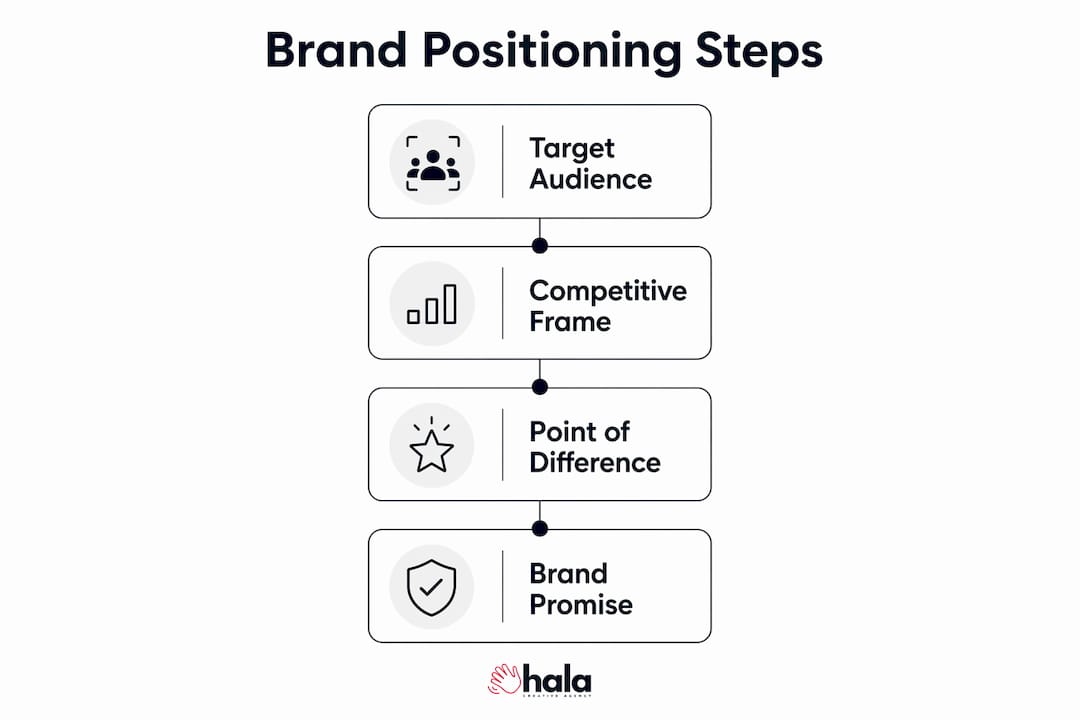
Brevity matters here. A positioning statement that requires three paragraphs to explain has not been thought through. If you cannot state your position in two sentences, the position itself is not clear enough to execute against.
Pro Tip: Write your positioning statement, then test it by asking your sales team to explain your brand’s advantage without looking at it. If their answers diverge significantly, your positioning has not been internalized and needs simplification.
How does brand positioning differ from brand identity and brand messaging?
This is one of the most common points of confusion in marketing, and it costs businesses real money when the concepts get conflated.
- Brand positioning is the strategic intent. It defines the specific perception you want to own in your customer’s mind relative to competitors. It is stable, internal, and directional.
- Brand identity is the visible and verbal expression of that intent. It includes your logo, color palette, typography, tone of voice, and visual language. As The Marketing Juice explains, identity encompasses what customers see and hear. Positioning informs what identity should express. For a deeper look at how these elements work together for regional businesses, the brand identity guide for Dubai SMBs is a practical starting point.
- Brand messaging is the tactical layer. It is the specific language used in campaigns, ads, website copy, and social content to communicate the positioning to different audiences in different contexts.
The risk of confusing these three is significant. A brand can have a strong visual identity and still fail commercially if the underlying positioning is weak or undefined. Harvard Business School Online identifies minimizing the perception gap as a core challenge in branding. The perception gap is the distance between what a brand intends to communicate and what customers actually believe about it. A polished logo does not close that gap. A clear, consistently executed positioning strategy does.
Think of it this way: positioning is the strategy, identity is the costume, and messaging is the script. You can have a great costume and a well-written script, but if the strategy is wrong, the performance fails.
What frameworks help businesses develop strong brand positioning?
Several frameworks give marketers a structured way to develop positioning rather than guessing at it.

Al Ries and Jack Trout’s mental categorization model
The original positioning framework argues that the mind resists change and organizes information into categories. To win, a brand must either own the top slot in an existing category or create a new category where it can be first. This is why being “the first” in a category carries such disproportionate commercial value. The framework also operates at two levels: category positioning and competitive positioning require different approaches depending on whether you are creating a new market or competing within an established one.
April Dunford’s five-component framework
April Dunford’s approach, detailed in her book Obviously Awesome, starts with competitive alternatives rather than internal assumptions. Her framework asks: what would customers use if your product did not exist? From that baseline, you identify your unique attributes, the value those attributes deliver, the specific customers who care most about that value, and the market category that makes your value obvious. This customer-focused approach produces positioning that is grounded in real market dynamics rather than internal wishful thinking.
Porter’s Generic Strategies
Michael Porter’s framework identifies three strategic positions: cost leadership, differentiation, and focus. Companies must pursue one strategy to position themselves effectively. Trying to be both the cheapest and the most premium creates strategic confusion that customers sense immediately.
| Framework | Best used when | Core question it answers |
|---|---|---|
| Ries and Trout | Entering or reshaping a category | What mental slot can we own? |
| April Dunford | Product or service with clear alternatives | What makes us the obvious choice? |
| Porter’s Generic Strategies | Setting competitive direction | Are we competing on price, differentiation, or focus? |
Pro Tip: For most SMEs in the UAE, Dunford’s framework produces the fastest clarity because it starts with what customers already do, not with internal assumptions about what makes the brand special.
How to implement and maintain effective brand positioning over time
Developing a positioning strategy is the first step. Making it stick across an organization and over time is where most brands fall short.
- Align internally before communicating externally. Your positioning statement must be understood and accepted by your leadership, marketing, sales, and customer service teams before it reaches customers. Inconsistency at the internal level produces inconsistency at every customer touchpoint.
- Use positioning as a decision filter. Every campaign brief, product decision, and partnership opportunity should be evaluated against the positioning statement. If a campaign idea does not reinforce the intended position, it dilutes it. Successful brand positioning influences all brand communications, from copywriting to visual design to campaign structure.
- Monitor the perception gap actively. Customer surveys, social listening, and perceptual mapping are practical tools for measuring whether your intended position matches what customers actually believe. HBS Online identifies rooting brand identity in company purpose as the mechanism that aligns communication with customer experience over time.
- Adjust deliberately, not reactively. Markets shift, competitors move, and customer needs evolve. Repositioning is sometimes necessary, but it should be a strategic decision, not a reaction to a single quarter’s results. Consistent positioning over time compounds marketing effectiveness more than any single campaign.
- Narrow your audience deliberately. Counterintuitively, narrowing your brand audience increases strategic clarity and commercial success. Trying to position for everyone produces a position that resonates with no one.
For regional businesses, maintaining positioning across Arabic and English communications adds a layer of complexity. The branding tips for Middle East businesses resource addresses how to preserve positioning coherence across dual-language markets.
Key takeaways
Effective brand positioning requires a clear internal statement, consistent execution across all communications, and active monitoring of how customers actually perceive the brand.
| Point | Details |
|---|---|
| Positioning lives in the mind | Brand positioning is a perceptual strategy, not a product feature or visual identity choice. |
| Four-element statement | Every positioning strategy needs a target customer, market category, primary benefit, and reason to believe. |
| Positioning drives identity | Brand identity and messaging should express the positioning, not substitute for it. |
| Use a proven framework | Dunford, Ries and Trout, or Porter each offer structured paths to a defensible market position. |
| Consistency compounds | Maintaining the same position over time builds more marketing effectiveness than frequent repositioning. |
Why most brands in Dubai get positioning backwards
After working with businesses across the UAE and the wider Gulf region, the pattern I see most often is this: brands invest heavily in identity before they have defined their positioning. They commission a logo, build a website, run campaigns, and then wonder why nothing sticks. The identity looks polished. The campaigns are well-produced. But there is no strategic core holding it together.
The uncomfortable truth is that positioning work is harder than identity work because it requires making real choices. Choosing a specific target customer means explicitly not targeting others. Claiming a specific benefit means accepting that you cannot claim everything. Most business owners resist that narrowing because it feels like leaving money on the table. It is actually the opposite. Specificity is what makes a brand memorable and referrable.
I have also seen brands treat their positioning statement as a one-time exercise, something produced in a workshop and filed away. The brands that actually win treat it as a living document, one that gets reviewed when a new competitor enters the market, when a product line changes, or when customer research reveals a shift in perception. That discipline is rare, and it is exactly what separates brands that grow from brands that plateau.
If you are building or refining your positioning, start with the perception gap. Ask your best customers why they chose you over the alternative. Their language, not yours, is where your real positioning lives.
— Hisham
How Hala Creative Agency can help you define your brand position

Brand positioning is the foundation that every marketing investment builds on. Without it, even well-executed campaigns produce inconsistent results. Hala Creative Agency works with businesses across Dubai and the UAE to define, articulate, and execute positioning strategies that translate directly into stronger market presence and measurable growth. From initial positioning workshops to full marketing strategy development, the team combines strategic rigor with creative execution to help brands own a specific, defensible space in their market. If your current marketing feels scattered or your brand is not resonating the way it should, the starting point is almost always positioning. Reach out to explore how a clearer position can change what your marketing produces.
FAQ
What is brand positioning in simple terms?
Brand positioning is the specific perception a brand occupies in a customer’s mind relative to competitors. It defines why a customer should choose your brand over every available alternative.
How is brand positioning different from brand identity?
Brand identity covers the visual and verbal expressions of a brand, including logo, color, and tone. Brand positioning is the strategic intent that determines what those expressions should communicate.
What are the four elements of a positioning statement?
A positioning statement includes the target audience, competitive frame of reference, primary point of difference, and a credible reason to believe the claim. These four elements together define a brand’s unique promise.
How often should a brand revisit its positioning?
Positioning should be reviewed when a significant competitor enters the market, when customer research reveals a perception gap, or when the product or service offering changes materially. Reactive repositioning based on short-term results typically weakens brand equity.
Why does narrowing your audience improve brand positioning?
Deliberately narrowing the target audience forces specificity in the positioning statement, which produces clearer messaging and stronger resonance with the customers most likely to convert and refer others.