
TL;DR:
- Advertising is essential for business growth because it increases brand visibility and drives sales. Small businesses should allocate at least $500 to $800 monthly on Google Ads and $300 to $500 on Meta Ads to gather meaningful data. Consistent advertising during downturns helps SMBs maintain market share and gain a competitive advantage.
Advertising is the primary engine that connects your business to paying customers, and its role in business growth extends far beyond simple brand awareness. Research confirms that most businesses are leaving measurable profit on the table by underinvesting in advertising. The companies that treat ad spend as a growth asset rather than a line-item cost consistently outperform those that treat it as optional. For entrepreneurs and SMB owners in Dubai and across the UAE, understanding how advertising drives sales, builds brand equity, and compounds over time is the difference between steady growth and stagnation.
How does advertising directly impact business growth and profitability?
Advertising increases brand visibility, which translates directly into higher sales volume. When customers can recall your brand at the moment of purchase, they choose you over a competitor they cannot name. This concept, called mental availability, is the core mechanism through which advertising converts attention into revenue.

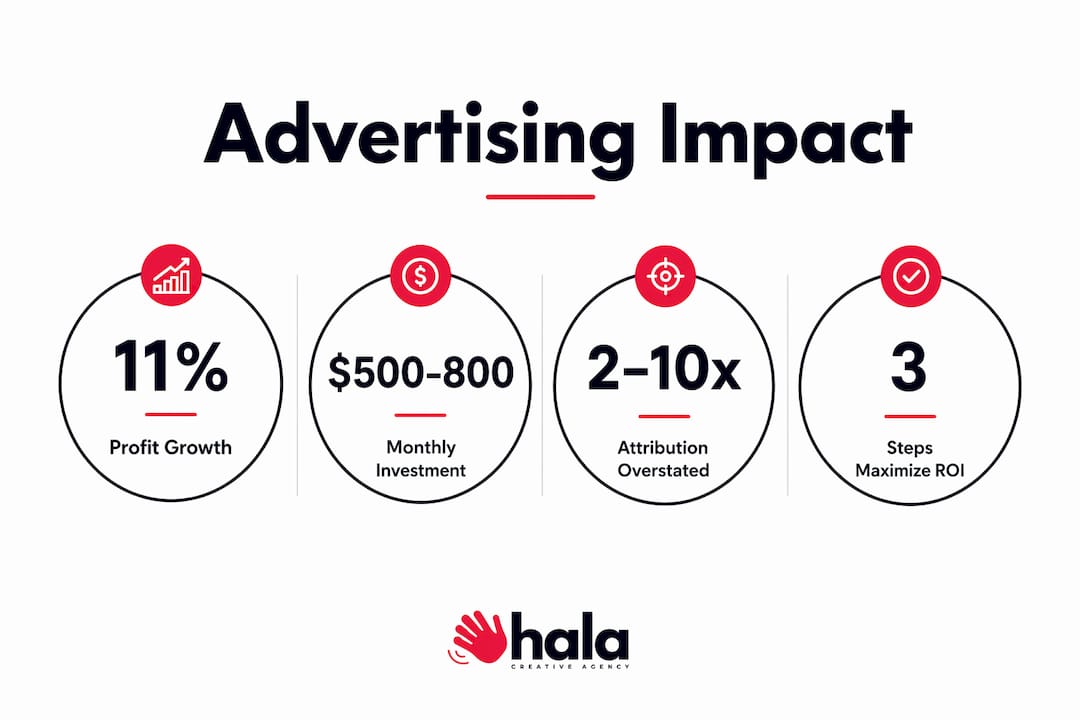
The numbers behind this are striking. Brands underinvest in advertising, leaving 11% of potential profit growth unrealized. The same research found that the average brand spends around £15 million on advertising, while the profit saturation point sits at £30 million. That gap represents a doubling of ad spend that would still generate profit, not waste it.
Economic uncertainty causes many SMB owners to cut advertising first. That instinct is understandable but costly. Brands that maintain or increase ad spend during downturns typically gain market share from competitors who go quiet. The businesses that pull back lose ground that takes years to recover.
Pro Tip: Front-load your advertising budget toward long-term impact channels like video and display, then use search and social ads for short-term sales activation. This channel timing approach improves your overall payback curve without requiring a larger total budget.
Successful companies treat advertising not as an optional cost but as a long-term growth asset that supports competitive advantage. That framing changes how you budget, measure, and defend ad spend internally.
What advertising strategies maximize effectiveness for SMBs?
Budget sizing is the first decision most SMB owners get wrong. Spending too little does not just produce weak results. It produces no usable data, which means you cannot improve.
The minimum viable monthly test budgets for meaningful data are:
- Google Search Ads: $500–$800 per month to gather enough clicks and conversions for the algorithm to learn.
- Meta Ads: $300–$500 per month to test audiences and creatives at a statistically meaningful scale.
- Conversion volume: At least 50 conversions per month before switching to automated bidding strategies.
- Testing window: Paid ads deliver hypothesis-testing data in 72 hours versus 6–12 months for SEO, making them the fastest feedback loop available to SMBs.
The second mistake is handing campaigns over to automated systems too early. Small businesses frequently fail with automated black-box campaigns because they lack the conversion volume those algorithms need to function. Start with manual or enhanced CPC bidding on search campaigns. This gives you keyword-level control to identify wasted spend before you hand the wheel to automation.
Pro Tip: Run brand awareness campaigns and performance campaigns simultaneously, not sequentially. Awareness builds the mental availability that makes your performance ads more efficient. Separating the two budgets prevents awareness from being cut whenever performance targets tighten.
Balancing brand-building with direct-response advertising is one of the most underrated advertising strategies for business owners in competitive markets like Dubai. The businesses that only run conversion campaigns eventually see their cost per acquisition rise as brand recognition fades.
How do advertising and R&D investment work together for sustained growth?
Advertising does not work in isolation. Research shows that advertising and R&D expenditures positively mediate the relationship between free cash flow and sales, particularly in high-tech industries. When a business increases cash flow, the most productive use of that capital is a combination of product development and market communication.
The logic is straightforward. R&D creates a better product. Advertising tells the market that the better product exists. Without advertising, product improvements go unnoticed. Without R&D, advertising eventually promotes something customers stop valuing.
| Investment type | Primary function | Growth impact |
|---|---|---|
| Advertising | Communicates value to the market | Drives immediate and long-term sales volume |
| R&D | Improves product quality and differentiation | Sustains competitive advantage over time |
| Combined approach | Reinforces both market presence and product quality | Produces compounding sales growth, especially in high-tech sectors |
For UAE SMBs, this means that advertising in branding should be viewed alongside product or service investment, not as a separate budget category. The two reinforce each other. A business that improves its service quality and simultaneously increases ad spend will outperform one that does either alone.
Advertising also signals quality to the market. When a business advertises consistently, customers interpret that consistency as a signal of stability and confidence. That perception influences purchase decisions even before a customer reads a single word of ad copy.
What happens when businesses stop advertising?
Cutting advertising is not a neutral decision. It is a decision to lose ground.
“Mental availability is critical for brand growth. Large brands may sustain growth briefly after pausing ads, but smaller brands do not. The Ehrenberg-Bass Institute for Marketing Science found that small brands face rapid sales decline the moment advertising stops, because they lack the residual brand equity that larger brands have built over decades.”
The mechanism here is mental availability. Customers do not actively remember brands they have not seen recently. When your advertising goes quiet, your brand fades from the consideration set. A competitor who stays visible fills that gap.
Share of voice is the advertising industry’s term for the proportion of total category advertising that your brand owns. When your share of voice drops below your market share, your market share follows it downward. This relationship is well-documented and applies directly to SMBs competing in crowded local markets like Dubai’s retail, hospitality, and real estate sectors.
Consistent advertising is not about running the same ad forever. It is about maintaining presence so that when a customer is ready to buy, your brand is the one they think of first. That is the practical definition of brand mental availability, and it requires uninterrupted investment to sustain.
Key Takeaways
Advertising is a compounding growth asset, and businesses that treat it as such consistently outperform those that treat it as a discretionary expense.
| Point | Details |
|---|---|
| Underinvestment costs profit | Brands leave 11% of potential profit unrealized by not scaling ad spend to the saturation point. |
| Budget minimums matter | Google Search requires $500–$800/month and Meta requires $300–$500/month to generate usable data. |
| Automation needs volume | Switch to automated bidding only after reaching 50+ conversions per month to avoid wasted spend. |
| R&D and ads compound | Combining product investment with advertising produces stronger sales growth than either approach alone. |
| Stopping ads harms small brands | Small brands face rapid sales decline when advertising stops, unlike large brands with residual equity. |
Why I think most SMBs are measuring advertising wrong
After working with SMB owners across the UAE, the most common mistake I see is not the budget size. It is the measurement model. Most businesses rely on last-touch attribution, which credits the final ad a customer clicked before purchasing. That model overstates digital ad impact by 2–10 times. You end up pouring money into channels that look productive on a dashboard but are not actually causing purchases.
The fix is not complicated, but it requires discipline. Dropbox ran geo-level blackout experiments to measure true incremental impact, and the results changed their entire budget allocation. Reallocation away from low-incrementality ads improved their lifetime value to acquisition cost ratio by 53%. That is not a marginal improvement. That is a structural shift in how efficiently their ad budget worked.
For SMBs, you do not need Dropbox’s engineering team to apply this thinking. Start by turning off one channel for 30 days and watching what actually changes in revenue. The results will surprise you. Most business owners discover that one or two channels are doing almost all the real work, while others are just collecting attribution credit.
The other thing I push back on is the instinct to pause advertising when business slows. That is exactly when your competitors are most likely to go quiet, and exactly when consistent presence pays the highest return. The businesses I have seen grow through difficult periods in Dubai’s market are almost always the ones that held their ad spend steady while others retreated. Advertising during a slowdown is not reckless. It is one of the few times you can gain share of voice at a lower cost.
— Hisham
How Hala Creative Agency helps SMBs grow through advertising
Advertising works when the strategy, budget, and measurement are aligned. Most SMBs struggle with at least one of those three.
Hala Creative Agency works with SMB owners across Dubai and the UAE to build advertising campaigns with measurable ROI, from initial budget planning through campaign execution and performance analysis. The agency’s approach combines data-driven targeting with brand-building creative, so your ads build recognition while also driving direct conversions. Whether you are starting your first paid campaign or looking to improve an existing one, the marketing services at Hala Creative Agency are built around the specific growth challenges that SMBs face in competitive regional markets. Reach out to discuss a strategy built around your budget and your goals.
FAQ
What is the role of advertising in business growth?
Advertising drives business growth by increasing brand visibility, attracting new customers, and building the mental availability that influences purchase decisions. Businesses that advertise consistently outperform those that treat ad spend as optional.
How much should a small business spend on advertising?
Small businesses need at least $500–$800 per month on Google Search Ads and $300–$500 per month on Meta Ads to gather enough data for meaningful optimization. Budgets below these levels prevent algorithms from learning effectively.
What happens if a small business stops advertising?
Small brands face rapid sales decline when advertising stops, because they lack the residual brand equity that larger brands have built over time. Mental availability fades quickly without consistent ad presence.
How do you measure advertising effectiveness accurately?
Last-touch attribution overstates digital ad impact by 2–10 times. Geo-level blackout experiments or channel pause tests provide more accurate measures of which ads are actually causing incremental revenue.
How does advertising work alongside other business investments?
Advertising and R&D expenditures work together to drive sales growth, particularly in high-tech industries. R&D improves the product; advertising communicates that improvement to the market. Combined investment produces stronger results than either alone.